




Web Application Development
Admin panels, customer portals, booking systems. That kind of thing is the core of our custom web application development work. Opens in any browser, office or home, laptop or phone.

We help businesses across multiple industries build scalable, secure and future-ready digital products. Our team combines deep technical expertise with industry knowledge to deliver custom software solutions that drive growth.
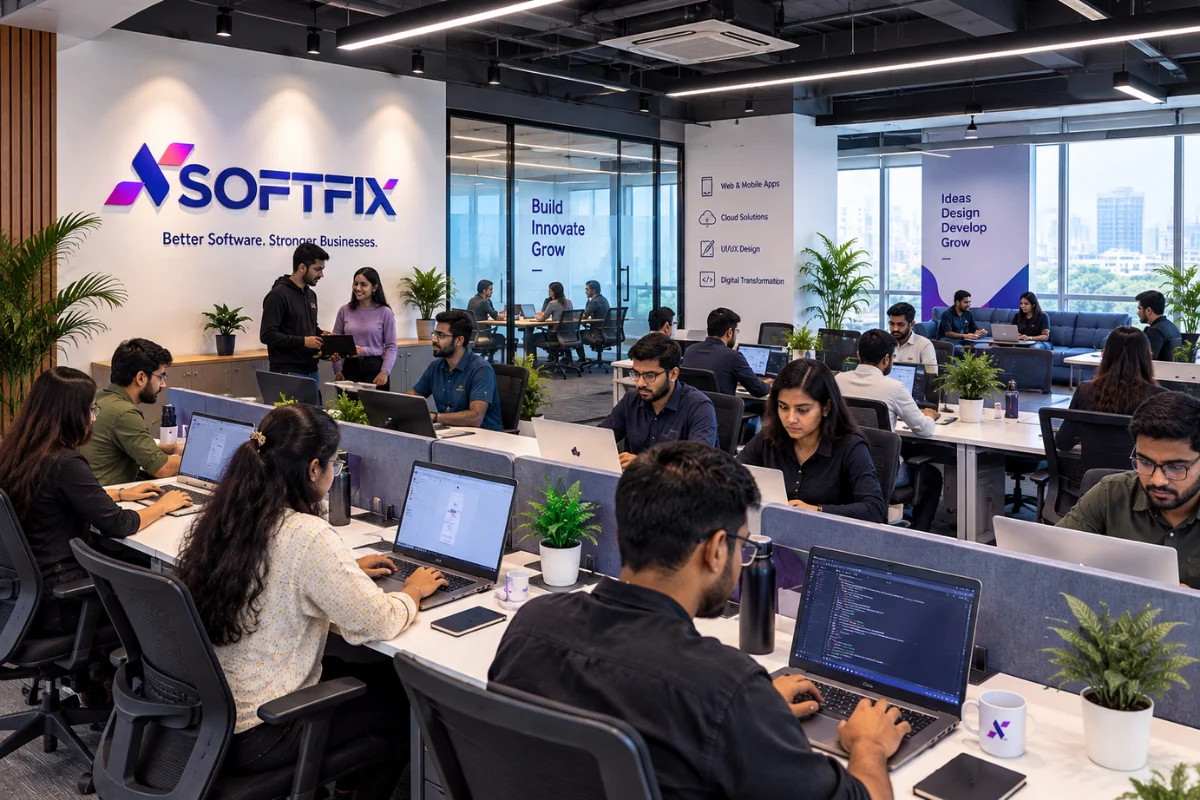
Let's TalkWe're Softfix. We write software for businesses from our office in Lucknow, and we've done 300+ projects so far for startups, small shops, and some fairly big companies too. Usually it goes like this. You tell us what's eating up your team's time; we figure out what to build; we build it, and we stick around after it goes live. And the code is yours. Fully.
We reply within 4 hours on working days. Want an NDA first? No problem.
So what is bespoke software development? Simple. It's software written for one company only, also known as tailor-made software development. The apps you download are made for lakhs of companies together. They'll do maybe 70% of what you want, and the rest you manage on paper.
Custom software solutions are different. Your accounts team sees the exact reports they ask for, sales sees their own leads, and nobody has to change their routine to suit the software. And since you own it, there's no vendor who can hike the price next year or quietly remove a feature you depend on.
Honestly, most projects end up needing two or three of these. Don't stress about picking the right one, we'll sort that out on the first call.
Admin panels, customer portals, booking systems. That kind of thing is the core of our custom web application development work. Opens in any browser, office or home, laptop or phone.
Not all work happens at a desk. Field staff, warehouse teams and delivery people need an app. Our custom application development team makes Android, iOS and desktop apps that sync back to your main system.
When bigger companies come to us for custom enterprise software development, it's mostly ERP, HR, finance or MIS reporting with hundreds of users logging in. We build these as enterprise-grade solutions, with proper role-based access and audit trails.
Got an old system that only one person in the company knows how to fix? That's a risk. We shift it to newer tech in phases, and your staff keep working the whole time.
Tally, Zoho, Razorpay, shipping partners, WhatsApp, SMS gateways... we've done third-party integrations with pretty much all of them. Type the data in once and it reaches everywhere.
Have ongoing work but no time to hire? Take a dedicated development team from us. They join your meetings, report to you, and we bill monthly.
A hospital doesn't work like a godown, so one template for both makes no sense. These are the industries we've worked in the most.

Patient records, OPD appointments, billing, lab reports. Our custom healthcare software development keeps the screens really simple since reception staff are always busy with patients. Data is encrypted and access is controlled.

POs, vendor follow-ups, demand planning. With custom supply chain software your purchase team sees stock levels and supplier delays the same day, instead of finding out at month-end.

Fleet tracking, route planning, proof of delivery, driver apps. With custom logistics software your dispatcher isn't calling 30 drivers every evening to ask where they've reached.

Got three branches and stock in all of them? Custom retail inventory management software linked with your POS shows which items sell fast and which haven't moved in months. Billing and loyalty points sit in the same system.

Made for schools, colleges and coaching centres. Our custom education software covers admissions, fee collection, attendance, online classes and results. Parents log in and check things themselves, so the school office gets a lot fewer calls.

Leads come from 99acres, MagicBricks, walk-ins, phone calls, everywhere. Custom real estate software collects them in one list for builders and brokers, then tracks the site visit, the booking and every payment after that.

Barcode scanning, batch and expiry tracking, reorder alerts, stock by location. Warehouses and factories use our custom inventory management software mainly so the count on screen matches what's actually on the rack.
Screens and reports follow your team's existing way of working. New staff usually pick it up in a couple of days.
We hand over full source code ownership. So it's proprietary software, your company's asset. A competitor can't just go and buy the same thing.
Whether 10 people use it or 500, you pay nothing extra. Do the maths over 3–5 years and it often beats a subscription.
We plan for software scalability on day one. Opening a new branch or adding a module later? No rebuild needed.
Accounting, payments, CRM, WhatsApp. We build third-party integrations around whatever you already use.
You choose the server where data is kept. You choose who in the team can see what.
For regular things like email or basic accounts, ready-made software is perfectly okay. Go custom when the way you work is what sets you apart from competitors. Or when you're already paying for four or five tools and your team still does half the work in Excel.
| Feature | Off-the-shelf Software | Custom Software |
|---|---|---|
| Upfront cost | Low monthly fee | One-time build cost |
| Cost over 5 years | Rises with every user and add-on | Mostly maintenance |
| Fit | You adjust to the tool | The tool follows your process |
| Ready to use | Same day | A few weeks to a few months |
| Ownership | You rent access | You own the code |
| Integrations | Only what the vendor supports | Whatever you need |
| Support | Shared helpdesk | A team that knows your system |
Many of our clients use both. They keep ready-made tools for routine work and get custom software built for the part that's specific to them.
These are the stages of the custom software development lifecycle we follow on every project. An MVP can move through all of them in a few weeks. A large system takes a few months.
We sit with the people who will actually use the software, and with the managers too. Then we make a list of must-haves, nice-to-haves and the systems it needs to talk to. You get a written scope document at the end.
Laravel, React, Node.js, .NET, Flutter... the choice depends on budget, how many users you expect and who will look after the code later. We'll explain why we picked what we picked.
Our architects design a scalable architecture and plan the database. Getting this right early saves expensive changes later.
Wireframes first, then clickable screens. You can try them on your phone and ask for changes before coding starts.
We use agile development with short sprints. A project manager keeps you updated, and you get a demo at the end of each sprint.
Our testers try every feature on budget Android phones, iPhones, Chrome, Safari, the lot. Automated tests run alongside, and we check for the usual security holes.
Servers get set up, old data gets moved over and your staff get trained. We pick a slow day to go live, never month-end or a festive season rush.
Any bug in the first 30 days, we fix free. After that you can take a monthly plan for updates, monitoring and small changes.

Most startups get one real shot before the money runs out. So we help you cut the first version down to what matters and launch it fast as an MVP. Then we watch what real users do and build the next features from that. A few of our startup clients have grown from MVP to a full platform with us.

A small business doesn't need some giant system. Tell us which job eats up the most hours (maybe billing, maybe stock, maybe chasing customers for payment) and we build for that first. The rest can be added later. You know the cost upfront and start seeing a difference in a few weeks.

Big companies need enterprise-grade solutions. Hundreds of users, strict access rules, audit trails. A lot of our enterprise work is legacy system modernization, plus linking systems that were never meant to work together. We're ISO 27001 certified, so data handling follows a proper audited process.
There's no fixed price, because two projects are rarely the same. The cost mainly depends on:
A simple internal tool might cost a fraction of a full SaaS platform. Indian development rates are also much lower than in the US, UK or Canada for the same experience level.
We offer three ways to work:
Suits projects with a clear scope.
Works when requirements will change.
Suits ongoing work and is billed monthly.
Any good company will arrange this.
Ask for names and experience of the team.
Regular demos are a good sign.
The answer should be yes, in writing.
Get support terms and costs before signing.
Look for an NDA and certifications like ISO 27001.
300+
Projects Delivered
200+ clients. About 98% of our clients come back to us for their next project.
ISO
9001 & 27001 Certified
Our quality and data security processes are audited every year.
100%
Source Code Yours
Full ownership of code, designs and documents is written into every contract.
One
Team Under One Roof
Developers, designers, testers and project managers all work from our Lucknow office.
Global
Time Zones Covered
Our Toronto office helps clients in Canada and the US, and our India team keeps some hours overlapping with yours.
Tell us what's slowing your team down. A senior engineer will reply within 4 hours with first thoughts on scope, timeline and cost. The call is free, and we'll sign an NDA before you share details.
to help our experts understand your business objectives and create your customized plan.