


The build-versus-buy decision is not a contest between modern and old-fashioned technology. It is a question of fit. Buy standard capabilities when they are genuinely standard; build where your workflow, data or customer experience creates meaningful value.
- Start with the business constraint, not a feature list.
- Map the current workflow and its exceptions.
- List integration and export requirements.
General scenario (not a Softfix case study)
Imagine a growing organisation whose teams rely on spreadsheets, email and separate systems for a workflow that is becoming difficult to control. The useful first move is not to assume that a particular product or vendor is right. Map the current steps, identify the costly exception and test a narrow improvement with the people who do the work.
This scenario is illustrative guidance, not a report of Softfix work or a promise about a particular result. Its lesson is to connect a proposed capability to evidence: a baseline, a user need, a risk control and an owner. The same discipline applies whether the decision is to buy, build, partner or introduce an AI-assisted feature.
Define the problem before choosing a product
A good build versus buy decision begins with context. Write down who is affected, what they do today, where the delay or error appears and what a better result would look like. This keeps the conversation grounded in an outcome rather than a fashionable feature or a vendor's preferred tool. Include the exceptions: they are often where cost, risk and user frustration hide.
Make the decision testable. Name the evidence you will review, the people who must agree and the point at which you will stop or change direction. Teams make better decisions when they can say, 'we learned this, so we changed the plan'. That is not indecision; it is disciplined product work. Keep a short decision log so new stakeholders can understand why the route was chosen.
Do not treat the first release as the final architecture. A sensible first phase proves the riskiest assumption with the smallest safe slice. Document what remains unknown, what is deliberately manual and what would justify the next investment. This approach protects cash and attention while still giving users something useful early.
Where packaged software works well
A good build versus buy decision begins with context. Write down who is affected, what they do today, where the delay or error appears and what a better result would look like. This keeps the conversation grounded in an outcome rather than a fashionable feature or a vendor's preferred tool. Include the exceptions: they are often where cost, risk and user frustration hide.
Make the decision testable. Name the evidence you will review, the people who must agree and the point at which you will stop or change direction. Teams make better decisions when they can say, 'we learned this, so we changed the plan'. That is not indecision; it is disciplined product work. Keep a short decision log so new stakeholders can understand why the route was chosen.
Do not treat the first release as the final architecture. A sensible first phase proves the riskiest assumption with the smallest safe slice. Document what remains unknown, what is deliberately manual and what would justify the next investment. This approach protects cash and attention while still giving users something useful early.
A practical comparison should also examine what happens when the chosen option no longer fits. Check whether data can be exported in a usable format, whether integrations can be replaced and whether configuration remains understandable to your team. Exit effort is part of the decision even when you expect a long relationship with the product or supplier.

When custom software earns its keep
A good build versus buy decision begins with context. Write down who is affected, what they do today, where the delay or error appears and what a better result would look like. This keeps the conversation grounded in an outcome rather than a fashionable feature or a vendor's preferred tool. Include the exceptions: they are often where cost, risk and user frustration hide.
Make the decision testable. Name the evidence you will review, the people who must agree and the point at which you will stop or change direction. Teams make better decisions when they can say, 'we learned this, so we changed the plan'. That is not indecision; it is disciplined product work. Keep a short decision log so new stakeholders can understand why the route was chosen.
Do not treat the first release as the final architecture. A sensible first phase proves the riskiest assumption with the smallest safe slice. Document what remains unknown, what is deliberately manual and what would justify the next investment. This approach protects cash and attention while still giving users something useful early.
Compare total cost of ownership
A good build versus buy decision begins with context. Write down who is affected, what they do today, where the delay or error appears and what a better result would look like. This keeps the conversation grounded in an outcome rather than a fashionable feature or a vendor's preferred tool. Include the exceptions: they are often where cost, risk and user frustration hide.
Make the decision testable. Name the evidence you will review, the people who must agree and the point at which you will stop or change direction. Teams make better decisions when they can say, 'we learned this, so we changed the plan'. That is not indecision; it is disciplined product work. Keep a short decision log so new stakeholders can understand why the route was chosen.
Do not treat the first release as the final architecture. A sensible first phase proves the riskiest assumption with the smallest safe slice. Document what remains unknown, what is deliberately manual and what would justify the next investment. This approach protects cash and attention while still giving users something useful early.
| Decision | Option A | Option B | Watch for |
|---|---|---|---|
| Capability | Packaged option | Custom option | Decision test |
| Accounting | Usually strong | Often unnecessary | Is the process standard? |
| Core operations | May need workarounds | Fits exact workflow | Does it create advantage? |
| Reporting | Fast if templates fit | Flexible data model | Can users trust the data? |
The hybrid approach is often practical
A good build versus buy decision begins with context. Write down who is affected, what they do today, where the delay or error appears and what a better result would look like. This keeps the conversation grounded in an outcome rather than a fashionable feature or a vendor's preferred tool. Include the exceptions: they are often where cost, risk and user frustration hide.
Make the decision testable. Name the evidence you will review, the people who must agree and the point at which you will stop or change direction. Teams make better decisions when they can say, 'we learned this, so we changed the plan'. That is not indecision; it is disciplined product work. Keep a short decision log so new stakeholders can understand why the route was chosen.
Do not treat the first release as the final architecture. A sensible first phase proves the riskiest assumption with the smallest safe slice. Document what remains unknown, what is deliberately manual and what would justify the next investment. This approach protects cash and attention while still giving users something useful early.
Separate a genuine competitive workflow from a preference for building. If the same process is common across many organisations, a mature package may reduce unnecessary ownership. If the process expresses a distinctive service, pricing rule or operating model, forcing it into generic fields can create workarounds that users must maintain every day.
Integration and data portability
A good build versus buy decision begins with context. Write down who is affected, what they do today, where the delay or error appears and what a better result would look like. This keeps the conversation grounded in an outcome rather than a fashionable feature or a vendor's preferred tool. Include the exceptions: they are often where cost, risk and user frustration hide.
Make the decision testable. Name the evidence you will review, the people who must agree and the point at which you will stop or change direction. Teams make better decisions when they can say, 'we learned this, so we changed the plan'. That is not indecision; it is disciplined product work. Keep a short decision log so new stakeholders can understand why the route was chosen.
Do not treat the first release as the final architecture. A sensible first phase proves the riskiest assumption with the smallest safe slice. Document what remains unknown, what is deliberately manual and what would justify the next investment. This approach protects cash and attention while still giving users something useful early.

Quick checklist
- ☐ Start with the business constraint, not a feature list.
- ☐ Map the current workflow and its exceptions.
- ☐ List integration and export requirements.
- ☐ Price licences, implementation, customisation and exit costs.
- ☐ Run a small proof before signing a long contract.
- ☐ Agree who owns data, configuration and extensions.
A decision process that reduces regret
A good build versus buy decision begins with context. Write down who is affected, what they do today, where the delay or error appears and what a better result would look like. This keeps the conversation grounded in an outcome rather than a fashionable feature or a vendor's preferred tool. Include the exceptions: they are often where cost, risk and user frustration hide.
Make the decision testable. Name the evidence you will review, the people who must agree and the point at which you will stop or change direction. Teams make better decisions when they can say, 'we learned this, so we changed the plan'. That is not indecision; it is disciplined product work. Keep a short decision log so new stakeholders can understand why the route was chosen.
Do not treat the first release as the final architecture. A sensible first phase proves the riskiest assumption with the smallest safe slice. Document what remains unknown, what is deliberately manual and what would justify the next investment. This approach protects cash and attention while still giving users something useful early.
| Check | Evidence | Owner |
|---|---|---|
| Outcome | Baseline and target are written | Product owner |
| Risk | Unknowns have a test or contingency | Delivery lead |
| Handover | Access and documentation are agreed | Operations |
Plan the next twelve months
A good build versus buy decision begins with context. Write down who is affected, what they do today, where the delay or error appears and what a better result would look like. This keeps the conversation grounded in an outcome rather than a fashionable feature or a vendor's preferred tool. Include the exceptions: they are often where cost, risk and user frustration hide.
Make the decision testable. Name the evidence you will review, the people who must agree and the point at which you will stop or change direction. Teams make better decisions when they can say, 'we learned this, so we changed the plan'. That is not indecision; it is disciplined product work. Keep a short decision log so new stakeholders can understand why the route was chosen.
Do not treat the first release as the final architecture. A sensible first phase proves the riskiest assumption with the smallest safe slice. Document what remains unknown, what is deliberately manual and what would justify the next investment. This approach protects cash and attention while still giving users something useful early.

Make the next decision smaller
If you are ready to turn the decision into a scoped next step, start with the outcome, current workflow and constraints. A focused brief gives any qualified team enough context to respond usefully.
Conclusion: Custom vs Off-the-Shelf Software: Which Is Right for Your Business?
Good decisions come from a clear outcome, stated assumptions and a small way to learn before committing to more work. Use the framework in this guide to document what is known, test what is uncertain and agree who will own the result after launch.
Keep reading: Custom software development cost in India · How to choose a custom software development company · AI in custom software development
Related articles
 Software Development
Custom Software Development
Build scalable custom software Personalised to your business needs. Softfix delivers CRM, ERP, workflow automation, API integration and cloud-based solutions.
Learn more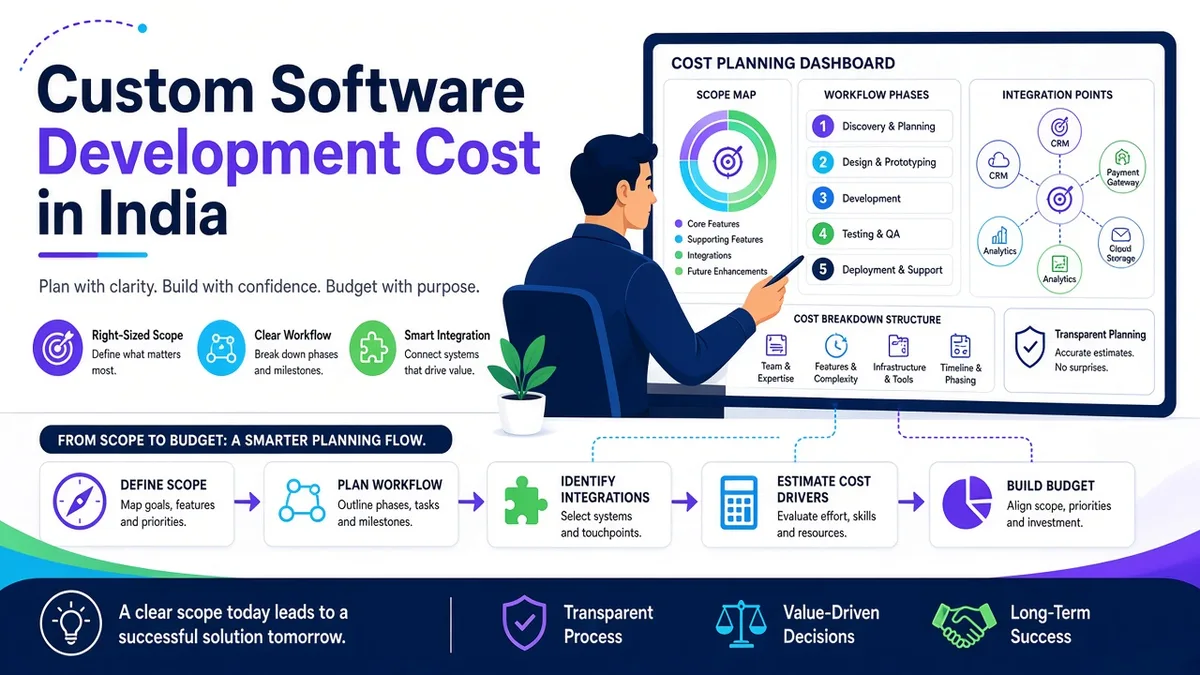 Articles
Custom software development cost in India
Learn what custom software costs in India, from MVPs to enterprise systems. See price ranges, cost factors and ways to save before you hire.
Learn more Articles
How to choose a custom software development company
Use this checklist to compare software vendors on experience, pricing, code ownership and support. Includes red flags and questions to ask.
Learn more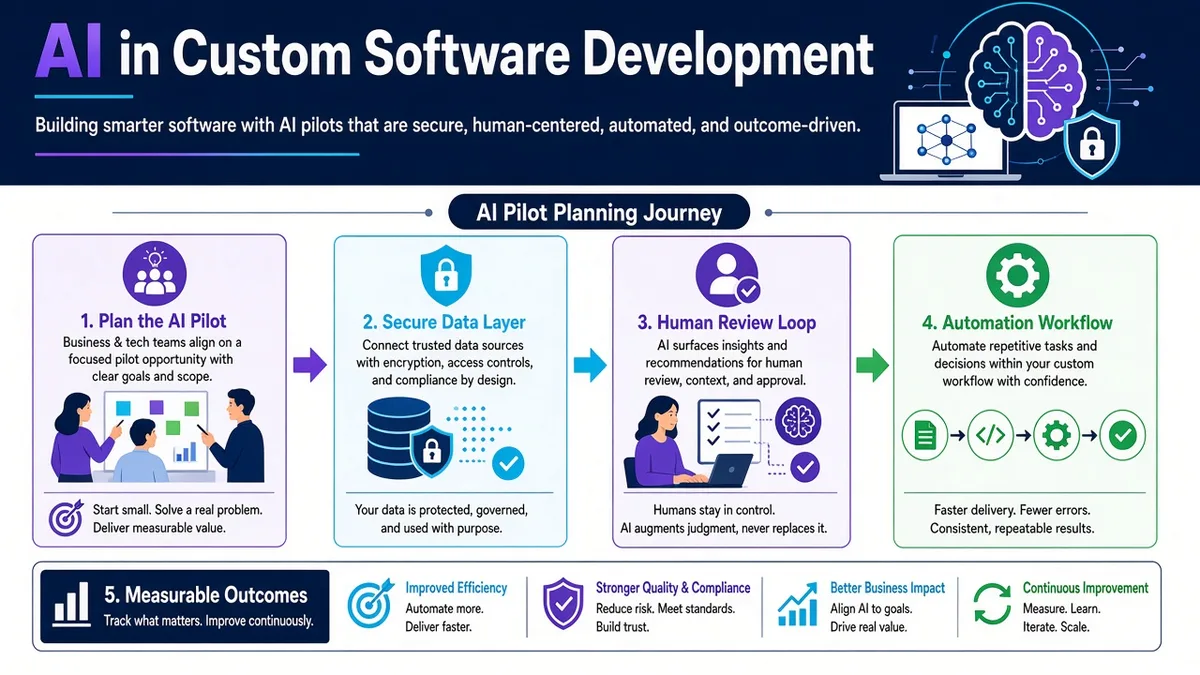 Articles
AI in custom software development
See where AI adds real value in custom software, from chatbots to automation. Learn costs, risks and how to start with a small pilot.
Learn more