

Customers keep finding the bugs
Every release goes through testing, and yet the support queue fills up the week after. That kind of defect leakage usually points to a gap in coverage or in timing, not effort.

Your developers moved to two-week sprints. Testing still works the way it did three years ago. We help you close that gap: we look at how your team tests today, agree on what "good" should look like, and then stay long enough to make the changes stick.

Usually the testers are working hard. The problem tends to be the system around them, and that's hard to see from the inside.
Every release goes through testing, and yet the support queue fills up the week after. That kind of defect leakage usually points to a gap in coverage or in timing, not effort.
Someone wrote a few hundred tests a while ago. Half of them fail for reasons nobody can explain, so the team runs them "when there's time". Which is never.
Code gets "finished" on Thursday and lands on the tester's desk on Friday afternoon. Everyone agrees this is a bad idea; nobody is quite sure how to change it.
Some clients want a single piece of advice. Others want a partner for a full QA transformation. Most start somewhere in between.
Two to three weeks of interviews, process reviews and a look at your real defect data. You end up with an honest score and a roadmap you can actually follow.
What gets tested, by whom, at which stage, and what "ready to release" means. Written down once, in plain language, so new hires don't have to guess.
Workflows for test planning, bug triage and sign-off that fit how your team really works. We keep the documents short, because long ones don't get read.
We spend time with each tester to understand their strengths and where they need support. From that, we put together a plan that covers training for the current team, which roles to hire, and what could be outsourced instead.
We compare tools based on your tech stack, your budget and what your team already knows. The two or three that fit best are then tried on a small part of your real product, so you can decide after seeing them work, not after watching a vendor demo.
We help testers take part in backlog refinement and write acceptance criteria with the product owner before development begins. As a result, stories are tested inside the same sprint instead of piling up at the end.
For larger organisations, our QA transformation services run over several months: new processes, tools, metrics and skills, rolled out team by team.
Workshops are a start. Real change happens when a coach sits with your testers on live work and helps them try new habits until they become normal.
We help you decide which tests are worth automating, whether they belong at the unit, API or UI level, which framework to use, and who will look after them. Teams that skip these decisions often end up with a test suite that takes more effort to maintain than it saves.
We use a simple five-level QA maturity model. Most teams we meet are somewhere between level 2 and level 3, and that's fine. What matters is knowing which level, and what the next step is.
Testing depends on who's around. Nothing is written down.
Test cases exist and are reused, but mostly at the end of each release.
A shared test strategy, a definition of done that includes testing, and some automation.
Decisions are based on data: test coverage, escaped defects, cycle time.
Continuous testing in the pipeline, with the focus on defect prevention rather than detection.
The most common mistake we see? Automating everything through the user interface. Those tests are slow and break whenever a button moves.
The test pyramid is an old idea, and it still works. Lots of fast unit tests at the bottom, a good layer of API tests in the middle, and only a thin layer of UI tests on top. People cover what scripts can't.
Test Pyramid Diagram
Fewer, slower tests at the top. Many fast, cheap ones at the bottom.
You don't need a big reorganisation. Small, practical changes do most of the work:
Every bug that reaches a customer is a small lesson. The trick is actually learning from it:
There are dozens of good options, from test management tools like TestRail, Xray and Zephyr to automation frameworks like Playwright, Selenium and Cypress. The best one is the one your team will actually use.
We have no reseller deals with any vendor, so our tool evaluation is based only on what fits you.
Language, CI system, issue tracker, cloud.
Developers, testers, business users, or all three.
Licences grow with headcount. Maintenance grows with test count.
Data export and lock-in matter more than most people expect.
Same discipline, very different problems.
 Startups
 usually come to us asking how to build a QA team from scratch. We help them decide who to hire first, how much process makes sense at their stage, and what is worth automating while the product is still changing every week.
 Enterprises
In a large company, a QA transformation roadmap has to take into account many teams, older systems and contracts that are already in place. We roll out changes in stages, starting with one or two teams, so that live releases aren't put at risk.
 CoE
A QA centre of excellence is a small central group that sets common standards, chooses shared tools and runs training for all teams. We help you set one up in a way that supports product teams rather than adding another layer of approvals.
 Healthcare
In a QA assessment for healthcare, we pay extra attention to traceability between requirements and tests, the validation records you keep, and how patient data is protected in test environments. These are the areas regulators and auditors tend to check first.
We're not interested in handing over a slide deck and disappearing. Here's what working with us looks like.
We talk to developers, testers, product owners and managers. They rarely describe the same problem.
We review your process, tools and bug history, and score each area against the maturity model.
Together we agree on a roadmap, with quick wins in the first month and bigger changes after that.
Our consultants help put the plan into practice, inside your sprints, with your people.
We step back once your team owns the new way of working. Then we check in again a few months later.
A quick self-check you can run with your team in half an hour. If you can't tick at least five of these, there's probably an easy win waiting.
That depends on the size of your organisation and how much hands-on help you want. Most clients start with the assessment, then decide what comes next once they've seen the roadmap.
Interviews, process and tool review, maturity scorecard and a prioritised roadmap.
Consultants working with your teams to roll out the roadmap over several months.
Flexible hours with a senior consultant for strategy questions, reviews or coaching.
 QA Testing
Improve software quality with Softfix manual QA testing services, including functional, regression, smoke, exploratory, UAT and cross-browser testing.
Learn more QA Testing
Accelerate software testing with Softfix test automation services that improve efficiency, reduce manual effort, and support faster, reliable releases.
Learn more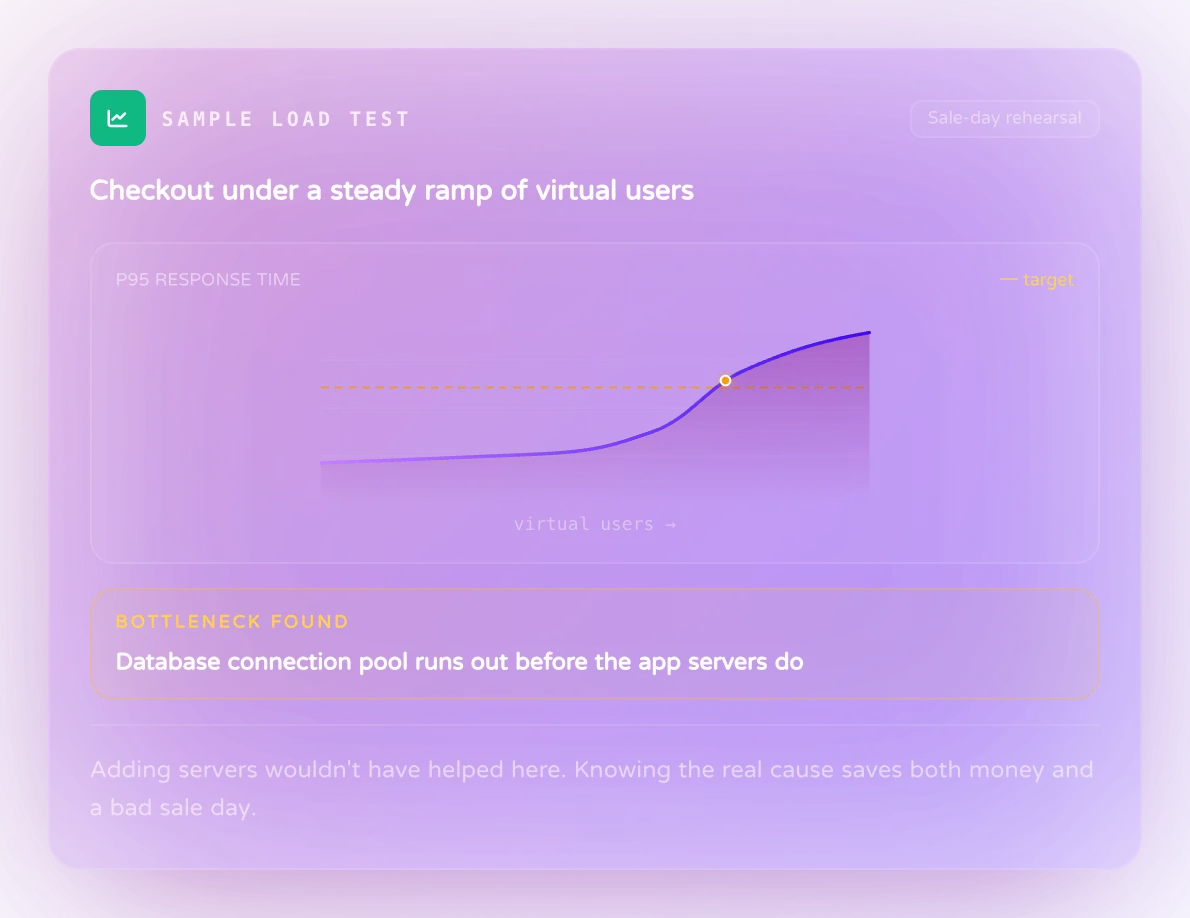 QA Testing
Ensure your software performs under real-world traffic with Softfix performance testing services for load, stress, spike, endurance and scalability testing.
Learn more QA Testing
Protect your applications with Softfix security testing services, including vulnerability assessment, penetration testing, API security, OWASP validation and secure code review.
Learn moreTell us a little about your team and what's bothering you. On a free 30-minute call, a senior QA consultant will ask a few pointed questions and suggest where you'd get the quickest improvement.
One of our QA leads will reply within a working day.
to help our experts understand your business objectives and create your customized plan.