


Your stock register says 400 kg of raw material. The store says 260. Production is waiting, a customer wants a delivery date, and the only person who knows the real numbers is on leave. If that sounds like your factory, you've probably started asking whether a custom ERP for small manufacturing is worth the money, or whether Tally and Excel can carry you a little longer.
The answers online don't help much. One vendor says ₹50,000. Another says ₹30 lakh. In this guide you'll see realistic 2026 price bands, the modules a small factory actually needs, what GST and job work rules mean for your software, how Tally fits in, and a plain way to decide when building makes sense and when it doesn't.
- A first custom ERP for a small factory often costs ₹2 lakh to ₹8 lakh; planning, quality and multi-plant needs push it higher.
- Production type, BOM depth, integrations and data clean-up move the price more than user count.
- Keep Tally for books if it works, build GST and job work rules in from day one, and roll out in phases.
What a Custom ERP for Small Manufacturing Actually Covers
ERP stands for enterprise resource planning, but the name makes it sound bigger than it is. In a small factory, it simply means one system where purchase, stores, production, quality, dispatch and billing share the same data. When a sales order is confirmed, the system knows what material it needs, what's in stock and what to buy.
Most manufacturing ERP software India vendors sell off the shelf gives you someone else's idea of how a factory works. A custom ERP for small manufacturing is built around yours: your bill of materials, your job work vendors, your batch rules and your report formats. You pay a team once to build it, then a smaller amount each year to support it.
That doesn't mean every factory should build a custom ERP for small manufacturing right away. Plenty of small units run well on Tally plus a few sheets. The point of a custom ERP for small manufacturing is to fix the specific places where your work happens outside the system, not to replace tools that already do their job.
Signs Your Factory Has Outgrown Tally and Excel
Before you look at any custom ERP for small manufacturing, be fair to Tally. It's excellent accounting software. Almost every CA in India knows it, and it handles GST returns, ledgers and invoicing very well. But stock in Tally lives on vouchers. It wasn't designed to follow material as it moves through machines, job workers and inspection.
The clearest warning sign? Your production manager keeps a separate Excel file for work orders. Once that happens, you have two versions of the truth, and nobody trusts either. Other signs show up quickly after that:
- Stock in the system rarely matches stock on the floor.
- You can't see the real cost of a product after a raw material price change.
- Material sent to job workers is tracked in a notebook or on WhatsApp.
- Delivery dates are guesses because nobody can see machine load.
- Month-end reports take days and depend on one person.
If three or more of these sound familiar, you're past the point where more spreadsheets will help. That's usually when owners start pricing a custom ERP for small manufacturing or a packaged SME ERP.
Custom ERP for Small Manufacturing: 2026 Cost Ranges in India
Here's the honest answer first. There's no fixed price, because "ERP" can mean a stock and billing app or a full planning system with machine data. Still, the 2026 guides published by Indian ERP developers put a custom ERP for small manufacturing into fairly clear bands.
Treat these as budgeting starting points, not quotes:
| Factory profile | Typical scope | Indicative custom build cost (INR) | Typical timeline |
|---|---|---|---|
| Small unit moving off registers or Excel | Item master, purchase, stock, GST billing, simple BOM | ₹2 lakh to ₹5 lakh | 6 to 10 weeks |
| Single plant with job work | Above plus production orders, job work challans, dispatch, owner dashboard | ₹4 lakh to ₹8 lakh | 2 to 4 months |
| Growing plant needing planning | Above plus MRP, quality checks, batch tracking, costing, supervisor app | ₹7 lakh to ₹18 lakh | 4 to 7 months |
| Multi-plant or machine-connected | Above plus several plants, machine data, dealer or vendor portals, analytics | ₹18 lakh to ₹40 lakh or more | 7 to 12 months |
Takeaway: the number of plants, production steps and integrations moves your bill far more than the number of users.

Why do quotes swing so wildly? Because one vendor's "complete ERP" is a stock register with a login screen, while another's includes MRP, job work tracking and e-invoicing. A ₹60,000 quote and a ₹12 lakh quote can both be honest. They just aren't describing the same product. Always ask for a module-wise breakdown of any custom ERP for small manufacturing quote.
What Drives ERP Development Cost in India?
A handful of factors decide most of your ERP development cost in India. If you know where your factory stands on each one, you can predict roughly where your quote will land before you speak to anyone.
Type of production
Make-to-order, make-to-stock, batch process and assembly each need different planning logic. A job shop that quotes every order is very different from a unit making the same five products daily. Mixed models cost more because a custom ERP for small manufacturing then has to handle both.
Depth of your bill of materials
A single-level BOM (raw material in, product out) is simple. Multi-level BOMs, with sub-assemblies inside assemblies, alternate materials and revisions, take far more work to model and test. In a custom ERP for small manufacturing, this is often the line that separates a ₹4 lakh build from a ₹10 lakh one.
Integrations
Tally sync, the GST e-invoice and e-way bill systems, barcode printers, weighbridges, payment gateways and WhatsApp each add effort. One published guide suggests integrations can add 20% to 35% on top of the core build, so list every one before you ask for a price.
Plants, stores and approvals
Each extra plant, godown or approval level means more rules and more testing. Two plants with different processes cost much more than one plant with two shifts, so count them before you price a custom ERP for small manufacturing.
Data migration
Item masters, BOMs, opening stock and pending orders all need cleaning before they go in. Messy data is the most common reason a custom ERP for small manufacturing runs late, and it's rarely priced well in the first quote.
Core Modules and What Each Adds to the Budget
A small factory rarely needs everything on a vendor's brochure. Six to ten well-built modules usually cover daily work. With a custom ERP for small manufacturing, the trick is choosing which ones go live first and which can wait.
Here's a practical way to sort them for a first phase:
| Module | What it does | When to build it |
|---|---|---|
| Item master and stores | Raw material, WIP and finished goods by location, batch and reorder level | Phase 1 |
| Purchase | Indents, purchase orders, GRN and vendor rates | Phase 1 |
| Sales and GST billing | Orders, invoices, e-invoice and e-way bill data | Phase 1 |
| BOM and production orders | Material issue, output, scrap and work in progress | Phase 1 or 2 |
| Job work | Challans, material at each vendor, returns and rejections | Phase 1 if you outsource processes |
| Quality control | Incoming, in-process and final checks with traceability | Phase 2 |
| MRP and planning | Material needs from orders and stock, machine load | Phase 2 |
| Costing and dashboards | Real cost per product, owner and supervisor views | Phase 2 |
| Maintenance, HR, dealer portal | Machine upkeep, attendance, dealer orders | Phase 3, if needed |
Takeaway: start with stores, purchase, billing and production, then add planning and quality once the team trusts the data.
The most underrated module is costing. When your system can show the real cost of each product, including material, labour, power and overheads, you price with confidence instead of habit. For many owners, that alone justifies a custom ERP for small manufacturing.
Shop-floor screens deserve thought too. Supervisors won't type long forms on a desktop. Simple tablet screens, large buttons and Hindi or regional language labels make the difference between real use and a system people avoid. A good custom ERP for small manufacturing can include a light supervisor app that runs on the same data.

GST, Job Work and E-Invoicing: Compliance to Build In
Generic ERP templates often handle Indian tax rules badly, and that's where a custom ERP for small manufacturing can earn its keep. Three areas matter for most small manufacturers. Rules and thresholds change, so confirm current details with your CA and the official portals before you finalise scope.
Job work and ITC-04
Under GST, you can send inputs to a job worker on a challan without paying tax, as long as they come back within one year (three years for capital goods like moulds and dies). Miss that window and the goods can be treated as supplied. Job work movements are reported in ITC-04, which the GST portal lists as a separate return. Your ERP should show what's lying with each vendor, flag old challans early and build ITC-04 data as you work.
E-invoicing
Businesses above the turnover threshold must report B2B invoices to the government's invoice registration portal and print the IRN and QR code on the bill. The e-invoice portal publishes the current rules and API details. If you're close to the limit, build this into your custom ERP for small manufacturing now rather than patching it in later.
E-way bills
Dispatches and many job work movements need an e-way bill. Your system can fill vehicle, transporter and distance details straight from the invoice or challan and generate the bill through the e-way bill system. That saves typing and removes a common source of mismatches.

Tally vs Custom ERP vs Packaged SME ERP
The Tally vs custom ERP question usually isn't either-or. Many factories keep Tally as the accounting book and run operations in a separate system that posts summary entries across. Your CA keeps working the way they like, and the shop floor gets proper tools.
Here's how the three main paths compare for a small factory:
| Factor | Tally with Excel | Packaged SME ERP (ERPNext, Odoo, BUSY and similar) | Custom ERP |
|---|---|---|---|
| First-year cost | Lowest | Low to medium, plus implementation | Highest |
| Cost over five years | Low, but hidden staff time | Grows with users and add-ons | One-time build plus yearly support |
| Fit with your process | Accounting only; production lives in sheets | Good if your process matches the product | Built around your exact process |
| Job work and BOM depth | Basic challans, limited BOM | Usually supported, may need configuring | As deep as you need |
| Shop-floor use | Rare | Varies by product | Screens designed for your staff |
| Code and data ownership | You own data | Vendor or community owns code | You own both, if the contract says so |
Takeaway: keep Tally for books, try a packaged SME ERP if your process is standard, and build only where your workflow is the thing that makes you money.
Let's put rough numbers on it. These are illustrations, not quotes. Say a 40-person component maker pays a cloud ERP ₹1,500 per user per month for 15 users. That's ₹2.7 lakh a year, or about ₹13.5 lakh over five years before add-ons. A custom build at ₹8 lakh plus ₹1.2 lakh a year in hosting and support comes to about ₹14 lakh over the same period. The totals are close, so the real question becomes fit. If the packaged product handles your job work and costing well, it's the safer choice. If your team keeps working around it, a custom ERP for small manufacturing wins.
Our guide on custom vs off-the-shelf software walks through that choice step by step, beyond just manufacturing.
When to Build a Custom ERP for Small Manufacturing (and When Not To)
Here's something most vendor pages won't tell you: many small factories should not build yet. If your production is simple and your main pain is GST filing, Tally does that job well, and a custom ERP for small manufacturing can wait. Building custom too early just adds cost and maintenance.
Use your factory's profile as a rough guide:
| Your situation | Sensible path |
|---|---|
| Under about 15 users, one product line, main pain is accounts | Stay on Tally, tidy up your sheets |
| Standard process that matches a packaged product | Packaged SME ERP through a good partner |
| Heavy job work, multi-level BOMs or unusual costing | Custom ERP for small manufacturing, built in phases |
| Two or more plants with different processes | Custom or a well-implemented packaged ERP, after a process study |
| Not sure | Pay for a short process-mapping phase before deciding |
Takeaway: build when your workflow is unusual and costly to work around, not just because the software you have feels old.
A quick example helps. Picture a Ludhiana fastener unit sending parts out for plating and heat treatment to six job workers. Material goes out daily, comes back in lots, and some gets rejected. Off-the-shelf tools track the challan but not the real quantity at each vendor. That's exactly where a custom ERP for small manufacturing pays off, because the workaround costs hours every day.
Now picture a small trader-cum-assembler with ten products and no job work. For them, Tally plus a well-set-up stock sheet is probably enough for another year or two.
Timeline, Data Migration and Running Costs
A sensible rollout happens in phases, so the first useful module goes live in weeks rather than months. It also spreads your spend and lets staff learn one change at a time.
Here's a typical phased plan:
| Phase | What happens | Typical duration |
|---|---|---|
| Process study | Map current steps, exceptions and reports | 1 to 3 weeks |
| Phase 1 build | Stores, purchase, billing, basic production | 6 to 10 weeks |
| Data clean-up and pilot | Clean masters, test on one product line, train users | 2 to 4 weeks |
| Phase 2 | Job work, quality, MRP, costing, dashboards | 2 to 4 months |
| Support | Fixes, GST updates, small changes | Ongoing |
Takeaway: a phased plan gets value early and keeps a custom ERP for small manufacturing from turning into one huge, risky launch.

Running costs come after go-live, and they're easy to forget when you budget a custom ERP for small manufacturing. Plan for hosting and backups, SMS or WhatsApp fees, any integration subscriptions and yearly support. Published guides put hosting for a small factory system roughly between ₹20,000 and ₹1.2 lakh a year, and yearly support often at 15% to 20% of the build cost.
Hosting choices matter more than people think. A well-planned cloud application setup in an Indian region keeps data in the country and spares you from running a server in the office. If the factory internet drops often, ask for screens that keep working offline and sync later. It adds a little to the bill, but it keeps the floor moving.
Data migration deserves its own budget line. Cleaning item codes, removing duplicate parties and checking BOMs takes real time from your own staff, not just the vendor. Some guides suggest keeping 15% to 25% of the project budget for migration, training and process changes. That's sensible advice for any custom ERP for small manufacturing.
Choosing an ERP Partner and Avoiding Costly Mistakes
The right partner matters more than the technology. Look for a team that asks about your process before it talks about features. A good one will also tell you when you don't need a custom ERP for small manufacturing at all.
Here are the mistakes that push the cost of a custom ERP for small manufacturing up the most:
Common mistakes to avoid
- ✗ Automating a messy process instead of fixing it first.
- ✗ Going live with dirty item masters and BOMs.
- ✗ Trying to launch every module on day one.
- ✗ Leaving the project to a junior with no owner involvement.
- ✗ Skipping training and a short parallel run.
- ✗ Not agreeing who owns the code and data.
Get these in writing before you sign:
Quick checklist
- ☐ A module-wise scope
- ☐ The integration list with costs
- ☐ Milestone-based payments
- ☐ Who owns the source code
- ☐ How you can export your data
- ☐ Warranty length
- ☐ Yearly support terms
A partner who shares a clear custom software development cost breakdown is easier to trust than one who quotes a single round number. You can also use our guide on how to choose a custom software development company to compare vendors fairly, and see how we approach ERP development at Softfix.
Ask every shortlisted team to show a live system they built for another factory, not just slides. Then call that client and ask one simple question: are your supervisors still using it every day?
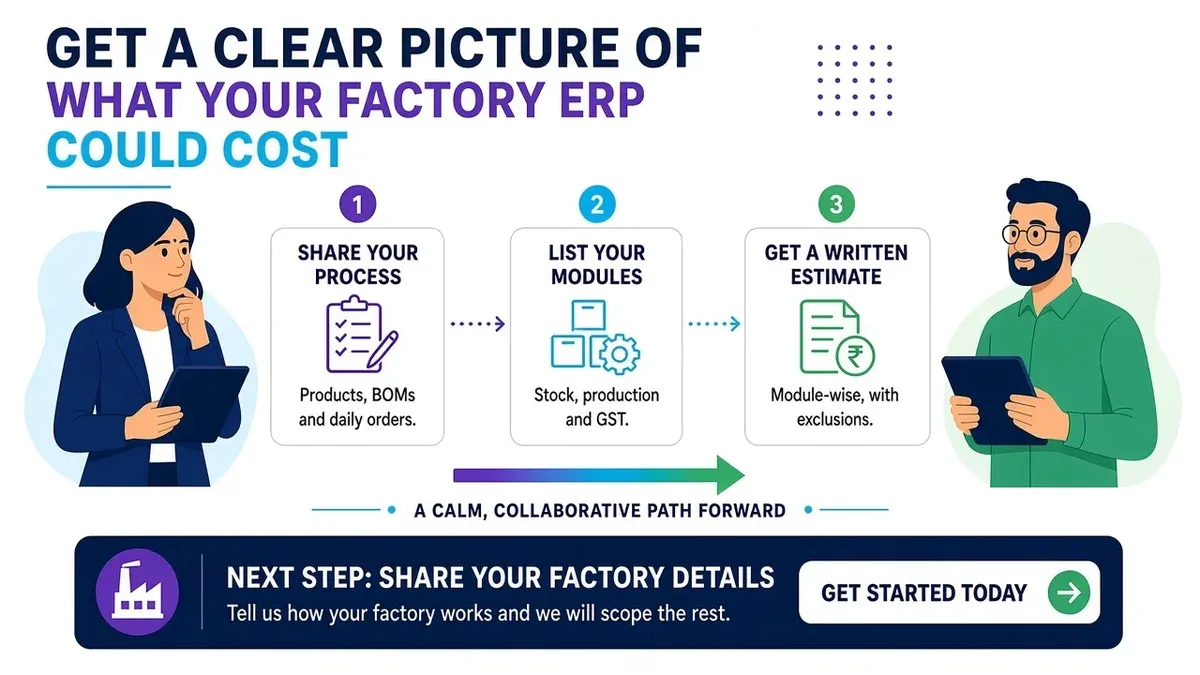
Get a Module-Wise ERP Estimate for Your Factory
If you are ready to turn your ERP plans into a scoped first release, start with your product list, a sample bill of materials, your job work vendors and the reports you check every week. A short brief like that gives any qualified team enough context to give you an honest, like-for-like quote.
Conclusion: Build for the Factory You'll Run in Three Years
A custom ERP for small manufacturing isn't about replacing Tally or chasing a big software project. It's about giving your stores, production and dispatch teams one reliable source of truth. Most small builds land between ₹2 lakh and ₹8 lakh, with planning and multi-plant needs pushing higher. The bigger risks are messy data, unclear scope and launching too much at once.
Start with the modules that remove your biggest daily headache. Keep Tally for books if your CA prefers it. Build GST, job work and e-invoicing into the first scope, and plan for support from day one. If your process fits a packaged SME ERP, take that route. If it doesn't, build in phases and own your code.
Want a clear, module-wise estimate for your factory? Talk to the Softfix team and we'll help you scope an ERP that fits your budget and the way your factory really works.
Keep reading: Custom software development cost in India · Custom software vs off-the-shelf software · How to choose a custom software development company
Related articles
 Application Development
ERP Development
Softfix Technologies provides custom ERP development services to integrate business operations, streamline workflows, manage data, and improve efficiency through scalable enterprise software.
Learn more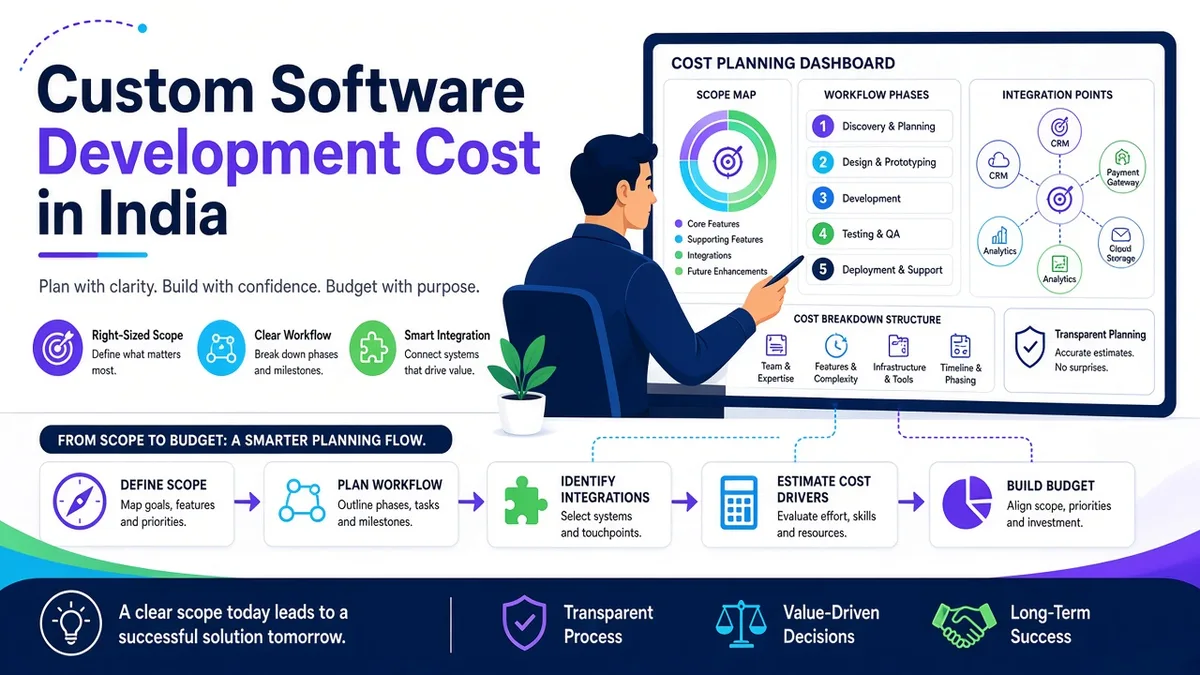 Articles
Custom software development cost in India
Learn what custom software costs in India, from MVPs to enterprise systems. See price ranges, cost factors and ways to save before you hire.
Learn more Articles
Custom software vs off-the-shelf software
Compare custom and off-the-shelf software on cost, speed, security and scalability. Use our checklist to decide what fits your business.
Learn more Articles
How to choose a custom software development company
Use this checklist to compare software vendors on experience, pricing, code ownership and support. Includes red flags and questions to ask.
Learn more