


It's late May. Your accountant is matching a year of UPI credits, cheques and cash slips against a donor sheet that lists the same supporter three different ways, and the annual donation statement is due on the 31st. If that sounds familiar, you've probably wondered whether donation management software for NGOs could take this pain away, and whether you should buy a tool or build your own.
This guide answers both questions in plain terms. You'll see what the software must do for Indian trusts and foundations, how 80G receipts, Form 10BD and FCRA rules shape it, what custom builds cost in 2026, when a ready-made nonprofit CRM is the smarter pick, and how to plan a build in phases without wasting donor money.
- Custom donation management software for NGOs in India often costs ₹2.5 lakh to ₹10 lakh; FCRA, grants and field apps push it higher.
- Numbered 80G receipts, PAN capture and a clean yearly donor statement (Form 10BD, now Form 113) matter more than fancy features.
- Start with SaaS if your process is simple; build in phases when compliance or scale makes the tool a daily workaround.
What Donation Management Software for NGOs Should Do
At its simplest, donation management software for NGOs is one place where every rupee and every supporter is recorded once. A donation comes in by UPI, card, cheque, cash or bank transfer. The system links it to the right donor, the right project and the right bank account, then sends a proper receipt without anyone opening a Word template.
That's the floor, not the ceiling. Good tools also remember why people give. They show who gives every month, who stopped after one gift, and which campaign brought in new supporters.
The best donation management software for NGOs also protects you at audit time. It keeps an unchangeable trail of receipts, ties every donation to a valid PAN where the law needs one, and produces the yearly statements your CA has to file. If the software can't do that, it's only a fancy spreadsheet.
Signs Your NGO Has Outgrown Excel and Receipt Books
Excel isn't the enemy. Trouble starts when the sheet becomes the only record of who gave what, and two or three people edit it at once.
Here are the warning signs most teams notice first:
- The same donor appears under different spellings, so yearly totals don't match.
- Receipts are typed by hand, and numbering gaps show up at audit.
- Donors keep asking you to resend last year's receipt.
- Nobody can say which donors gave last year but not this year.
- Foreign and local donations sit in the same register.
If three or more of these apply, more spreadsheets won't fix it. That's usually the point when trustees start comparing ready-made tools with custom donation management software for NGOs.
Here's a quick example. Picture a Lucknow trust with 600 regular donors and two volunteers handling receipts. Every March they spend evenings fixing names and PAN numbers by hand. Good donation management software for NGOs would catch those errors the day each gift arrives, not ten months later.
Core Modules of a Donor Management System
A donor management system isn't one feature. It's a set of modules that share the same data. You don't need all of them on day one, but you should know what each one does before you ask for a quote. Think of it as the menu that donation management software for NGOs is built from.
The table below shows the modules most Indian NGOs ask for and what each one solves.
| Module | What it does | Who needs it most |
|---|---|---|
| Donor records | One profile per donor with PAN, contact details, consent and giving history | Every NGO |
| Donation capture | Online pages, UPI, payment links, plus entry for cash, cheque and bank transfer | Every NGO |
| Receipts | Numbered 80G or plain receipts as PDF, sent by email or WhatsApp | NGOs with 80G approval |
| Recurring giving | Monthly mandates, reminders and alerts when a donor stops | NGOs with monthly donors |
| Campaigns and projects | Goals, progress and donation tagging per programme or appeal | NGOs running several projects |
| Annual statements | Donor-wise data export for the yearly income tax filing | NGOs with 80G approval |
| FCRA ledger | Separate tracking of foreign contributions and their use | FCRA-registered NGOs |
| Reports and dashboards | Totals, retention, campaign results and trustee reports | Larger trusts and foundations |
Takeaway: donor records, donation capture and receipts are the core; the rest depends on your registrations and how you raise money.
A smaller trust can stop at the first four rows. A foundation with foreign funding and several programmes will need nearly all of them. That's why two quotes for "NGO software" can be so far apart. One vendor may be pricing a receipt tool, while another is pricing full donation management software for NGOs with grants, FCRA and dashboards.
Many teams also want a simple nonprofit CRM India layer on top: call notes, follow-up tasks, birthday greetings and donor segments. It's useful, but it's the part you can add later. Getting receipts and records right comes first, because that's what donation management software for NGOs is judged on at audit time. If your fundraising team already lives in a CRM, a good build will connect to it rather than replace it, and our CRM development team often handles that link.

80G Receipts, Form 10BD and the New Form 113 and 114
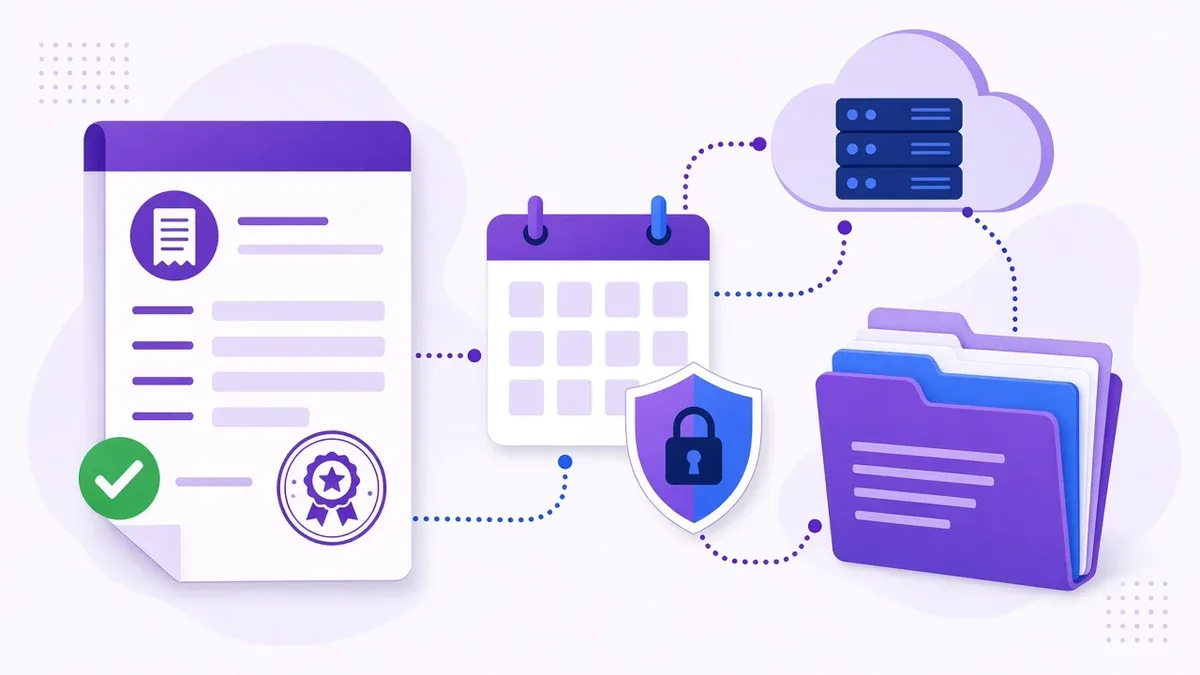
This is where most generic tools fall short, and where custom 80G receipt software earns its keep. If your NGO has 80G approval, donors expect a receipt they can use to claim a deduction. Any donation management software for NGOs you choose should treat that receipt as a legal document, not a thank-you note. Each year you also have to report donor-wise details to the Income Tax Department.
The annual donation statement
Under the old rules, approved NGOs file Form 10BD and issue Form 10BE certificates to donors by 31 May after the financial year ends, as the Income Tax Department's Form 10BD and 10BE guide explains. Under the Income-tax Act, 2025 and the 2026 rules, these forms are called Form 113 and Form 114. The deadline is still 31 May, and the filing is still online only.
Your software should handle both names during the changeover, because last year's donations and this year's donations may follow different labels. It should also allow correction statements, since mistakes happen and a revised donor certificate may be needed. In donation management software for NGOs, this usually means a one-click export in the format the e-filing portal expects, with a check that flags missing PAN or address details before you upload.
Receipt rules to build in
The Income Tax Department matches what donors claim against what you report. So your receipts and your yearly data must agree, line by line. That shapes a few design choices:
- Number receipts in sequence for each financial year, with no gaps.
- Never edit an issued receipt; cancel it and issue a new one, with a reason logged.
- Flag cash donations above ₹2,000, since cash above that limit doesn't qualify for the deduction.
- Capture PAN or Aadhaar details at the time of the gift, not in May.
A donor who chose the new tax regime can't claim 80G anyway, but they'll still want a receipt. Keep that simple too. When these rules live inside your donation management software for NGOs, your accountant stops being the last line of defence.
FCRA and Foreign Donations: What the Software Must Separate
If your NGO receives foreign money, the rules get stricter. All foreign contribution must first land in the designated "FCRA Account" at SBI's New Delhi Main Branch. From there it can move to utilisation accounts, but local donations must never mix with it.
Your software has to mirror that split. Foreign donations need their own ledger, their own bank accounts and their own reports. Plenty of off-the-shelf donation management software for NGOs treats every gift the same way, which is exactly what FCRA doesn't allow. The annual return, Form FC-4, is filed on the FCRA online portal, and recent amendments ask for project-wise and activity-wise use of funds, plus details of the original foreign donor even when money comes through an intermediary.
So tag every foreign gift with the donor's country, the purpose and the project it funds. Then track every rupee spent against that project. Retrofitting this later is painful and costly, so if you hold FCRA registration or plan to apply, put it in the first scope. Donation management software for NGOs with FCRA support should also block a foreign gift from being recorded against a local bank account, so the mistake can't happen in the first place.
Donor Data, Consent and the DPDP Act
Donor records hold names, phone numbers, addresses and PAN details. That's personal data, and any donation management software for NGOs has to treat it carefully. The Digital Personal Data Protection Act, 2023 covers it. The rules under the Act were notified in November 2025, with most duties for organisations starting from May 2027.
In practice, your system should ask for clear consent before sending appeals, record what each donor agreed to, and let donors unsubscribe in one click. PAN and phone numbers should be encrypted and masked on screen, so a volunteer helping with calls can't copy the full list.
Donors can ask you to delete their data, yet tax law needs you to keep donation records for audit. A sensible build handles this by removing marketing data and contact details while keeping the receipt trail that the law requires. Ask your developer how they'll handle that before you sign. It's a small design choice in donation management software for NGOs, but it's the kind that matters if a donor ever complains.
Donation Management Software for NGOs: 2026 Cost Ranges in India
So what does it cost? The honest answer is "it depends on scope", but published vendor guides give useful bands. The table below pulls together the ranges Indian developers list for custom builds in 2026. Treat them as indicative, not as a price list. Prices for donation management software for NGOs vary with scope, so use these bands to sense-check quotes, not to fix a budget.
| Scope | Typical modules | Indicative cost (INR) | Typical timeline |
|---|---|---|---|
| Starter | Donation page, donor list, PDF receipts, Excel export | ₹60,000 to ₹2 lakh | 3 to 6 weeks |
| Standard | Donor records, online and offline donations, 80G receipts, annual statement export, basic reports | ₹2.5 lakh to ₹5 lakh | 6 to 10 weeks |
| Advanced | Standard plus recurring giving, FCRA ledger, projects and grants, donor portal | ₹5 lakh to ₹10 lakh | 10 to 16 weeks |
| Large foundation | Advanced plus programme tracking, field app, CSR portal, several entities | ₹10 lakh to ₹15 lakh and up | 4 to 6 months |
Takeaway: compliance needs and the number of projects move the price far more than the number of donors.
What pushes the price up
FCRA ledgers and fund-wise accounting add real work, as do grant tranches and utilisation reports. A donor portal, where supporters log in and download past receipts, adds design and security effort. So do Tally sync, WhatsApp messaging and several payment gateways. Moving years of messy donor data also takes longer than most people expect. Each of these can add weeks to donation management software for NGOs, so decide early which ones belong in the first release.
Running costs to budget for
You'll pay for hosting, email and SMS or WhatsApp messages, and yearly support. Payment gateways charge a fee on each online donation, often around 2% plus GST, so check your gateway's current rates. Ask every vendor to list these running costs next to the build price, since the yearly cost of donation management software for NGOs matters as much as the first invoice. For a fuller picture of how custom builds are priced, see our guide to custom software development cost in India.
Custom Build vs Nonprofit CRM SaaS: Which Fits Your NGO?
You don't have to build. Several Indian SaaS tools now offer free or low-cost plans with 80G receipts, and some charge between a few hundred and a few thousand rupees a month. For a new NGO with simple needs, that's often the right call. Ready-made donation management software for NGOs gets you receipts in a day, and you can always move later if you outgrow it.
The comparison below shows where each option tends to win.
| Factor | Nonprofit CRM SaaS | Custom donation software |
|---|---|---|
| Upfront cost | Low or nil | Higher, paid in milestones |
| Ongoing cost | Monthly fee that grows with donors or users | Hosting and support |
| Fit with your workflow | You adapt to the tool | Built around your process |
| FCRA and multi-project funds | Only on higher plans, if at all | Built to your exact structure |
| Data ownership | Stays on the vendor's platform; check export terms | You own the code and the data |
| Speed to start | Days | Weeks to months |
Takeaway: start with SaaS if your process is simple; build when compliance, scale or your own way of working makes the tool a daily workaround.
Here's a quick test. If your team spends hours every month exporting from the SaaS tool, fixing data in Excel and re-uploading it, you're paying twice. You're paying for the subscription and for the staff time that the donation management software for NGOs was supposed to save. That's when custom NGO software development India starts to make financial sense. Our article on custom vs off-the-shelf software walks through the same decision in more detail. Whichever way you go, make sure your donation management software for NGOs lets you export all donor and receipt data in a standard format.
How to Build Donation Management Software for NGOs, Step by Step
A good build doesn't start with screens. It starts with a week or two of listening. Who records donations today? How does a cheque travel from the office to the bank? Which reports do trustees and auditors actually read?
Plan the first release around one pain
Pick the problem that hurts most. For most NGOs, that's receipts and the yearly donor statement. Build that well, go live and let the team use it. Then add recurring giving, campaigns or FCRA in later phases. Building donation management software for NGOs this way also makes it easier to raise money for the next phase, because trustees can see the first one working.
The phased plan below is how many teams approach donation management software for NGOs without risking the whole budget at once.
| Phase | What gets built | Typical length | Done when |
|---|---|---|---|
| 1. Discovery | Workflow map, data audit, receipt formats, compliance list | 1 to 2 weeks | Trustees sign off a written scope |
| 2. Core release | Donor records, donation entry, 80G receipts, exports | 4 to 6 weeks | Staff issue real receipts from the system |
| 3. Online giving | Donation pages, UPI and gateway, auto receipts | 3 to 4 weeks | Online gifts reconcile without manual work |
| 4. Growth features | Recurring giving, campaigns, donor portal, WhatsApp | 4 to 6 weeks | Donors fetch their own receipts |
| 5. Compliance and scale | FCRA ledger, grants, Tally sync, dashboards | 4 to 8 weeks | Year-end filing runs from system data |
Takeaway: go live in phases so your team learns one change at a time and every rupee spent shows results early.

Pick a simple, proven tech stack
Most donation systems are web apps, so your staff can work from any browser. A web application development team will usually pick a common framework, a reliable database and hosting in India. Field staff collecting cash at events may need a small mobile app as well, which an Android app development team can add later.
Clean your data before you move it
Data migration is where projects slip. Merge duplicate donors, fix PAN formats and decide which old records to bring over. Even the best donation management software for NGOs can't fix bad data on its own. Run a test import, check totals against last year's audited figures and only then switch off the old sheet.
Choosing an NGO Software Development Partner
The right partner asks about your donors before talking about technology. They should understand 80G, the annual statement and, if you need it, FCRA. They should also be willing to say "a SaaS tool will do" when that's the truth. A team that has built donation management software for NGOs before will ask about receipts, PAN capture and year-end filing in the very first call.
Ask to see live work. At Softfix, for example, we built Aaghaz, an Android app for Taqi Meer Foundations that's live on the Play Store. Their product coordinator said, "It is nice experience to work with softfix." You can read more about our non-profit software work on our industry page.
Here are the mistakes we see NGOs make most often when they commission donation software:
Common mistakes to avoid
- ✗ Asking for every module in the first release.
- ✗ Leaving receipt formats until the end.
- ✗ Ignoring FCRA until after launch.
- ✗ Not checking who owns the code and the data.
- ✗ Skipping training for the staff who enter donations.
Get these in writing before you sign:
Quick checklist
- ☐ A module-wise scope
- ☐ Milestone-based payments
- ☐ Who owns the source code and donor data
- ☐ How you can export your data
- ☐ Warranty length
- ☐ Yearly support terms
Ask too for a short demo of a test receipt and a sample donor statement before the final payment, so you know the donation management software for NGOs you paid for actually works.
Get a Module-Wise Estimate for Your NGO Software
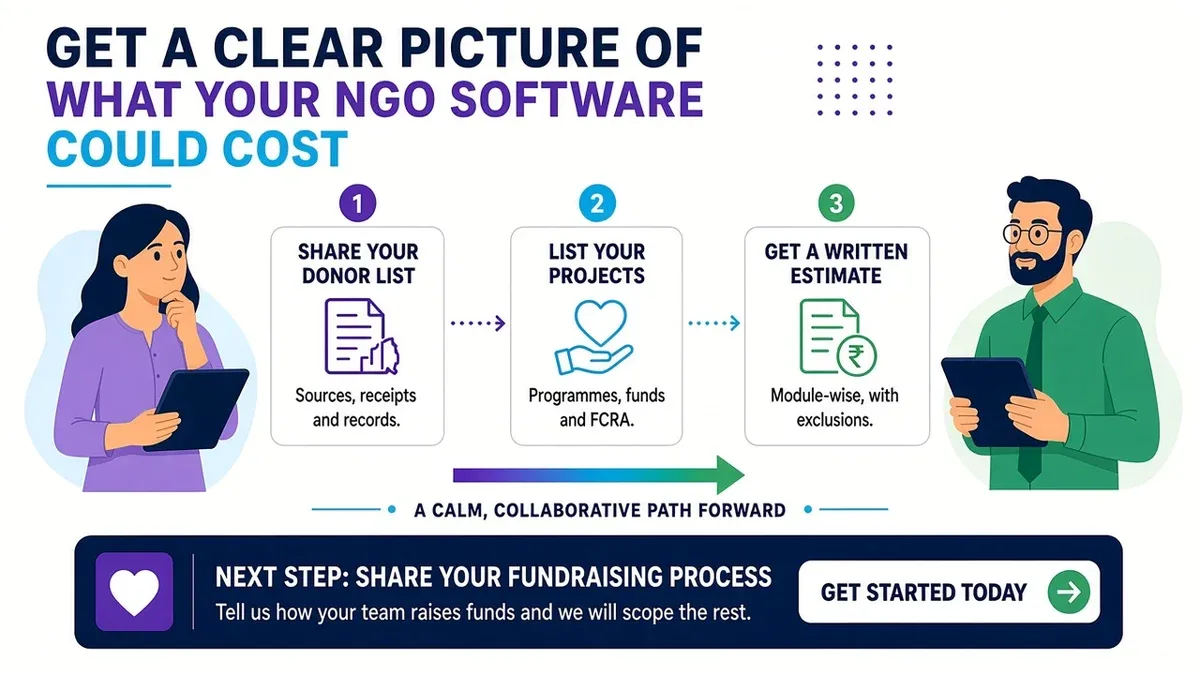
If you are ready to turn your donation plans into a scoped first release, start with a sample of your donor list, your current receipt format, your registrations (12A, 80G, FCRA) and the reports your trustees and CA ask for each year. A short brief like that gives any qualified team enough context to give you an honest, like-for-like quote.
Conclusion: Build Trust Into Every Receipt
Donation management software for NGOs isn't just about saving staff time. It's about giving every donor a correct receipt, filing a clean annual statement and showing trustees and auditors exactly where money went. Most custom builds in India land between ₹2.5 lakh and ₹10 lakh, with FCRA and multi-project needs pushing the cost higher.
Start with the module that removes your biggest headache, usually receipts. Plan for Form 113 and 114, consent under the DPDP Act and FCRA separation from day one. If a SaaS tool fits your process, use it. If you need donation management software for NGOs built around your own projects and funders, a custom build is worth the investment. If it doesn't, build in phases and own your code.
Want a clear, module-wise estimate for your NGO? Talk to the Softfix team and we'll help you scope donation software that fits your budget and the way your organisation really works.
Keep reading: Custom software development cost in India · Custom software vs off-the-shelf software · How to choose a custom software development company
Related articles
 Articles
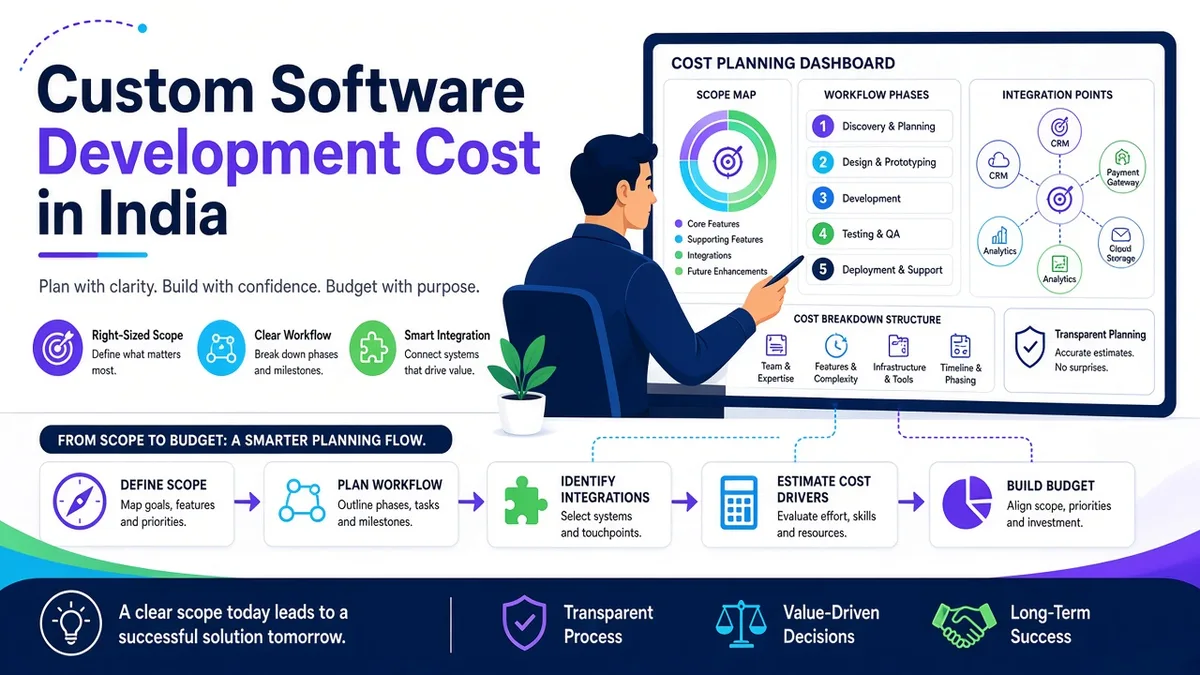
Custom software development cost in India
Learn what custom software costs in India, from MVPs to enterprise systems. See price ranges, cost factors and ways to save before you hire.
Learn more Articles
Custom software vs off-the-shelf software
Compare custom and off-the-shelf software on cost, speed, security and scalability. Use our checklist to decide what fits your business.
Learn more Articles
How to choose a custom software development company
Use this checklist to compare software vendors on experience, pricing, code ownership and support. Includes red flags and questions to ask.
Learn more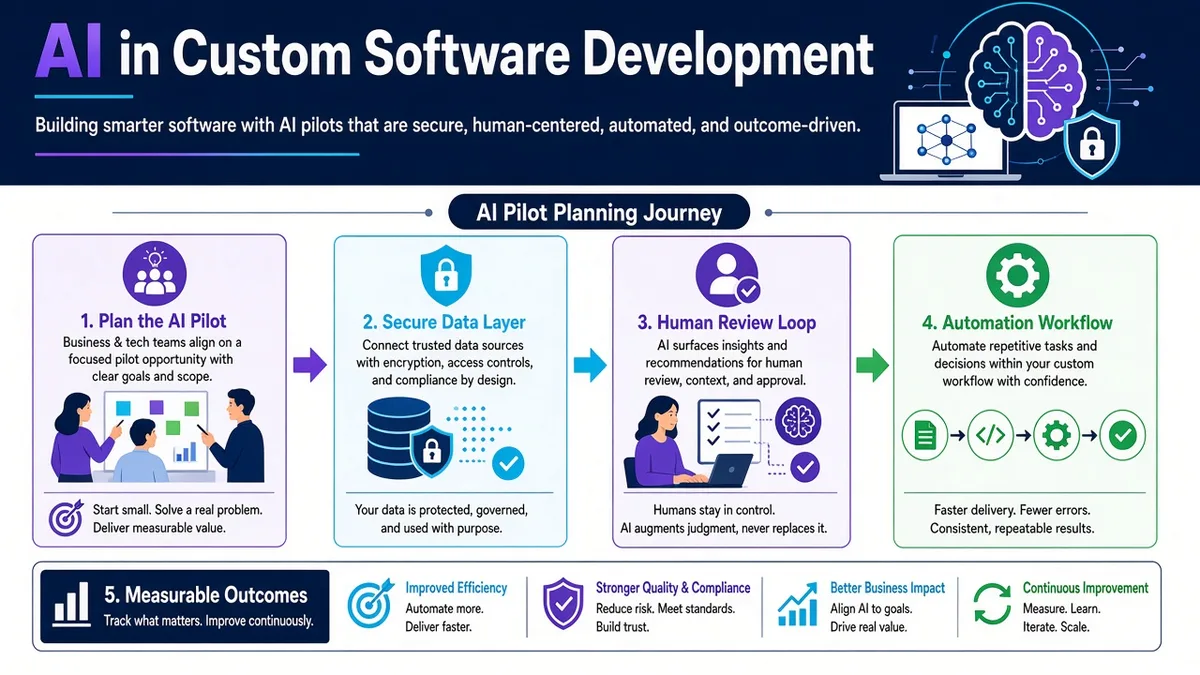 Articles
AI in custom software development
See where AI adds real value in custom software, from chatbots to automation. Learn costs, risks and how to start with a small pilot.
Learn more