


Your reps say they visited 22 outlets yesterday. Orders came in on WhatsApp, the scheme was applied wrong at two shops, and the distributor still doesn't know what to load tomorrow. Sound familiar? That's usually the week a sales head starts asking about field sales app development cost, and the quotes that come back can be miles apart.
One vendor offers an SFA plan at a few hundred rupees per rep a month. Another quotes ₹20 lakh for a custom build. Both can be honest, because they're selling different things. In this guide you'll see indicative 2026 price ranges for custom apps and ready-made SFA software, the features that push the price up, how FMCG and pharma needs differ, and the running costs that appear after launch. You'll also get a checklist for comparing quotes.
- A basic custom field sales app often costs ₹1.5 lakh to ₹5 lakh, and an SFA platform with distributors and schemes usually needs ₹12 lakh or more.
- Offline sync, scheme logic and Tally or ERP integration move the price more than the number of screens.
- Ready-made SFA plans suit most small teams; set aside 15% to 25% of build cost a year if you go custom.
What a Field Sales App Does and Who Needs a Custom One
A field sales app, often called a sales force automation app or SFA software, runs the working day of people who sell on the road. Reps mark attendance, follow a beat plan, check in at outlets with GPS, book orders from a catalogue, collect payments and log expenses. Managers see all of it on a web dashboard instead of chasing calls at 8 pm.
Plenty of Indian teams start on a ready-made SFA product, and that's often sensible. Entry plans from Indian vendors begin at a few hundred rupees per user a month. If your sales process looks like everyone else's, the field sales app development cost of building your own is hard to justify in year one.
Custom work starts to make sense when the product keeps fighting you. Maybe your schemes have slabs no tool can model. Maybe you sell through super stockists, distributors and retailers with different price lists, or your pharma reps need doctor visit reports tied to sample stock. That's when the field sales app development cost question changes. You stop renting a product and start paying a team to build one that fits how you already sell.
Field Sales App Development Cost in India: 2026 Ranges
Here's the straight answer first. There's no single field sales app development cost, because "field sales app" can mean an attendance tracker or a full distribution platform. Still, published 2026 guides from Indian developers fall into fairly consistent bands for custom builds.
Use these as budgeting starting points, not quotes:
| Team profile | Typical scope | Indicative custom build cost (INR) | Typical timeline |
|---|---|---|---|
| Small team moving off WhatsApp and Excel | Attendance, GPS check-in, outlet visits with photos, order booking, simple dashboard | ₹1.5 lakh to ₹5 lakh | 6 to 12 weeks |
| Growing team with beats and offline work | Above plus offline sync, beat plans, catalogue, collections, expenses, Tally sync | ₹5 lakh to ₹12 lakh | 3 to 4 months |
| Brand with distributors and schemes | Above plus scheme engine, distributor stock, secondary sales, claims, ERP link, multi-level roles | ₹12 lakh to ₹25 lakh | 4 to 6 months |
| Multi-state sales force | Above plus incentives, retail audits, advanced analytics, hundreds of reps, single sign-on | ₹25 lakh or more | 6 to 9 months |
Takeaway: offline sync, scheme logic and integrations move your field sales app development cost far more than the number of screens.
Why such wide bands? Because one vendor's "complete SFA" may skip offline mode, while another includes it with conflict handling and a two-way Tally link. A ₹1 lakh quote for a "complete" app is usually a GPS form with a login screen. Always ask what's inside the number.
What Drives Field Sales App Development Cost?
Six things decide most of the field sales app development cost. If you know where your team stands on each, you can predict your quote before a vendor gives it to you.
Offline mode and sync
Reps work in basements, rural belts and Tier 3 towns where the signal drops to nothing. A proper offline app stores orders, visits and photos on the phone and syncs later without duplicates. One published rate card puts offline sync with conflict handling at roughly ₹75,000 to ₹2.2 lakh on its own. Skip it and adoption suffers, so it's rarely optional.
Schemes, pricing and credit rules
Buy-ten-get-one offers, value slabs, outlet-specific price lists and credit limits all have to work at the moment of order. This logic is where cheap tools break. It's also where a big share of the field sales app development cost goes, because every rule needs testing against real invoices.
Integrations with Tally, ERP or a DMS
Orders that land in a spreadsheet still need someone to retype them. A two-way sync with Tally, SAP Business One or your ERP software removes that work, but it takes weeks, not days. Published Indian guides put a basic Tally sync around ₹50,000 to ₹1.5 lakh and deeper ERP or DMS links at ₹1 lakh to ₹5 lakh.
Roles and sales hierarchy
A rep, an area manager, a regional head and a national head all see different data. Add distributors and super stockists and the permission model grows fast. More roles mean more screens, more approval flows and a higher field sales app development cost.
Platform choice
Most Indian field teams carry Android phones, many with 2 GB to 4 GB of RAM. Building once with a cross-platform framework such as Flutter keeps iPhone support cheap if managers need it. Two separate native apps can push the field sales app development cost noticeably higher for the same scope.
GPS, photos and verification
Basic GPS check-in barely moves the field sales app development cost. Geofencing against outlet locations, live tracking during work hours, mock-location detection and duplicate-photo checks each add effort. They're worth it if fake visits are a real problem in your team.
SFA Software Features and What Each Adds to the Budget
Not every feature deserves your money on day one. A ten-rep dealer team shouldn't spend its field sales app development cost on retail audits, while a national FMCG brand can't live without secondary sales data. The trick is matching features to how your team actually sells.
Here's how common modules affect the field sales app development cost:
| Module | What it does | Effect on cost | Who needs it first |
|---|---|---|---|
| Attendance and GPS check-in | Selfie or geofenced attendance, visit time and location | Low | Every field team |
| Beat planning | Daily routes and outlet lists set by managers | Low to medium | Teams with fixed territories |
| Order booking with catalogue | Products, prices, stock and order history on the phone | Medium | Anyone taking orders in the field |
| Offline mode with sync | Works without signal, syncs without duplicates | Medium to high | Rural and Tier 2 or Tier 3 coverage |
| Scheme and discount engine | Slabs, free goods and outlet-specific pricing at order time | High | FMCG and distribution brands |
| Collections and outstanding | Cash, cheque and UPI entries with ageing reports | Medium | Teams that collect payments |
| Expenses and travel allowance | Distance-based claims and approvals | Low to medium | Teams paying travel allowance |
| Distributor management module | Distributor stock, primary and secondary sales, claims | High | Brands selling through distributors |
| Manager dashboard and reports | Live map, target vs achievement, outlet coverage | Medium | Every team with more than one manager |
Takeaway: start with attendance, beats, orders and offline mode, then add schemes and distributor modules once the basics are in daily use.
A good field force tracking app should save the rep time, not just watch them. One-tap reorder from the last order, the right scheme shown automatically and an instant order confirmation on WhatsApp do more for adoption than another report for head office. Ask any vendor to show you how many taps a no-order visit takes, because that detail affects both adoption and field sales app development cost.
If you also need lead tracking, quotations and follow-ups for desk-based sales, it can make sense to build the field app as part of a wider CRM development project, so both teams share one customer record.

FMCG, Pharma and Distributor Apps: How the Needs Differ
"Field sales" covers very different jobs, and the same app rarely fits all of them. Knowing which group you belong to keeps your field sales app development cost focused on features your reps will actually open.
FMCG and consumer goods
FMCG teams visit many small outlets a day, so speed matters most. The app needs fast order entry, schemes applied correctly, outlet photos and stock checks. Secondary sales, meaning what distributors sell to retailers, is often the number leadership cares about most.
Pharma and healthcare
Pharma reps visit doctors, chemists and stockists. Their reports focus on call frequency, products discussed and sample or gift stock handed out. Tour plans, doctor lists by specialty and manager joint-work reports are common needs that generic SFA products handle only partly. Building these properly adds to the field sales app development cost, but it saves hours of manual reporting each month.
Distributor management app
Some businesses need the distributor side more than the rep side. A distributor management app handles distributor orders, stock, GST billing, claims and e-way bill details. If your trucks move goods between states, check how the app will feed data to the GST e-way bill system before you sign off the scope.
Many brands need a mix. A paint or building materials company might want a dealer ordering app, a rep app and a distributor portal sharing one back end. That's where custom builds tend to win, because packaged tools often sell each piece separately and the combined field sales app development cost of three subscriptions keeps climbing.
Custom App vs Ready-Made SFA Software: Which Keeps Field Sales App Development Cost Lower?
This is the decision that matters most, and the honest answer is that many teams should buy, not build. A ready-made sales force automation app in India is quick to start, cheap per rep and improves without you paying for it.
Here's a simple way to compare the two:
| Factor | Ready-made SFA software (SaaS) | Custom field sales app |
|---|---|---|
| Upfront cost | Low, setup often ₹15,000 to ₹2 lakh | ₹1.5 lakh to ₹25 lakh or more, depending on scope |
| Yearly cost | Per rep per month, rising as the team grows | Hosting plus about 15% to 25% of build cost for support |
| Go-live | Days to a few weeks | Two to nine months |
| Fit with your process | You adapt to the product | The product adapts to you |
| Schemes and pricing | Standard rule types only | Any rule you can define clearly |
| Ownership | You rent access; export terms vary | You own code and data if the contract says so |
Takeaway: buy while your team is small and your process is standard, and consider custom once per-rep fees and workarounds start costing more than a build.
Let's put rough numbers on it. These are illustrations, not quotes. A team of 25 reps on a ₹600 per user monthly plan pays about ₹1.8 lakh a year, or roughly ₹5.4 lakh over three years plus setup. A custom build at ₹6 lakh with about ₹1.2 lakh a year in support would cost close to ₹9.6 lakh over the same period. At that size, SaaS wins easily.
Now take 120 reps on a mid-market plan at ₹1,200 per user a month with distributor modules. That's about ₹17.3 lakh a year, or around ₹52 lakh over three years. A custom platform at ₹20 lakh plus ₹4 lakh a year in support and hosting comes to about ₹32 lakh. Here the three-year field sales app development cost can favour building, as long as your process is stable.
Our guide on custom vs off-the-shelf software walks through that choice step by step, and the wider custom software development cost in India guide explains how agencies price the work.
Field Force Tracking, Privacy and Rep Adoption
Tracking is the feature owners ask for first and reps resent most. It also affects your field sales app development cost more than people expect. Handle it badly and you'll pay for an app nobody opens. Handle it well and it becomes the reason your data is finally trustworthy.
Location tracking and consent
Track location only during working hours, between check-in and check-out, and tell reps in writing what's recorded and who sees it. Location history is personal data, so your app and policies should line up with India's Digital Personal Data Protection Act, 2023. Get legal advice on the details for your business.
Play Store rules for background location
If the app tracks location while it's in the background, Google Play asks for a declaration and a clear in-app disclosure. Read Google's background location policy early, because a rejected update can delay your launch by days.
Battery, fake GPS and adoption
GPS that polls every few seconds can drain a cheap phone by afternoon, and reps will simply switch it off. Smart sampling, mock-location detection and checks for reused photos cost a little more upfront. They protect your field sales app development cost from being wasted on data you can't trust.
Adoption is part of the field sales app development cost too. Train reps in small groups, pick a few champions per region and show each rep their own targets and incentives in the app. When the tool helps them earn, they use it.

Hidden and Running Costs After Go-Live
The build price is only part of the field sales app development cost. Plan for these recurring and one-time items too, so year two doesn't come as a shock.
- Hosting and backups: cloud servers, storage for outlet photos and backups. Photo-heavy apps grow storage bills quickly.
- Maps and messaging: map APIs, SMS OTPs and WhatsApp messages are charged by the provider, usually per use.
- Devices and data: if you supply phones, a basic Android handset for each rep adds up fast, along with mobile data plans.
- Data cleanup: duplicate outlets, wrong SKU codes and unclear territories have to be fixed before launch, and that takes paid time.
- Play Store and App Store: developer accounts, review cycles and policy updates for new Android versions.
- Support and updates: budget about 15% to 25% of the build cost each year for fixes, small changes and OS updates.
- Training: new reps join every month, so onboarding never really ends.
Many owners only see the full field sales app development cost once the second year's bills arrive. Ask every vendor to list these items in the quote, even if they're your own costs, so nothing is left to guess.
How Long Field Sales App Development Takes
Timelines depend on scope, but integrations and data cleanup usually decide the launch date more than coding does. Most teams do best when they go live in phases. It's easier on reps, and it ties your field sales app development cost to features that already work.
Here's a typical phased plan:
| Phase | What goes live | Typical duration |
|---|---|---|
| 1. Discovery | Sales process mapping, outlet and product masters, roles, scheme rules | 2 to 3 weeks |
| 2. Core app | Attendance, GPS check-in, visits, order booking, manager dashboard | 6 to 10 weeks |
| 3. Offline and integrations | Offline sync, Tally or ERP link, collections, expenses | 6 to 8 weeks |
| 4. Distribution layer | Schemes, distributor stock, secondary sales, claims | 6 to 10 weeks |
| 5. Extras | Incentives, retail audits, analytics, iPhone app | As needed |
Takeaway: a phased rollout spreads your field sales app development cost over months and lets reps learn one change at a time.

Pilot each phase with one region before going national, so any surprise in field sales app development cost shows up while it's still small. Keep the final payment until a full week of orders has flowed from rep to distributor to accounts without a manual workaround. That single condition protects you better than most contract clauses.
Choosing a Development Partner and Avoiding Costly Mistakes
The right partner matters as much as the right features. A good team will ask about your beats, outlets, schemes, distributors and accounting system before it puts a number on your field sales app development cost. Be wary of anyone who quotes a fixed price after a ten-minute call.
Look for real field-sales experience. Ask to see a live app used by reps in low-signal areas, and test it yourself with mobile data switched off. Check how the app handles two people editing the same order offline, because that's where weak sync breaks. Ask how they'll keep your field sales app development cost under control when your scheme rules change mid-year.
Here are the mistakes that push field sales app development cost up the most:
Common mistakes to avoid
- ✗ Choosing the lowest quote without checking what's excluded
- ✗ Launching to every region on day one instead of piloting
- ✗ Treating offline mode as a later add-on
- ✗ Leaving scheme and credit rules vague until after launch
- ✗ Not getting source code and data ownership in writing
Get these in writing before you sign:
Quick checklist
- ☐ A module-wise scope
- ☐ Your integration list (Tally, ERP, DMS) with costs
- ☐ Milestone-based payments
- ☐ Who owns the source code
- ☐ How you can export your data
- ☐ Warranty length
- ☐ Yearly support terms
A partner who tells you when not to build custom is usually one you can trust. You can see how we approach mobile app development at Softfix.

Get a Module-Wise Field Sales App Estimate
If you are ready to turn your field sales plans into a scoped first release, start with your number of reps, territories, outlet count, scheme types and accounting system. A short brief like that gives any qualified team enough context to give you an honest, like-for-like quote.
Conclusion: Plan for the Sales Team You'll Have in Three Years
A field sales app doesn't have to be a guessing game. As a rough guide, a basic custom app might cost ₹1.5 lakh to ₹5 lakh. An offline SFA app with beats and Tally sync often needs ₹5 lakh to ₹12 lakh, and a platform with distributors and schemes ₹12 lakh or more. Your real field sales app development cost depends on offline needs, schemes, integrations and how you phase the rollout.
Keep it simple. Map how your team sells today, start with a lean first release, pilot in one region and plan for privacy and adoption from day one. Compare every quote by what's inside it, not just the final figure.
Want a clear, module-wise estimate for your sales team? Talk to the Softfix team and we'll help you scope an app that fits your budget and the way your reps actually work.
Keep reading: Custom software development cost in India · How to choose a custom software development company · Custom software vs off-the-shelf software
Related articles
 Application Development
CRM Development
Softfix Technologies provides custom CRM development services to help businesses manage leads, customers, sales, communication, workflows, and customer relationships efficiently.
Learn more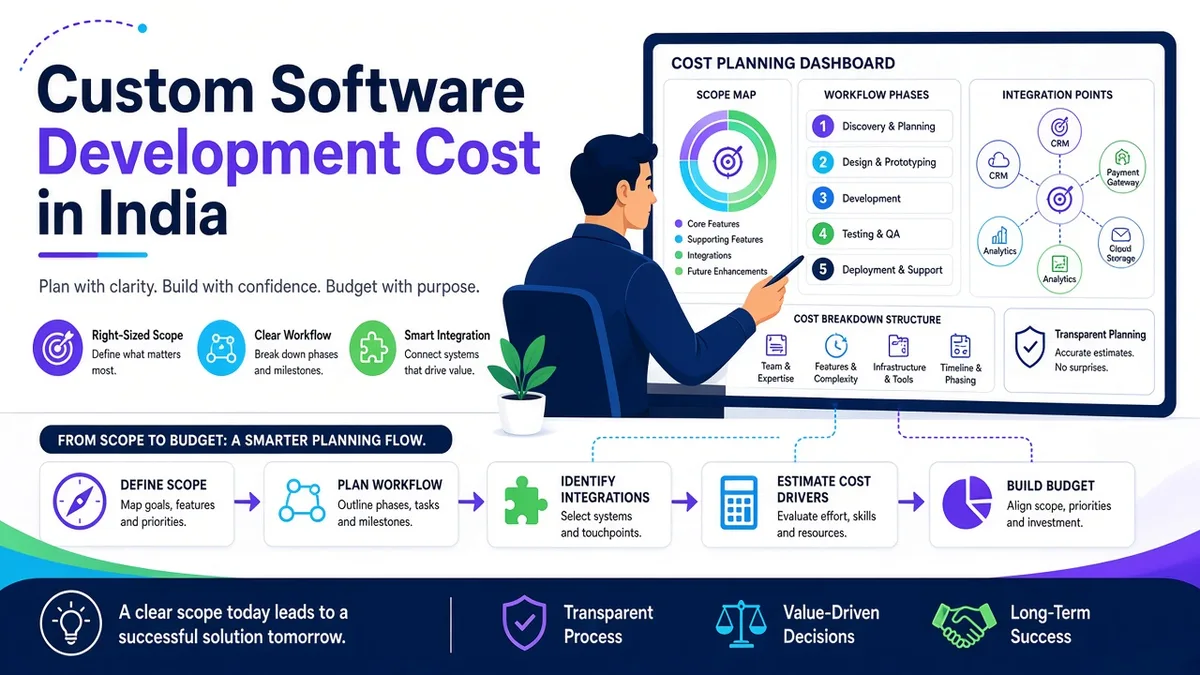 Articles
Custom software development cost in India
Learn what custom software costs in India, from MVPs to enterprise systems. See price ranges, cost factors and ways to save before you hire.
Learn more Articles
Custom software vs off-the-shelf software
Compare custom and off-the-shelf software on cost, speed, security and scalability. Use our checklist to decide what fits your business.
Learn more Articles
How to choose a custom software development company
Use this checklist to compare software vendors on experience, pricing, code ownership and support. Includes red flags and questions to ask.
Learn more