


Your sales team bought 400 portal leads last month. A third were never called back. Two executives blocked the same flat for two different buyers, and a channel partner is now arguing that a booking was "his" lead. Sound like your office? Then you've probably started asking about real estate CRM software development cost. And the quotes swing from ₹2 lakh to ₹40 lakh.
That gap isn't random. A broker's lead tracker and a builder's booking-to-collection system are very different products. In this guide you'll see indicative 2026 price ranges, the modules that move the budget, what channel partner portals and RERA add, how custom compares with subscription CRMs over three to five years, and the running costs after launch. You'll also get a checklist for comparing quotes.
- A broker CRM often costs ₹2 lakh to ₹5 lakh, while a builder CRM with inventory, bookings and payment plans usually needs ₹7 lakh to ₹15 lakh.
- Post-sales modules, channel partner rules and lead sources move the price more than the number of leads.
- Ready-made CRMs suit small teams; compare subscription and custom over five years, and set aside 15% to 25% of build cost a year for support.
What a Real Estate CRM Does and Who Needs a Custom One
A real estate CRM is the system your sales team lives in. It pulls enquiries from portals, ads, your website, missed calls and walk-ins into one list. It assigns each lead and reminds the executive to follow up. It books site visits and records what happened. For builders, it goes further. It handles unit blocking, booking, the payment plan and demand letters.
Brokers and builders need different things, and so does their real estate CRM software development cost. A CRM for real estate brokers is mostly about speed: fast replies, listing matches and a clean pipeline. A custom CRM for builders has to think in towers, floors and units, and it has to stop two people from selling the same flat. That second job is where most of the real estate CRM software development cost sits.
There's also a third kind. A property management CRM handles what happens after possession or for rental portfolios: tenants, rent reminders, maintenance requests and society billing. Some developers want sales and property management in one system. That's possible, but it adds scope and raises the real estate CRM software development cost by a module or two.
So who should build? If you're a small brokerage with a simple pipeline, a ready-made real estate CRM India product is usually cheaper and ready today. Custom makes sense when your units, payment plans and partner rules keep fighting the software you rent. You can see how we approach property businesses on our real estate software development page.
Real Estate CRM Software Development Cost in India: 2026 Ranges
Let's start with the number you came for. There's no single price, because "real estate CRM" can mean a lead list or a full sales-to-collections platform. Still, the 2026 guides published by Indian developers put real estate CRM software development cost into fairly steady bands.
Treat these as budgeting starting points, not quotes:
| Buyer profile | Typical scope | Indicative custom build cost (INR) | Typical timeline |
|---|---|---|---|
| Broker or small agency | Lead capture, assignment, follow-ups, site visits, listings, WhatsApp | ₹2 lakh to ₹5 lakh | 6 to 10 weeks |
| Single-project builder | Above plus unit inventory, blocking, cost sheets, booking form | ₹4.5 lakh to ₹9 lakh | 2 to 4 months |
| Developer with channel partners | Above plus payment plans, demand letters, partner portal, Tally sync, sales app | ₹7 lakh to ₹15 lakh | 3 to 5 months |
| Multi-project or multi-city developer | Above plus call centre, home loan tracking, customer portal, advanced reports | ₹12 lakh to ₹20 lakh or more | 5 to 8 months |
Takeaway: your real estate CRM software development cost depends far more on what happens after the site visit than on how many leads you get.

A few agencies quote ₹16 lakh to ₹40 lakh for similar scopes. That isn't always padding. It can mean a bigger team or a customer app bundled in. Ask what's included before you compare one real estate CRM software development cost estimate with another.
For context, the same vendors usually add about ₹2 lakh for a dedicated field app for sales staff. Hosting tends to run ₹5,000 to ₹15,000 a month for a typical builder setup, and yearly support is often 15% to 25% of the build price.
What Drives Real Estate CRM Software Development Cost?
Two builders with the same number of flats can get very different quotes. Here's what really moves real estate CRM software development cost.
Number of lead sources
Every source is a small integration. Your website form is easy. Meta and Google lead forms are well documented. Property portals like 99acres, MagicBricks and Housing.com depend on what your advertiser plan allows, and sometimes the only option is reading enquiry emails. Each extra source adds testing time and a little to the real estate CRM software development cost.
Units, towers and pricing rules
A plotted layout, a single tower and a mixed-use project all need different inventory screens. Floor rise, preferential location charges, parking, and GST on different parts of the price make cost sheets tricky. If your price list changes every launch phase, the system has to keep dated versions, and that logic adds to the real estate CRM software development cost.
Booking and post-sales depth
Booking forms, KYC uploads and allotment letters come first. Then come payment plans, demand letters, receipts and overdue reminders. Together they turn a CRM into something close to an ERP. This is the biggest single jump in real estate CRM software development cost.
Channel partners
A partner portal sounds simple. Then you add lead ownership windows, duplicate checks, brokerage slabs and TDS on payouts. Getting these rules right takes careful workshops, so budget time for them.
Mobile apps and telephony
Web apps that work on phones are cheaper than native apps. Cloud calling, call recording and click-to-call need a provider with an API. Each one is set up a little differently.
Reports and migration
Cost per lead and cost per booking by campaign are what owners really want. Moving old leads and bookings out of Excel also takes time. Messy data takes longer.
Takeaway: list your lead sources, project types and post-sales steps before you ask for quotes, because those three decide most of the price.
Custom CRM for Builders: Modules and What Each Adds
A modular build lets you start small and add pieces as sales grow. This table shows how each module usually affects the real estate CRM software development cost and who needs it first.
| Module | What it does | Effect on cost | Who needs it first |
|---|---|---|---|
| Lead capture and routing | Portals, ads, website, IVR and walk-ins in one list, auto-assigned | Low to medium | Everyone |
| Follow-ups and site visits | Call outcomes, reminders, visit booking, pickup, visit result | Low | Everyone |
| Listings and matching | Owner details, listing status, buyer-to-listing match | Low to medium | Brokers |
| Unit inventory and blocking | Towers, floors, units, price list, holds that expire | Medium | Builders |
| Booking and cost sheet | Application, KYC, allotment letter, PLC and floor rise | Medium | Builders |
| Payment plans and demands | Construction-linked schedules, demand letters, receipts | High | Builders with live projects |
| Channel partner portal | Partner sign-up, lead tagging, brokerage and TDS | Medium to high | Developers using brokers |
| Customer portal or app | Payment history, documents, construction updates | Medium to high | Larger developers |
| Reports and dashboards | Source-wise cost per booking, team response time, collections | Low to medium | Owners and sales heads |
Takeaway: start with capture, follow-ups and inventory, then add payment plans and portals once the team actually uses the basics.
Take a mid-sized builder in Lucknow with one project of 180 flats. Most of their pain is missed callbacks and double-blocked units. A first release with lead routing, site visits and live inventory fixes both. Demand letters can wait until the first construction milestone, which spreads the real estate CRM software development cost over two budgets instead of one.

Channel Partner Portals and Lead Ownership Rules
For many Indian developers, channel partners bring a big share of bookings. That's also where most sales disputes start. A broker says he sent the buyer. Your team says the buyer walked in. Nobody has proof.
A good partner module settles this with rules, not arguments. It's also one of the line items that quietly lifts real estate CRM software development cost, so it deserves its own discussion. The partner tags a lead with a phone number. The system checks for duplicates and gives the partner ownership for a fixed window, say 30 or 60 days. If the buyer books in that window, the brokerage is linked to the booking.
Payouts need their own logic. Brokerage slabs often differ by project, unit type or target. TDS has to be cut before payment. Partners also want to see their own leads and dues without calling your office. Each of these rules adds design and testing time to your real estate CRM software development cost, so write them down early.
Keep one thing in mind. A partner portal is only as good as your partner onboarding. Collect PAN, GST and RERA agent details at sign-up. Otherwise you'll chase them at payout time.
RERA, Data Protection and WhatsApp: Compliance Costs to Plan For
Compliance won't double your real estate CRM software development cost, but leaving it out of the first estimate leads to rework. Here's what to plan for.
RERA details the CRM should hold
The Real Estate (Regulation and Development) Act, 2016 requires projects to be registered and gives each registered agent a registration number that must be quoted in every sale they facilitate. Your CRM should store each project's RERA number and each partner's agent number, and print them on cost sheets and templates. It should also keep a dated record of the price list and payment plan shown to every buyer. State rules differ, so ask your legal adviser what each project needs.
Buyer data under the DPDP Act
Buyers share PAN, Aadhaar, bank details and income proofs. The Digital Personal Data Protection Act, 2023 expects you to collect consent, use data only for the stated purpose and protect it properly. In practice that means role-based access, encrypted documents, an access log and a way to delete or export a person's data. Plan these into your real estate CRM software development cost from the start.
WhatsApp Business messaging
Most Indian buyers prefer WhatsApp. Brochures, visit reminders and payment demands go out through the WhatsApp Business Platform. They use approved templates, and Meta charges per message. Check the current WhatsApp Business Platform pricing before you plan a big broadcast budget, because these fees sit outside your real estate CRM software development cost.

Ready-Made Real Estate CRM vs Custom Build: Which Costs Less Over Five Years?
Subscription CRMs are easy to start with. Published 2026 pricing in India ranges from under ₹1,000 per user a month for simple tools to ₹2,500 to ₹5,000 per user a month for full real estate suites, before 18% GST. Custom costs more upfront but has no per-seat fee, so real estate CRM software development cost is mostly a one-time number.
Here's how the two compare on the things that matter:
| Factor | Ready-made CRM (SaaS) | Custom real estate CRM |
|---|---|---|
| Upfront cost | Low; setup fees vary | ₹2 lakh to ₹20 lakh, depending on scope |
| Yearly cost | Grows with every user you add | Hosting plus about 15% to 25% of build cost |
| Go-live | Days to a few weeks | Two to eight months |
| Fit with your process | You adapt to the product | The product adapts to you |
| Units and payment plans | Good in real estate suites, limited in generic CRMs | Built around your projects |
| Ownership | You rent access; export terms vary | You own code and data if the contract says so |
Takeaway: buy when your team is small and your process is standard, and consider custom once seats, units and partner rules start piling up.
Now a worked example. These figures are illustrations built on published prices, not quotes. Assume a subscription suite at ₹2,599 per user a month, which is one vendor's published module price. For custom, assume a ₹10 lakh developer CRM, ₹1 lakh a year hosting and ₹2 lakh a year support from year two.
| Team size | SaaS over 3 years | Custom over 3 years | SaaS over 5 years | Custom over 5 years |
|---|---|---|---|---|
| 15 users | About ₹14 lakh | About ₹17 lakh | About ₹23.4 lakh | About ₹23 lakh |
| 40 users | About ₹37.4 lakh | About ₹17 lakh | About ₹62.4 lakh | About ₹23 lakh |
Takeaway: for a small team the two cost about the same over five years, but every extra seat tilts the math toward custom.
That's why the real estate CRM software development cost question is really a team-size question. Our guide on custom vs off-the-shelf software walks through the same decision for other kinds of business systems.
Running Costs Beyond Real Estate CRM Software Development Cost
Your real estate CRM software development cost is only part of the picture. Plan for these from day one:
- Hosting and backups: often ₹5,000 to ₹15,000 a month, more with call recordings and document storage
- WhatsApp and SMS: per-message fees from your provider, which grow with campaign volume
- Cloud telephony: virtual numbers, IVR and call minutes from your telephony vendor
- Portal subscriptions: your 99acres, MagicBricks or Housing.com plan, which the CRM can't replace
- Support and updates: commonly 15% to 25% of the build cost a year
- Training: new sales hires every quarter need onboarding
Adoption is the cost people forget, and it can waste the whole real estate CRM software development cost. If executives keep working from their phone's notes app, you've paid for a CRM nobody uses. Keep the mobile screens fast and simple, and tie incentives to bookings recorded in the system.
Hosting choices matter too. A well-planned cloud application setup in an Indian region keeps buyer data in the country and scales smoothly during a launch weekend.
How Long a Custom Real Estate CRM Takes to Build
Most teams don't need everything on day one, and a big-bang launch inflates real estate CRM software development cost. A phased plan gets leads under control fast and leaves heavier modules for later.
Here's a typical rollout for a builder with channel partners:
| Phase | What goes live | Typical duration |
|---|---|---|
| 1. Discovery | Lead source audit, sales stages, unit data, partner rules | 2 to 3 weeks |
| 2. Lead core | Capture, routing, follow-ups, site visits, WhatsApp templates | 5 to 8 weeks |
| 3. Inventory and booking | Units, blocking with expiry, cost sheets, booking form | 4 to 6 weeks |
| 4. Post-sales | Payment plans, demand letters, receipts, Tally sync | 4 to 6 weeks |
| 5. Partners and extras | Partner portal, customer portal, sales app, advanced reports | As needed |
Takeaway: a phased rollout spreads your real estate CRM software development cost across months and lets the team learn one change at a time.

Plan for a short parallel run. Keep your old sheet or CRM alive for two to four weeks while the team moves over. That's when you catch missing lead sources and odd pricing rules. Better then than on a launch weekend. If your field team needs an app of their own, our mobile app development team can build it in a later phase.
Choosing a CRM Partner and Avoiding Costly Mistakes
Pick a team that asks about your sales process before it talks about technology or real estate CRM software development cost. A good partner wants to see your lead sheet, your cost sheet format and a sample demand letter in the first meeting.
Ask for examples of unit inventory or booking systems they've built. Ask how they stop double blocking and how holds expire. Their answers tell you more than a slide deck. Our CRM development services page shows what a scoped CRM project should include.
Here are the mistakes that push real estate CRM software development cost up most often:
Common mistakes to avoid
- ✗ Building ERP-sized scope in the first release
- ✗ Letting units be blocked without an expiry time
- ✗ No clear lead ownership window for channel partners
- ✗ Skipping data migration until the last week
- ✗ Ignoring the mobile experience for site staff
- ✗ Choosing on price alone without checking support terms
Get these in writing before you sign:
Quick checklist
- ☐ A module-wise scope
- ☐ A list of integrations and who pays for each
- ☐ Milestone-based payments
- ☐ Who owns the source code
- ☐ How you can export your data
- ☐ Warranty length
- ☐ Yearly support terms
A partner who tells you what not to build first is worth more than one who says yes to everything.

Get a Module-Wise Real Estate CRM Estimate
If you are ready to turn your sales process into a scoped first release, start with your lead sources, projects and unit counts, payment plans and channel partner rules. A short brief like that gives any qualified team enough context to give you an honest, like-for-like quote.
Conclusion: Budget for the Sales Team You'll Have in Three Years
Real estate CRM software development cost in India usually runs from about ₹2 lakh for a broker's lead system to ₹15 lakh or more for a developer platform with bookings, payment plans and a partner portal. Your lead sources, unit rules and post-sales steps decide where your real estate CRM software development cost will land.
Start with the problem that costs you money today. It might be missed callbacks, double-blocked units or brokerage disputes. Fix it in a first release, then add modules as projects and team size grow. Compare subscription and custom over five years, not five months.
Want a clear, module-wise estimate for your project or brokerage? Talk to the Softfix team and we'll help you scope a CRM that fits your budget and the way your team sells.
Keep reading: Custom software development cost in India · How to choose a custom software development company · AI in custom software development
Related articles
 Industries
Real Estate
Modernize property management with Softfix real estate software solutions. Build custom property platforms, automate workflows and simplify real estate operations.
Learn more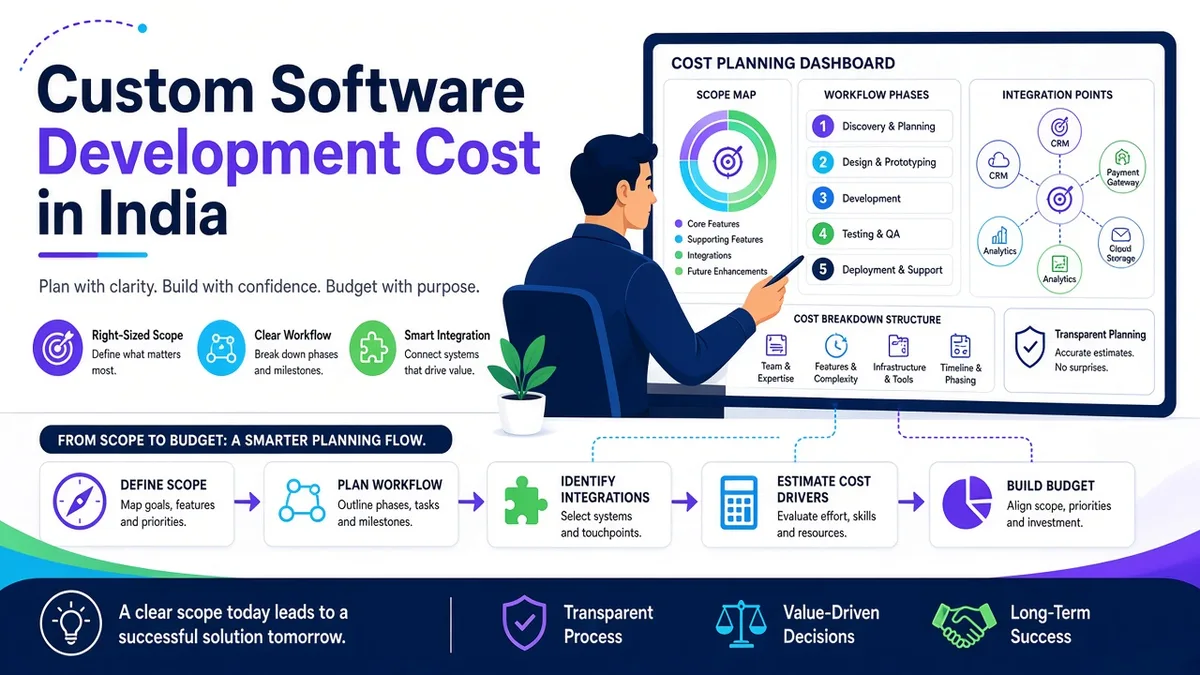 Articles
Custom software development cost in India
Learn what custom software costs in India, from MVPs to enterprise systems. See price ranges, cost factors and ways to save before you hire.
Learn more Articles
Custom software vs off-the-shelf software
Compare custom and off-the-shelf software on cost, speed, security and scalability. Use our checklist to decide what fits your business.
Learn more Articles
How to choose a custom software development company
Use this checklist to compare software vendors on experience, pricing, code ownership and support. Includes red flags and questions to ask.
Learn more