


You have an idea, a rough budget and a lot of conflicting quotes. One agency says $8,000. Another says $120,000. A freelancer says "it depends." So what is the real cost to build an MVP in 2026? For most software products, a launch-ready first version costs somewhere between $15,000 and $80,000. The exact number depends on scope, platforms, integrations and who builds it.
This guide is for founders, product owners and business teams who want a clear budget before they talk to vendors. You'll see price ranges by MVP type, the factors that move the number, what the same product costs with teams in different regions, a week-by-week timeline, the costs that show up after launch and the red flags to watch for in quotes.
- Most launch-ready software MVPs cost about $15,000 to $80,000 in 2026. A clickable prototype costs far less, and marketplaces or AI products cost more.
- Scope sets the hours and the team's location sets the rate. The same 600 to 900 hour MVP can cost $15,000 with an India team or $150,000 with a US agency.
- Keep 30% to 50% of the budget for the months after launch, and compare quotes only on the same written scope.
What an MVP Is (and What It Is Not)
A minimum viable product, or MVP, is the smallest working version of your product that real users can use to solve one real problem. The Lean Startup method places the MVP at the start of a build, measure and learn loop. You build something small, watch how people use it and decide what to do next. You can read the idea in its original form on the Lean Startup principles page.
An MVP is not a cheap version of your full product. It is a learning tool. That difference matters, because it changes the cost to build an MVP more than any hourly rate. Here is how an MVP compares with the things people often confuse it with.
| Stage | What it is | Typical goal |
|---|---|---|
| Clickable prototype | Designed screens with no real backend | Test the idea and the flow with users and investors |
| Proof of concept (PoC) | A small technical test of one risky part | Prove that something hard can be built |
| MVP | Working software with real users and real data | Prove that people will use it, and ideally pay |
| Version 1 product | A fuller product with more roles and polish | Grow and keep customers |
Takeaway: decide which stage you actually need before you price anything. The cost to build an MVP is far higher than the cost of a prototype, and many founders pay for a version 1 product when a prototype or a lean MVP would answer their main question.
Why does this matter so much? CB Insights studied 431 VC-backed startups that shut down since 2023. Poor product-market fit was named in 43% of those failures, behind running out of capital at 70% (CB Insights, 2026). An MVP exists to test product-market fit early, before you spend the larger budget. Seen that way, the cost to build an MVP is the price of an answer, not the price of a product.
Cost to Build an MVP by Product Type
The type of product sets the starting point. A simple internal tool has fewer screens, fewer users and fewer rules than a two-sided marketplace. The cost to build an MVP rises with every extra user role, payment flow and platform.
Use the planning ranges below as a starting point for 2026. They assume a small, experienced team and a tightly scoped first release. These are estimates based on typical hours and market rates, not fixed quotes.
| MVP type | Typical scope | Planning range (USD) | Typical timeline |
|---|---|---|---|
| Clickable prototype | 10 to 25 designed screens, no backend | $3,000 to $10,000 | 2 to 4 weeks |
| Internal tool or dashboard | One user type, forms, reports, login | $10,000 to $30,000 | 4 to 8 weeks |
| SaaS web app | Sign-up, subscriptions, core workflow, admin | $25,000 to $60,000 | 8 to 14 weeks |
| Mobile app (iOS and Android) | Cross-platform app, backend, push alerts | $30,000 to $80,000 | 10 to 16 weeks |
| Marketplace | Buyers, sellers, listings, payments, reviews | $50,000 to $120,000 | 12 to 20 weeks |
| AI-powered MVP | One AI feature at the core, with testing | $35,000 to $100,000 | 10 to 16 weeks |
Takeaway: the cost to build an MVP for a marketplace is often two to four times the cost of a single-user web app, because you are building two products and the rules between them.
A few notes on these ranges, since each type changes the cost to build an MVP in its own way. A clickable prototype is often the best first spend if you are still testing demand. A SaaS MVP needs billing and account management from day one, which adds work most founders forget. Mobile apps cost more because of app store rules, device testing and release steps. For a deeper look at SaaS builds, see our SaaS product development services.

What Drives the Cost to Build an MVP
Every MVP quote is really hours multiplied by a rate. The hours come from scope. The rate comes from the team. If you understand what adds hours, you can control the cost to build an MVP before you sign anything.
These are the six biggest drivers:
- Features. Each screen and workflow needs design, frontend, backend and testing. One "small" feature can add 40 to 120 hours.
- Platforms. Web only is the cheapest. Adding iOS and Android adds scope, even with a cross-platform framework.
- Integrations. Payments, maps, email, calendars, CRMs and accounting tools each add setup, error handling and testing.
- Design. A custom design system costs more than a proven UI kit. For an MVP, a clean kit is usually enough.
- AI and data. Model calls, data pipelines and accuracy testing add real work. Reliable AI features take longer than demos suggest.
- Team location and seniority. The same hours cost very different amounts in different regions.
The next table shows how common features add to the cost to build an MVP. Use it to see where a quote's hours are going.
| Feature | What it involves | Typical extra hours | Approx. extra cost at $50/hour |
|---|---|---|---|
| Sign-up and login with roles | Email, social login, password reset, permissions | 40 to 80 | $2,000 to $4,000 |
| Payments or subscriptions | Stripe or similar, plans, invoices, failed payments | 60 to 140 | $3,000 to $7,000 |
| In-app chat or messaging | Real-time messages, alerts, history | 80 to 160 | $4,000 to $8,000 |
| Admin panel | Manage users, content, orders and reports | 60 to 150 | $3,000 to $7,500 |
| Search and filters | Keyword search, filters, sorting | 40 to 100 | $2,000 to $5,000 |
| One AI feature | Prompting, guardrails, evaluation set | 80 to 200 | $4,000 to $10,000 |
Takeaway: payments, messaging and AI features are the most expensive single additions. If one of them is not central to your test, leave it for version two.

MVP Cost by Team Location
Who builds your product changes the price more than almost anything else. Hourly rates vary widely by country. Clutch's 2026 pricing guide says most web development agencies listed on its platform charge $25 to $49 an hour, though rates vary by region and expertise (Clutch). For context, the US Bureau of Labor Statistics puts the 2025 median pay for software developers, QA analysts and testers at $64.44 an hour, before any agency overhead or margin (BLS).
Here is what the cost to build an MVP of about 600 to 900 hours might look like with teams in different regions. These are planning estimates based on typical agency rate bands. Rupee figures use a rate of roughly ₹93 to the dollar (November 2026) and are for comparison only.
| Team location | Typical agency rate (USD/hour) | Same MVP, 600 to 900 hours | Rough INR comparison |
|---|---|---|---|
| US or Canada agency | $100 to $165 | $60,000 to $150,000 | About ₹56 lakh to ₹1.4 crore |
| Western Europe | $75 to $120 | $45,000 to $110,000 | About ₹42 lakh to ₹1 crore |
| Eastern Europe | $50 to $85 | $30,000 to $75,000 | About ₹28 lakh to ₹70 lakh |
| India team | $25 to $50 | $15,000 to $45,000 | About ₹14 lakh to ₹42 lakh |
Takeaway: location changes the cost to build an MVP, but a lower rate only saves money if the team is senior and the scope is clear. A cheap team that needs twice the hours costs the same, and takes longer.
Many founders now mix models to keep the cost to build an MVP down without losing control. Product ownership and user research stay close to the market, while design and engineering sit with an offshore team. Softfix works this way, with a Toronto office for planning calls and a delivery team in India. If you are comparing regions, our guides to custom software development cost in India and hiring a dedicated development team in India go deeper on rates and contracts.

How Long It Takes to Build an MVP
Time and cost move together, because both come from hours. Timeline is the other half of the cost to build an MVP. A focused web MVP with a team of three to five people usually takes 8 to 16 weeks from kickoff to launch. A prototype can be ready in two to four weeks. A marketplace or a mobile app with complex rules can take longer.
Here is a typical plan for a standard MVP:
- Discovery (weeks 1 to 2). This short phase has the biggest effect on the cost to build an MVP. Agree on the problem, the users, the one core flow and what success looks like. Write user stories and a scope list.
- Design (weeks 2 to 4). Wireframes, then clickable screens. Test them with five to ten target users before coding.
- Build (weeks 4 to 12). Backend, frontend and integrations in one or two week sprints, with a demo at the end of each.
- Testing (weeks 10 to 14). Functional, device and basic security testing, plus fixes. Testing overlaps with the last build sprints.
- Launch (weeks 12 to 16). Deploy to production, set up analytics and error tracking, and release to the first users.
The biggest time risk is not coding. It is slow decisions. When feedback on designs takes two weeks instead of two days, the whole timeline moves, and so does the cost to build an MVP if you are paying by the hour.

A Sample Budget: Cost to Build an MVP for a SaaS App
Ranges are useful, but a worked example shows where the money goes. Imagine a simple SaaS tool for small clinics to book and remind patients. It has one admin user type, one staff user type, online booking, SMS reminders, Stripe subscriptions and a basic report. It runs on the web only.
Here is how a small team might split the hours for this MVP. The rate used is $40 an hour, a common blended rate for an experienced offshore team. Your own numbers will differ, but the shape of the budget is typical.
| Phase | Work included | Hours | Cost at $40/hour |
|---|---|---|---|
| Discovery and scope | Workshops, user stories, scope list, risks | 40 | $1,600 |
| UX and UI design | Wireframes, clickable screens, user tests | 80 | $3,200 |
| Backend and database | Accounts, bookings, roles, reminders, APIs | 220 | $8,800 |
| Frontend | Booking pages, staff screens, admin panel | 180 | $7,200 |
| Integrations | Stripe billing, SMS provider, email | 80 | $3,200 |
| Testing and fixes | Functional, browser and basic security tests | 100 | $4,000 |
| Project management and launch | Sprints, demos, deployment, analytics | 60 | $2,400 |
| Total | 760 | $30,400 |
Takeaway: design, testing and project management make up close to a third of the hours in this example. A quote that leaves them out is not cheaper. It just moves the risk to you.
The same 760 hours would cost roughly $76,000 to $125,000 with a US agency at $100 to $165 an hour. That is why the cost to build an MVP for the same idea can look so different from one vendor to the next. When you get quotes, ask each vendor for an hours split like this one. It makes the cost to build an MVP easy to compare and shows you which phases a cheap quote has quietly skipped.
How to Lower the Cost Without Losing Quality
You can reduce the cost to build an MVP a lot without making a weak product. The trick is to cut scope, not quality. A smaller product that works well teaches you more than a large one full of bugs.
Before you ask for quotes, run through this list. Each item can cut the cost to build an MVP by days or weeks of work:
Quick checklist
- ☐ Write down the one problem your MVP must solve, in one sentence.
- ☐ List every feature, then mark each one "must have for the test" or "later."
- ☐ Pick one platform first, usually web, unless your users only use phones.
- ☐ Use proven services for login, payments, email and hosting instead of custom code.
- ☐ Start with a ready UI kit and add custom design later.
- ☐ Do some tasks by hand at first, such as approvals or matching, before you automate them.
- ☐ Agree on a fixed scope and a change process before the build starts.
- ☐ Make sure the code, accounts and data are in your name from day one.
Two other choices help. First, consider whether you need custom code at all. A no-code tool or an off-the-shelf product may be enough to test demand, and our guide on custom vs off-the-shelf software can help you decide. Second, choose a stack your next team can maintain. A popular framework keeps future hiring simple and keeps the long-term cost to build an MVP and grow it under control.
Red Flags in MVP Quotes
Quotes for the same idea can differ by five times or more. Some of that is rate. Much of it is risk. A low headline number can hide a high real cost to build an MVP. Here are the mistakes and warning signs to watch for when you compare offers:
Common mistakes to avoid
- ✗ A fixed price given before anyone has asked about your users, flows or integrations.
- ✗ No discovery or scoping phase in the plan.
- ✗ No line for testing, or testing squeezed into the last week.
- ✗ Vague scope, such as "user management" or "admin features," with no detail.
- ✗ The vendor keeps the code repository, cloud account or app store account in its own name.
- ✗ No mention of who owns the source code and design files.
- ✗ No weekly demo or progress report.
- ✗ Pressure to add features "while we are at it."
- ✗ A very low price paired with a very long timeline, which often means junior staff.
A good partner pushes back on scope. They ask what you are trying to learn and suggest what to cut. For a full process, read our guide on how to choose a custom software development company. Comparing quotes on the same scope is the only fair way to judge the cost to build an MVP.
Get a Clear MVP Estimate
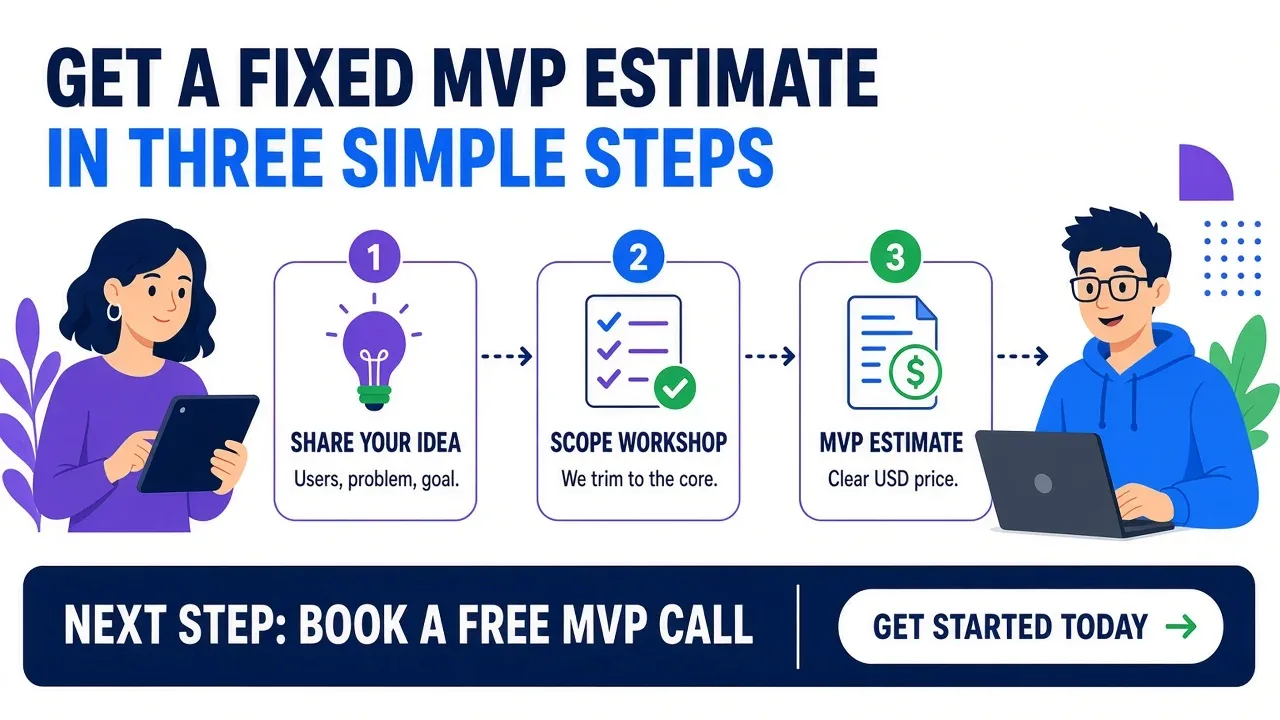
If you are ready to price your idea, start with a short brief: the problem you solve, who your first users are, the one core flow they need, the platforms you want and any launch date or budget limit. Add links to products you like. That is enough for a serious team to suggest a lean scope, a timeline and a USD estimate.
Conclusion: Budget for Learning, Not for Features
The cost to build an MVP in 2026 usually falls between $15,000 and $80,000 for a launch-ready product, with prototypes much lower and marketplaces or AI products higher. Scope drives most of that number. Platforms, integrations and team location decide the rest. Add 30% to 50% for the months after launch, because that is when your real learning starts.
In practice, the smartest way to control the cost to build an MVP is to be clear about what you want to learn, build only what tests it and pick a team that will tell you what to cut. If you want a second opinion on your scope or a clear USD estimate, our software development team can review your idea and map it to a lean first release.
Keep reading: Custom software development cost in India · Hire a dedicated development team in India · How to choose a custom software development company · SaaS development cost · Cost to build a marketplace app · How to hire an offshore development team
Related articles
 Articles
Custom software development cost in India
Learn what custom software costs in India, from MVPs to enterprise systems. See price ranges, cost factors and ways to save before you hire.
Learn more Articles
Custom software vs off-the-shelf software
Compare custom and off-the-shelf software on cost, speed, security and scalability. Use our checklist to decide what fits your business.
Learn more Articles
How to choose a custom software development company
Use this checklist to compare software vendors on experience, pricing, code ownership and support. Includes red flags and questions to ask.
Learn more Articles
AI in custom software development
See where AI adds real value in custom software, from chatbots to automation. Learn costs, risks and how to start with a small pilot.
Learn more