


You have a marketplace idea, a few sellers who say they will join, and quotes that range from a $10,000 script to a $400,000 platform. This guide explains the cost to build a marketplace app in 2026 in plain US dollars, so you can see why those numbers are so far apart. In short, a focused two-sided marketplace MVP often costs $50,000 to $120,000, a full marketplace with mobile apps $120,000 to $250,000, and a multi-vendor platform at scale $250,000 to $500,000 or more.
You'll see what drives the price, cost by stage and by marketplace type, what split payments and payouts really cost, the price of trust, reviews and search, team rates by region, and running costs after launch. It is written for founders and product teams in the US, Canada, the UK and Europe.
- A focused marketplace MVP often costs $50,000 to $120,000, a full marketplace with mobile apps $120,000 to $250,000 and a scale platform $250,000 to $500,000 or more (planning estimates).
- Money flow and trust drive the price. Use a payments platform such as Stripe Connect for split payments and payouts instead of moving money with custom code.
- Plan for running costs too: payment fees of about 3% to 5% of sales, hosting that grows with use and upkeep of about 15% to 25% of the build each year.
What Goes Into the Cost to Build a Marketplace App
A marketplace is not one app. It is at least three products that share one backend. Buyers need to search, compare, book or buy, and pay. Sellers need to sign up, list items or services, manage orders and get paid. Your team needs an admin panel to approve sellers, handle refunds, settle disputes and set fees.
That is why the cost to build a marketplace app is higher than the cost of a normal shopping app with the same number of screens. You are building two user journeys, plus the rules between them. Who gets paid, when, and how much? What happens when an order goes wrong? How do buyers trust a seller they have never met?
Platforms matter too. A web-only first version keeps the cost to build a marketplace app lower, because you design and test one front end instead of three. Many teams start on the web for sellers and add mobile apps for buyers once trades pick up. Good marketplace app development partners will ask about this choice early.
Here is how the main drivers affect the cost to build a marketplace app, from the factors that move the price most to those that move it least.
| Cost driver | What it covers | Effect on the budget |
|---|---|---|
| Number of apps and platforms | Buyer app, seller app or portal, admin panel, web, iOS, Android | High: each extra app adds design, code and testing |
| Money flow | Split payments, holds, refunds, payouts, platform fees | High: more rules mean more edge cases |
| Trust and safety | Seller checks, reviews, messaging, disputes, moderation | Medium to high, depending on risk in your niche |
| Search and matching | Filters, maps, availability, ranking | Medium: simple filters are cheap, smart matching is not |
| Team region and seniority | Hourly rate and skill mix | High: the same scope can cost 2 to 4 times more onshore |
| Integrations | Shipping, calendars, tax, accounting, CRM | Low to medium per integration |
Takeaway: the number of apps and the way money moves between buyers, sellers and you set most of the cost to build a marketplace app. Trust and search decide whether people use it.
Cost to Build a Marketplace App by Stage
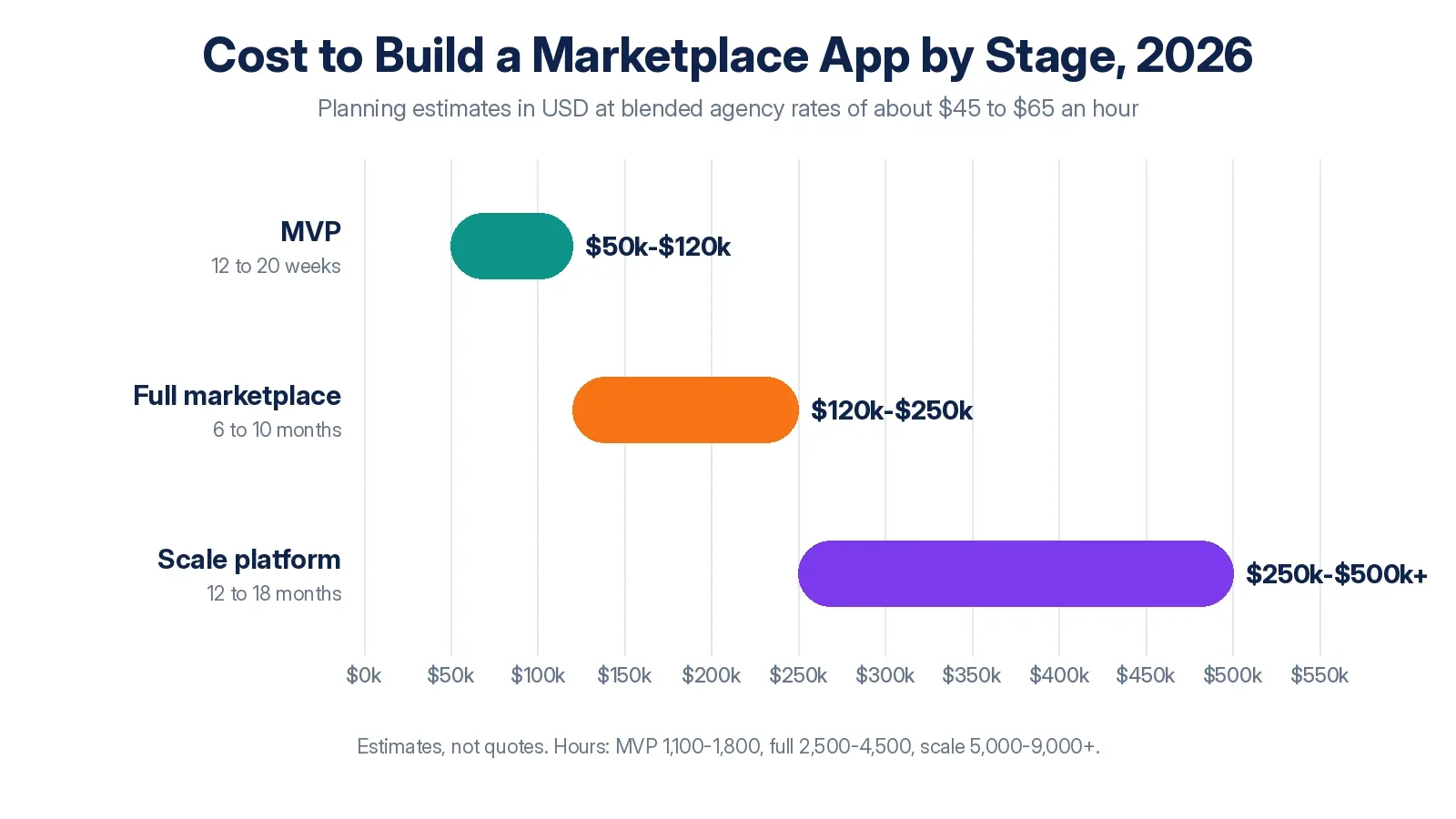
The clearest way to plan the cost to build a marketplace app is by stage. Each stage answers a different question. An MVP tests whether both sides show up and trade. A full marketplace is something you can grow city by city or niche by niche. A scale platform serves many sellers, markets and currencies.
Our planning ranges are below. They are estimates, not quotes. We worked them out from typical hours for each stage and blended agency rates of about $45 to $65 an hour. That sits a little above the $25 to $49 band most firms list in Clutch's software development pricing guide, because a marketplace needs senior payment and backend work.
| Stage | Typical hours (estimate) | Cost to build a marketplace app (USD, estimate) | Timeline | Usually includes |
|---|---|---|---|---|
| MVP | 1,100 to 1,800 | $50,000 to $120,000 | 12 to 20 weeks | Web or one cross-platform app, listings, search, split payments, reviews, basic admin |
| Full marketplace | 2,500 to 4,500 | $120,000 to $250,000 | 6 to 10 months | iOS, Android and web, seller dashboard, messaging, ID checks, disputes, booking or shipping |
| Scale platform | 5,000 to 9,000+ | $250,000 to $500,000+ | 12 to 18 months, staged | Multi-vendor carts, many currencies, seller ads, public API, fraud tools |
The MVP row matches the marketplace line in our guide to the cost to build an MVP, which covers MVP scoping in more depth. The biggest jump in the cost to build a marketplace app comes between MVP and full marketplace, because native apps, ID checks and dispute tools tend to arrive together. Most marketplaces do not jump to scale in one go. They launch in one city or niche, learn what sellers and buyers need, and then fund the next stage.
Takeaway: fund the MVP first and prove that real trades happen. Use those numbers to plan the next stage of the cost to build a marketplace app.
Cost by Marketplace Type: Products, Services and Rentals
What people trade changes the cost to build a marketplace app as much as the stage. A product marketplace needs stock, shipping and returns. A service marketplace needs bookings, quotes and proof that work was done. A rental marketplace needs calendars, deposits and damage claims. Business-to-business (B2B) marketplaces add quotes, invoices and payment terms.
This table compares the cost to build a marketplace app MVP by type. Each range is our estimate for a focused first version with one buyer app or web app, a seller portal and an admin panel.
| Marketplace type | Examples of the model | Features that add cost | MVP budget (USD, estimate) |
|---|---|---|---|
| Products (multi-vendor store) | Handmade goods, used electronics, local shops | Multi-seller cart, shipping rates, stock, returns | $50,000 to $110,000 |
| Services | Tutors, cleaners, freelancers, repairs | Booking calendar, quotes, milestones, held payments | $55,000 to $120,000 |
| Rentals | Equipment, cars, spaces, homes | Availability calendar, deposits, ID checks, damage claims | $60,000 to $130,000 |
| B2B | Wholesale, industrial parts, suppliers | Request for quote, bulk pricing, invoices, net terms | $70,000 to $150,000 |
| On-demand delivery | Food, groceries, couriers | Live tracking, dispatch, driver app | See our food delivery guide |
On-demand delivery is a marketplace too, but it adds a driver app and live dispatch. We price that model separately in our guide to food delivery app development cost, so we don't repeat it here.
Takeaway: pick your type before you ask for quotes. Rentals and B2B raise the cost to build a marketplace app because every booking or order carries more rules and more money at risk.
Split Payments, Payouts and Fees
Payments are the hardest part of any marketplace. You take money from a buyer, keep your fee, and send the rest to a seller, sometimes days later. Doing this yourself can bring licensing and compliance work, so most marketplaces use a platform built for it, such as Stripe Connect, Adyen for Platforms or PayPal. Building on one of these is a big part of keeping the cost to build a marketplace app under control.
Stripe publishes its Connect fees on its Connect pricing page. In the model where your platform sets its own prices for sellers, the page lists the fees below. Card payments on the same page start at 2.9% plus 30 cents per successful charge. These are Stripe's US list prices as we read them on 25 November 2026, so check the page for your country.
| Stripe Connect item ("you handle pricing" model) | Listed fee |
|---|---|
| Monthly active account (paid out that month) | $2 per account |
| Payout to a seller's bank or debit card | 0.25% + 25¢ per payout |
| Instant Payouts | 1% of payout volume |
| Cross-border payouts | Starting at 0.25% of payout volume |
| US 1099 tax forms | $2.99 per form e-filed with the IRS, $1.49 per state e-file |
Here is a worked example, using those list prices and our own maths. Say your marketplace handles $200,000 a month across 4,000 orders of $50, with 500 active sellers paid weekly. Card fees come to about $7,000. Payouts cost about $925, and active accounts $1,000. That is roughly $8,925, or about 4.5% of sales. A 15% commission earns $30,000, so about $21,000 is left for everything else.
This is why fee maths belongs in your plan for the cost to build a marketplace app from day one. The payment work itself, with holds, refunds and failed payouts, often takes 150 to 300 hours, by our estimates.
There is a second rule that matters for mobile apps. Apple's App Review Guidelines (section 3.1.3(e)) say apps that sell physical goods or services used outside the app must use payment methods other than in-app purchase, such as Apple Pay or card entry. That suits most product, service and rental marketplaces.
Takeaway: use a payments platform, not custom money movement. Model fees against your take rate before you launch, because payout timing and fees change your margin.

Trust, Reviews and Search: The Hidden Build
Buyers will not pay a stranger unless they trust the platform. Sellers will not list unless buyers can find them. That makes trust and search a large share of the cost to build a marketplace app, even though they rarely appear on a first feature list.
Trust features include seller sign-up checks, reviews in both directions, in-app messaging, reporting tools, and a way to handle refunds and disputes. Payment platforms help here. Stripe Connect, for example, lists risk-based KYC (know your customer) checks and hosted onboarding as included. Your team still has to build the screens, rules and admin tools around them, and that work counts toward the cost to build a marketplace app.
This table shows our hour estimates for the main trust and search features in a first version.
| Feature | Hours (estimate) | Cost at $55/hour (estimate) | Needed in an MVP? |
|---|---|---|---|
| Seller onboarding with hosted ID and payout setup | 40 to 90 | $2,200 to $5,000 | Yes |
| Reviews and ratings, both directions | 60 to 120 | $3,300 to $6,600 | Usually |
| Messaging with basic moderation | 100 to 180 | $5,500 to $9,900 | Usually |
| Refund and dispute center | 120 to 220 | $6,600 to $12,100 | Simple version |
| Search with filters and sorting | 80 to 180 | $4,400 to $9,900 | Yes |
| Map or location search | 60 to 120 | $3,300 to $6,600 | Only for local markets |
Search starts simple. Keyword search and a few filters are enough for most MVPs. Ranking by quality, personal suggestions or AI matching can wait until you have enough listings and data.
Takeaway: budget about a quarter of the cost to build a marketplace app MVP for trust and search. Cutting them saves money on paper but often stops the first trades from happening.
Team Region and Timeline
Where your team is based changes the cost to build a marketplace app more than almost any single feature. The same 3,000-hour full marketplace can cost under $150,000 with an offshore agency, or close to $500,000 with a US agency. Agency rates include management, testing, tools and profit, so they sit above a developer's salary.
The table below shows how region changes the cost to build a marketplace app for one example, a 3,000-hour full marketplace, at typical agency rates. The rates come from our guide to offshore software development rates by country, and the totals are estimates.
| Team region | Typical agency rate (USD per hour) | 3,000-hour full marketplace (USD, estimate) | Working-hours overlap with US East |
|---|---|---|---|
| India | $20 to $50 | $60,000 to $150,000 | Low, needs a planned overlap window |
| Eastern Europe | $30 to $65 | $90,000 to $195,000 | 1 to 2 hours |
| Latin America | $30 to $65 | $90,000 to $195,000 | 6 to 7 hours |
| Western Europe or UK | $60 to $110 | $180,000 to $330,000 | 2 to 3 hours |
| US or Canada | $85 to $165 | $255,000 to $495,000 | Full day |
A lower rate only cuts the cost to build a marketplace app if the work is good. Weak teams lose their savings through rework in payments, payouts and edge cases that only show up with real users.
Timeline follows hours. An MVP with a team of four to six people usually takes 12 to 20 weeks. A full marketplace takes six to ten months, and a scale platform a year or more, often in stages. Cross-platform tools such as Flutter app development can cut both time and cost when you need iOS and Android apps for buyers and sellers. If you plan to hire abroad, our guide on how to hire an offshore development team explains how to vet one.
Takeaway: compare the total cost for the same scope, not the hourly rate alone. An offshore team with real marketplace experience often gives the best value for a first version.

Running Costs After Launch
Launch day is not the end of the bill. After launch you pay for hosting, payment fees, email and text messages, maps or search tools, app store accounts and ongoing development. You also pay people to approve sellers, answer support tickets and settle disputes. Plan for these when you set the cost to build a marketplace app, not after.
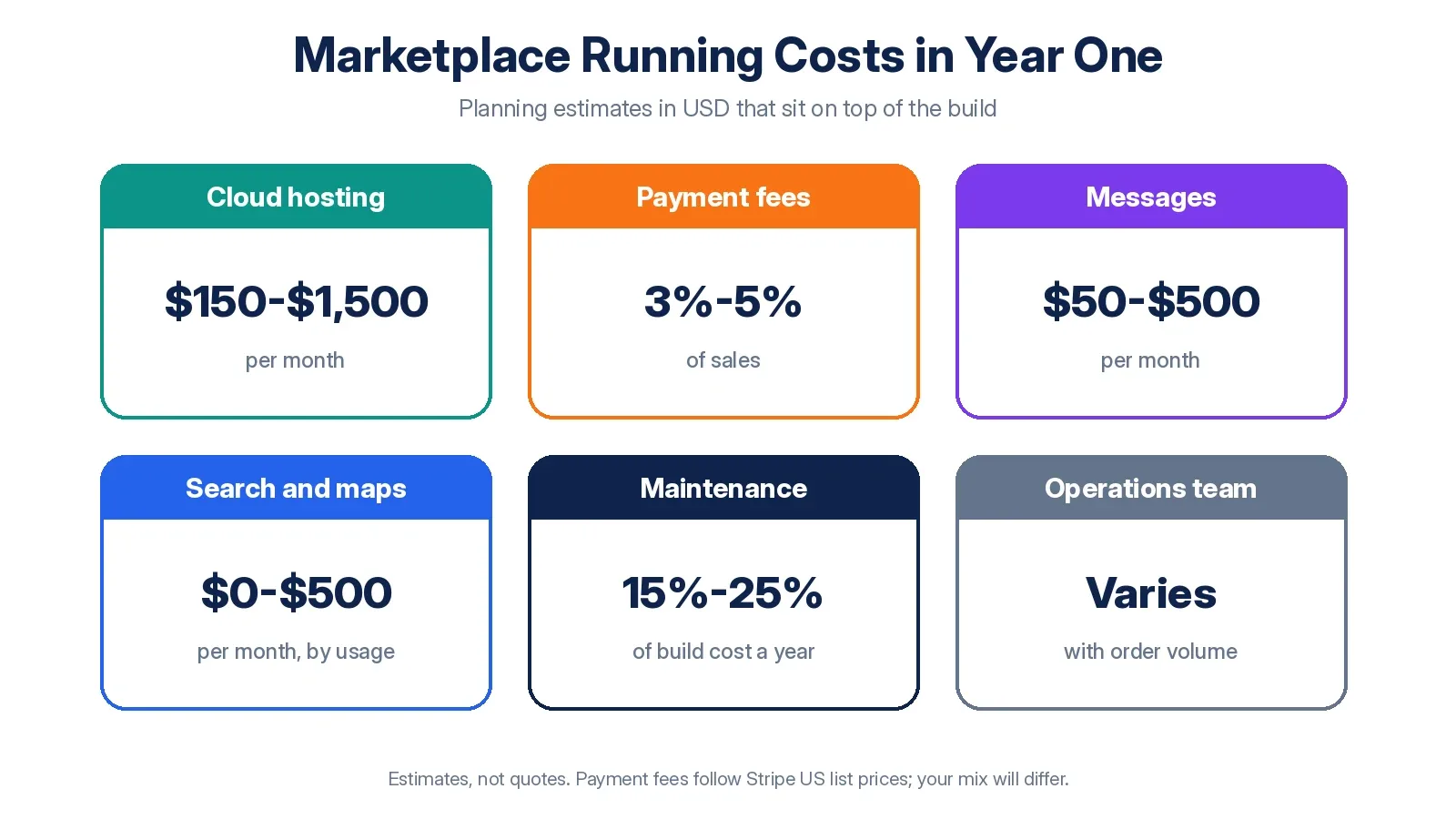
Here is a typical monthly picture for a marketplace in its first year. All figures are our planning estimates, except payment fees, which follow the Stripe example above.
| Running cost | What it covers | Typical first-year cost (USD, estimate) |
|---|---|---|
| Cloud hosting | Servers, database, file storage, backups | $150 to $1,500 a month |
| Payment and payout fees | Card fees, payouts, active seller accounts | About 3% to 5% of sales |
| Email, text messages and push | Order updates, codes, alerts | $50 to $500 a month |
| Search and maps tools | Hosted search, location lookups | $0 to $500 a month, by usage |
| Maintenance and small features | Bug fixes, updates, new OS versions | 15% to 25% of the build a year |
| Operations team | Seller approval, support, disputes | Depends on your order volume |
Maintenance is the largest line for most teams. A $100,000 build often needs $15,000 to $25,000 a year to stay healthy, before new features. If you would rather start on a ready-made base, our guide to white label app development explains when a licensed product makes sense and what it costs.
Takeaway: for every $100,000 of build, plan for roughly $15,000 to $25,000 a year of upkeep, plus fees that grow with sales. Both belong in the real cost to build a marketplace app.
How to Budget and Choose a Marketplace Partner
Your budget should start with a written scope, not a guess. Write down both sides of the market, the main journey for each, how money flows, and which trust features you need on day one. Mark each feature as "launch," "next" or "later." Then ask vendors to price only the launch list, plus a separate estimate for the next stage. That makes the cost to build a marketplace app much easier to compare across quotes.
Ask each vendor which parts of the cost to build a marketplace app they would cut for launch, and why. Good partners will ask about your take rate and payout timing before they talk about screens.
Before you ask for quotes, run through this list so you can compare each quote fairly.
Quick checklist
- ☐ You have a one-page scope for buyers, sellers and admins.
- ☐ You know your take rate and how and when sellers get paid.
- ☐ Payments will run on a platform such as Stripe Connect, not custom code.
- ☐ The quote splits design, development, testing, DevOps and project management.
- ☐ Hosting, payment fees and maintenance are listed as monthly costs.
- ☐ You will own the code, the cloud accounts and the payment account from day one.
- ☐ The vendor can show at least one live two-sided product it built.
Here are the red flags that most often push the final bill far past the quote.
Red flags to watch for
- ✗ A fixed price with no written feature list or change process.
- ✗ No plan for refunds, disputes or failed payouts.
- ✗ A promise to build payments or money holding from scratch.
- ✗ A "clone script" sold as custom work, with no source code handover.
- ✗ Only one senior name in the pitch and juniors on the real work.
If you also plan subscription plans for sellers, our guide to SaaS development cost covers billing and multi-tenant design.
Takeaway: a clear scope and a short paid discovery phase save more money than any discount on the hourly rate.
Get a Free Marketplace App Estimate
Ready to price your marketplace? Send us a short brief: what people will buy, book or rent, who the buyers and sellers are, how you plan to earn (commission, listing fees or seller plans), the apps you need and any launch date or budget limit. We can use that to suggest a stage-by-stage plan, a budget in USD and a realistic timeline.
Conclusion: Start Narrow, Then Grow
The cost to build a marketplace app in 2026 depends far more on scope, money flow and team than on any price list. As a planning guide, a focused MVP often costs $50,000 to $120,000, a full marketplace $120,000 to $250,000, and a scale platform $250,000 to $500,000 or more. Then add the run: payment fees of roughly 3% to 5% of sales, hosting that grows with use, and upkeep of about 15% to 25% of the build each year.
To keep the cost to build a marketplace app under control, start with one niche or city, use a payments platform, build trust features early and grow in stages. If you want an estimate for your own idea, share it with us. We'll suggest a stage-by-stage budget and timeline in USD.
Keep reading: Cost to build an MVP · Food delivery app development cost · Offshore software development rates by country · Property management software development cost · LMS development cost
Related articles
 Articles
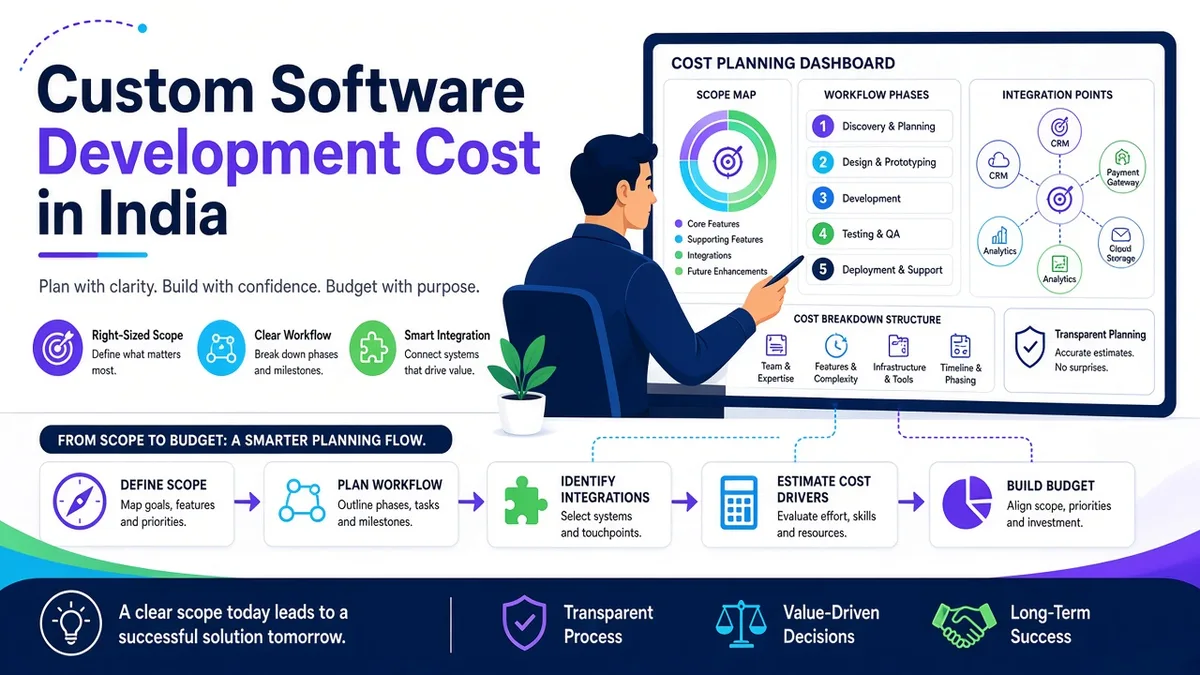
Custom software development cost in India
Learn what custom software costs in India, from MVPs to enterprise systems. See price ranges, cost factors and ways to save before you hire.
Learn more Articles
Custom software vs off-the-shelf software
Compare custom and off-the-shelf software on cost, speed, security and scalability. Use our checklist to decide what fits your business.
Learn more Articles
How to choose a custom software development company
Use this checklist to compare software vendors on experience, pricing, code ownership and support. Includes red flags and questions to ask.
Learn more Articles
AI in custom software development
See where AI adds real value in custom software, from chatbots to automation. Learn costs, risks and how to start with a small pilot.
Learn more