


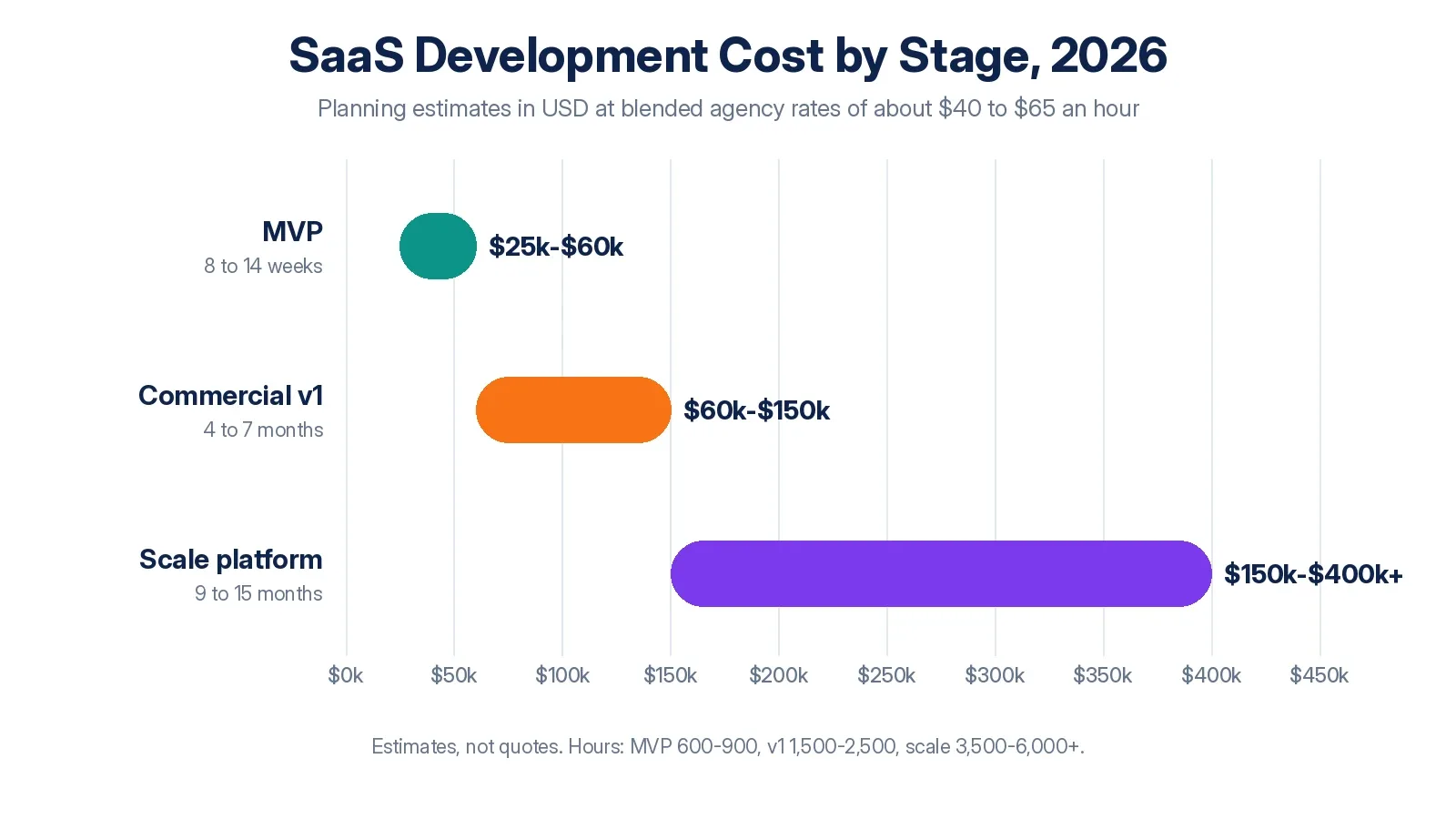
You have a SaaS idea, a rough feature list and three quotes that look nothing alike. One says $30,000. Another says $180,000. A third won't give a number until you sign up for a "discovery call." This guide explains SaaS development cost in 2026 in plain US dollars, so you can see where those gaps in SaaS development cost come from. In short, a focused SaaS MVP often costs $25,000 to $60,000, a sellable first version $60,000 to $150,000, and a platform built to scale $150,000 to $400,000 or more.
You'll see what drives the price, cost by stage, how multi-tenancy, billing and compliance add to the budget, what hosting costs each month, how team region changes the total, and a checklist for quotes. It is written for founders and product owners in the US, Canada, the UK and Europe.
- A focused SaaS MVP often costs $25,000 to $60,000, a commercial v1 $60,000 to $150,000 and a scale platform $150,000 to $400,000 or more (planning estimates).
- Multi-tenancy, billing and compliance decide whether the product can grow without a rebuild. Use a billing platform and start with a shared database and strict tenant checks.
- The build is only the first bill. Plan for payment fees of about 3% to 5% of revenue, a growing cloud bill and upkeep of about 15% to 25% of the build each year.
What Drives SaaS Development Cost
A SaaS product is not a website with a login. It is a service that many customers share, pay for every month and expect to work all day. That is why SaaS development cost is higher than the cost of a simple web app with the same screens.
Most of your SaaS development cost goes into five things. First is scope: the number of user roles, workflows, reports and integrations. Second is architecture: how you keep each customer's data apart and how the system grows. Third is billing: plans, trials, upgrades, invoices and failed payments. Fourth is security and compliance work that larger buyers will ask about. Fifth is the team: its size, its seniority and where it is based.
Here is how each driver affects SaaS development cost, from the factors that move the price most to those that move it least.
| Cost driver | What it covers | Effect on the budget |
|---|---|---|
| Scope and features | Roles, workflows, dashboards, reports, integrations | High: every extra role or integration adds design, code and tests |
| Team region and seniority | Hourly rate and skill mix of the team | High: the same scope can cost 2 to 4 times more onshore |
| Multi-tenant architecture | Data isolation, tenant settings, scaling plan | Medium to high, depending on the model you choose |
| Billing and subscriptions | Plans, trials, proration, invoices, dunning | Medium: simple with a billing platform, costly if custom |
| Security and compliance | SSO, audit logs, encryption, SOC 2 or GDPR work | Low for an MVP, high for enterprise sales |
| Hosting and DevOps | Cloud setup, monitoring, backups, deployments | Low to build, but a cost every single month |
Takeaway: scope and team rate set most of your SaaS development cost. Architecture, billing and compliance decide whether the product can grow without a rebuild.
SaaS Development Cost by Stage: MVP, v1 and Scale
The clearest way to plan SaaS development cost is by stage. Each stage answers a different business question, so it needs a different budget. An MVP tests whether people will pay. A first commercial version, or v1, is something you can sell with confidence. A scale platform serves larger customers and heavier use.
Our planning ranges for SaaS development cost by stage are below. They are estimates, not quotes. We worked them out from typical hours for each stage and blended agency rates of about $40 to $65 an hour, in line with the band most firms list in Clutch's software development pricing guide ($25 to $49 an hour) plus senior and design time.
| Stage | Typical hours (estimate) | SaaS development cost (USD, estimate) | Timeline | Usually includes |
|---|---|---|---|---|
| MVP | 600 to 900 | $25,000 to $60,000 | 8 to 14 weeks | Sign-up, one core workflow, one paid plan, basic admin |
| Commercial v1 | 1,500 to 2,500 | $60,000 to $150,000 | 4 to 7 months | Teams and roles, several plans, trials, onboarding, 2 to 4 integrations |
| Scale platform | 3,500 to 6,000+ | $150,000 to $400,000+ | 9 to 15 months | SSO, audit logs, public API, usage billing, compliance work, high availability |
We cover the MVP stage in depth in our guide to the cost to build an MVP, so this article spends more time on what comes after it. Most SaaS products do not jump from MVP to scale in one go. They grow into v1 with paying customers, then add enterprise features when bigger deals ask for them.
Takeaway: don't fund the full platform on day one. Budget the MVP, prove that customers will pay, then use real usage to plan the next stage of your SaaS development cost.
Multi-Tenancy: The Architecture Choice Behind the Price
Multi-tenancy means many customers, called tenants, share one running product while each sees only its own data. It is the core of almost every SaaS app, and one of the least visible parts of SaaS development cost. A mistake here is expensive, because fixing it later can mean moving every customer's data.
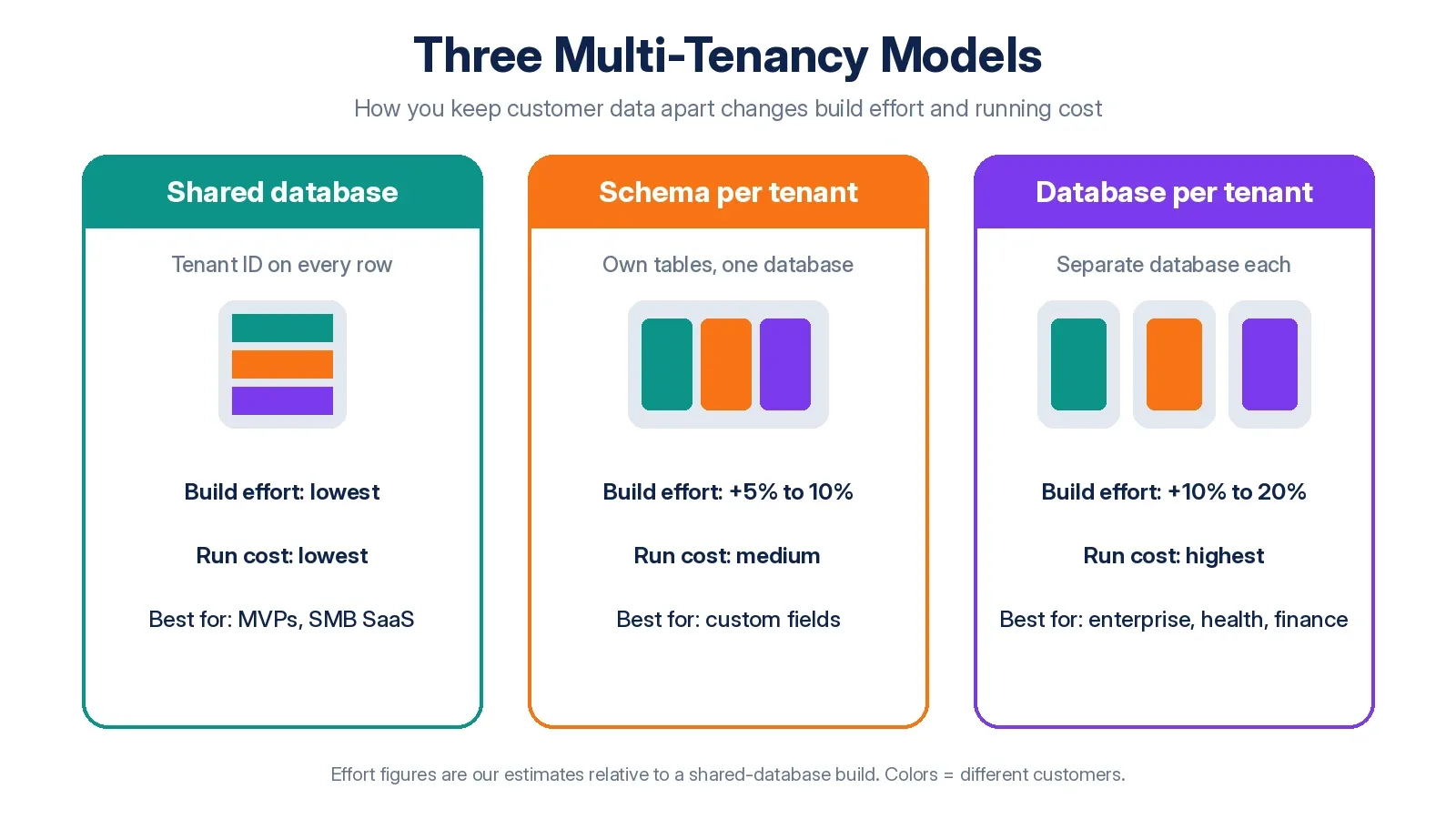
There are three common ways to build it. In a shared database, every table has a tenant ID, and the code filters by it on every query. With a schema per tenant, each customer gets its own set of tables inside one database. With a database per tenant, each customer gets a separate database, which gives the strongest isolation.
This table compares how each model affects SaaS development cost, running cost and fit.
| Tenancy model | Build effort (estimate) | Running cost | Data isolation | Best for |
|---|---|---|---|---|
| Shared database, tenant ID on every row | Lowest | Lowest | Good, if every query is tested | MVPs and most small business SaaS |
| Schema per tenant | Medium: 5% to 10% more work | Medium | Better | Products with custom fields per customer |
| Database per tenant | Highest: 10% to 20% more work | Highest | Strongest | Enterprise, healthcare or finance buyers |
You can also mix models. Many products start with a shared database and move their largest customers to a dedicated database later. That only works if tenant IDs and access checks are built in from the start. Tenant-level settings, branding, user limits and data exports add to SaaS development cost on top, whichever model you pick.
Takeaway: a shared database with strict tenant checks is the right start for most products. Plan the move to dedicated databases only when a paying customer asks for it.
Subscription Billing and Payment Costs
Billing looks simple until you build it. Customers want monthly and yearly plans, free trials, coupons, upgrades in the middle of a month and invoices with tax. You also need emails for failed cards and a page where customers update their own details. All of this sits inside your SaaS development cost.
The good news is that you rarely need to build billing from scratch. Platforms such as Stripe Billing, Chargebee or Paddle handle most of it. You still pay for the work to connect them, and you pay fees on every charge. Payment fees are part of SaaS development cost over time, too. Here are the published numbers from Stripe's Billing pricing page, checked in November 2026.
| Stripe item (US pricing) | Published fee | What it means for you |
|---|---|---|
| Billing, pay as you go | 0.7% of billing volume | Recurring billing, reminders, smart retries and customer portal |
| Card payments | 2.9% + 30¢ per successful charge | The main fee on most subscription revenue |
| ACH direct debit | 0.8%, capped at $5.00 | Cheaper for large annual invoices |
| Customer portal on your own domain | $10 per month | Optional, for a branded billing page |
Here is a worked example, using our own math on those fees. Say you have $20,000 a month in subscription revenue from 400 customers paying $50 each by card. Card fees come to about $700 (2.9% of $20,000 plus 400 times 30¢). Billing adds about $140 (0.7%). That is roughly $840 a month, or about 4% of revenue, before any tax tools.
Building the billing side usually takes 60 to 120 hours for an MVP with one or two plans. Expect 200 to 400 hours for a v1 with trials, proration, coupons and invoices (our estimates). Usage-based billing, where customers pay per seat, per API call or per record, raises SaaS development cost further.
Takeaway: use a billing platform, not custom code. Then budget payment fees of roughly 3% to 5% of revenue as a running cost, not a one-time line.
Security and Compliance: SOC 2 and GDPR
If you plan to sell to mid-size or enterprise companies, security questions will arrive early. Those questions can add real SaaS development cost. Many buyers send a security questionnaire before they sign. Larger ones often ask for a SOC 2 report. If you hold data on people in the EU, GDPR applies to you wherever your company is based.
SOC 2 is a report from an independent CPA firm on your controls for security, availability, processing integrity, confidentiality or privacy, as the AICPA explains. It is not a one-off product feature. It covers how your team works: access reviews, change control, backups, monitoring and incident response. A Type 1 report looks at your controls at one point in time. A Type 2 report checks that they worked over a period, often several months.
GDPR is a law, not a report. Its fines can reach €20 million or 4% of worldwide annual turnover, whichever is higher, under Article 83. For a product team, it means building consent records, data export, account deletion, data processing agreements and clear rules on where data is stored.
Here is the product work that compliance usually adds to SaaS development cost. The hours are our estimates for a typical v1.
| Feature or task | Why buyers ask for it | Extra build effort (estimate) |
|---|---|---|
| Single sign-on (SAML or OIDC) | Enterprise IT controls who logs in | 80 to 160 hours |
| Audit logs | Proof of who changed what and when | 60 to 120 hours |
| Data export and account deletion | GDPR rights of access and erasure | 40 to 80 hours |
| Encryption, backups and restore tests | Core SOC 2 and security questionnaire items | 40 to 100 hours |
| Role-based access and admin controls | Least-privilege access for customer teams | 60 to 140 hours |
The audit itself sits outside your SaaS development cost for the build. Each CPA firm sets its own fees based on scope and report type, so get quotes from at least three firms. Many teams also pay for a compliance tool that collects evidence. Budget your own team's time, too, because writing policies and running reviews takes weeks.
Takeaway: you don't need SOC 2 for an MVP. Build tenant isolation, audit logs and backups early, so that adding compliance later is a project, not a rebuild.
Cloud Hosting and Other Running Costs
Hosting is the part of SaaS development cost that never stops. The good news is that it starts small. A new product with a few hundred users can run on modest cloud resources, and AWS gives new accounts up to $200 in credits over six months on its Free Tier.
To make the numbers real, here is one example from AWS Fargate's pricing page. In US East, a container with 1 vCPU and 2 GB of memory costs $0.000011244 per vCPU-second and $0.000001235 per GB-second. Running it all month (about 730 hours) comes to roughly $36, by our math. Two copies for reliability are about $72. A managed database, file storage, email, logging and backups then add more to the monthly bill.
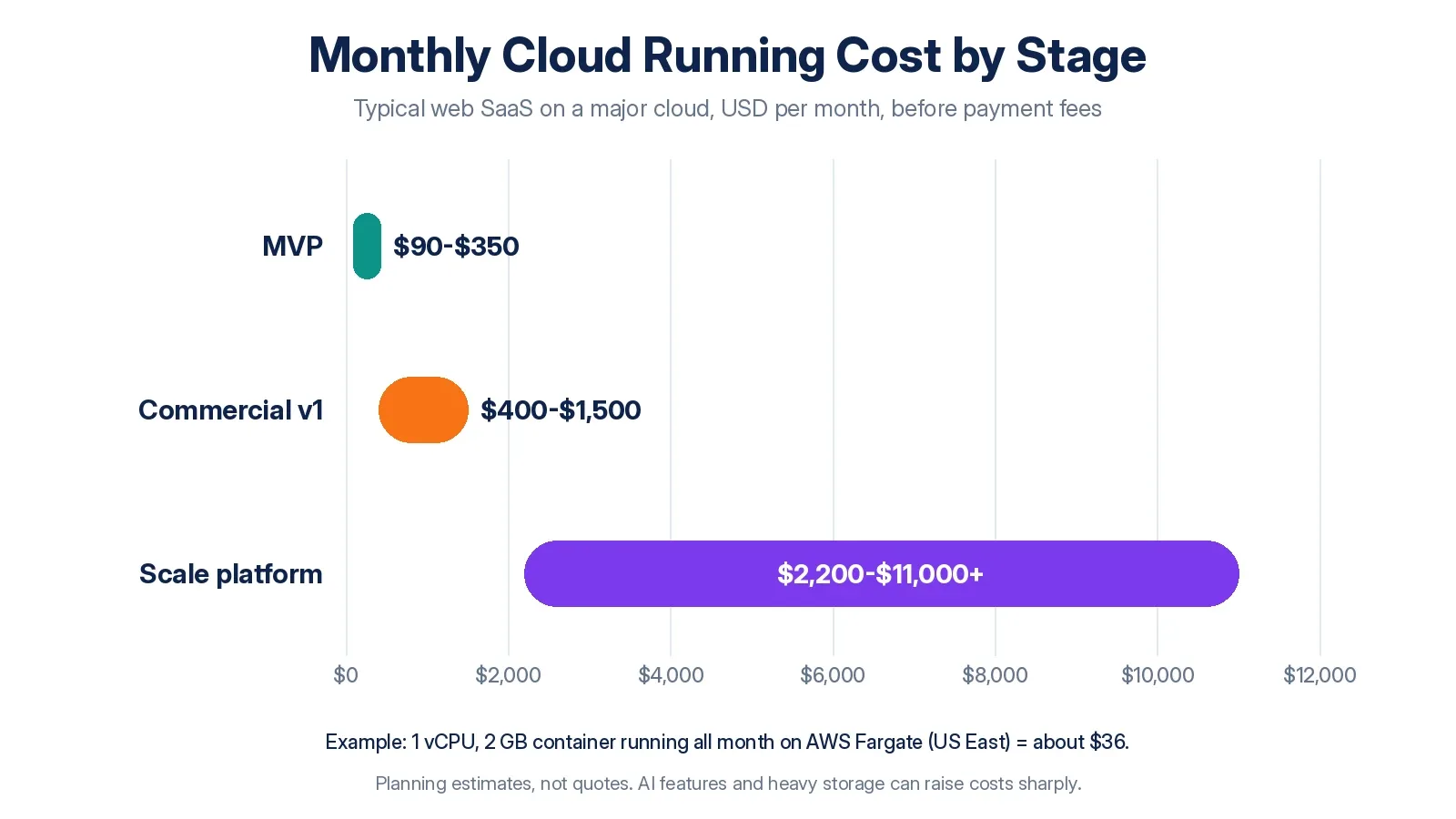
The table below shows planning ranges for monthly running costs by stage. These are our estimates for a typical web SaaS, not quotes, and AI features can raise them sharply.
| Monthly item (estimate) | MVP | Commercial v1 | Scale platform |
|---|---|---|---|
| App servers or containers | $40 to $150 | $150 to $600 | $1,000 to $5,000+ |
| Managed database and backups | $30 to $120 | $150 to $500 | $800 to $4,000+ |
| Email, storage, logs and monitoring | $20 to $80 | $100 to $400 | $400 to $2,000+ |
| Total cloud bill | $90 to $350 | $400 to $1,500 | $2,200 to $11,000+ |
Hosting is only one running cost that follows SaaS development cost. Maintenance covers bug fixes, security patches, library updates and small changes. A common rule of thumb is 15% to 25% of the build cost each year. That is a planning habit, not a measured average, so ask your vendor for a monthly support plan in writing. You'll also pay for third-party tools such as error tracking, analytics, customer support chat and the billing platform from the previous section.
Takeaway: for every $100,000 of build, plan for roughly $15,000 to $25,000 a year of upkeep, plus a cloud bill that grows with your customers.
SaaS Development Cost by Team Region
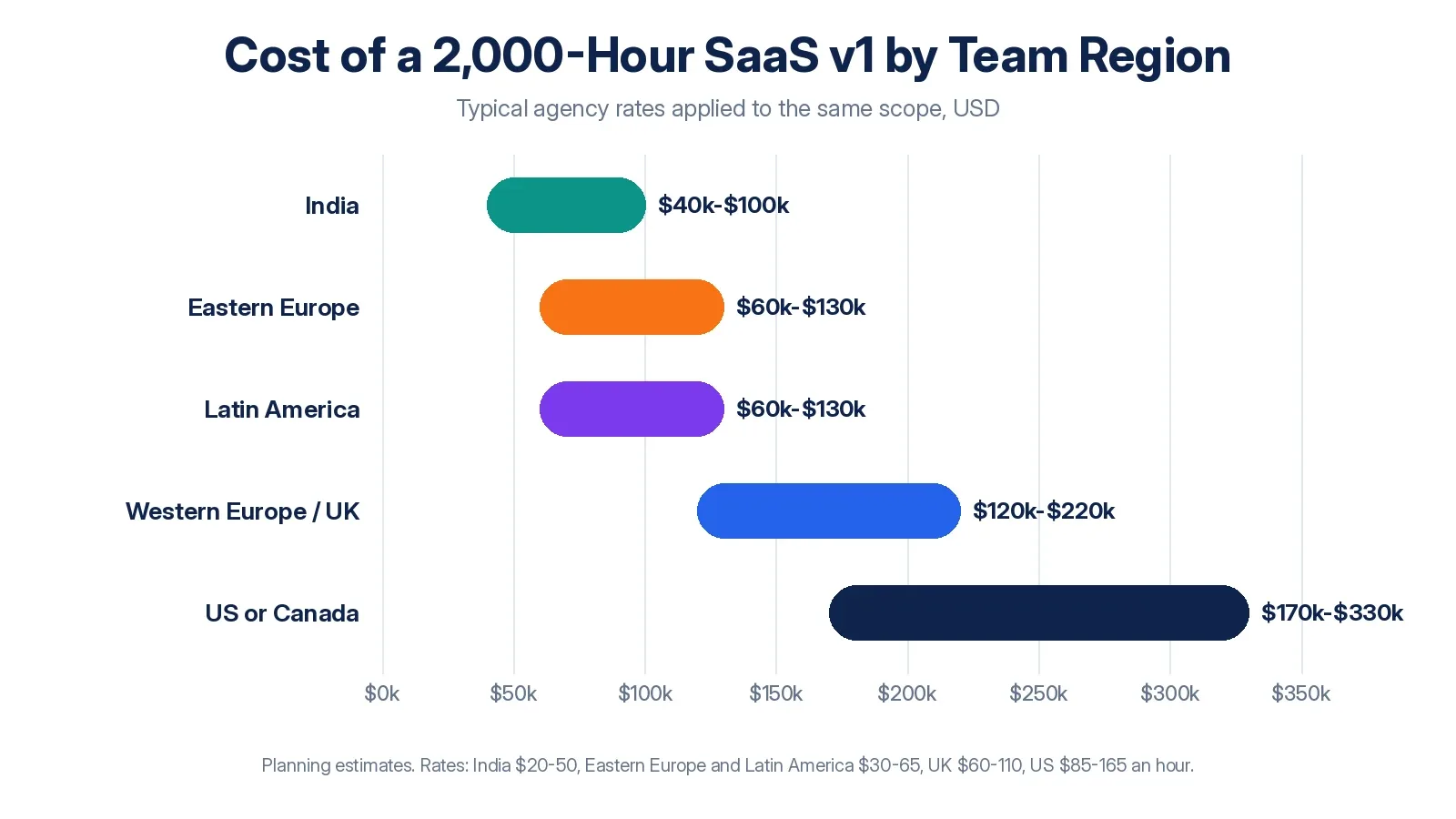
Where your team is based changes SaaS development cost more than almost any feature. The same 2,000-hour v1 can cost under $100,000 with an offshore agency, or well over $200,000 with a US agency. For context, the US Bureau of Labor Statistics puts the median pay of software developers at $135,980 a year in May 2025, in its Occupational Outlook Handbook. Agency rates sit above salary because they include management, testing, tools and profit.
The table below prices one example, a 2,000-hour commercial v1, at typical agency rates by region. The rates come from our guide to offshore software development rates by country, and the totals are estimates.
| Team region | Typical agency rate (USD per hour) | 2,000-hour v1 (USD, estimate) | Working-hours overlap with US East |
|---|---|---|---|
| India | $20 to $50 | $40,000 to $100,000 | Low, needs a planned overlap window |
| Eastern Europe | $30 to $65 | $60,000 to $130,000 | 1 to 2 hours |
| Latin America | $30 to $65 | $60,000 to $130,000 | 6 to 7 hours |
| Western Europe or UK | $60 to $110 | $120,000 to $220,000 | 2 to 3 hours |
| US or Canada | $85 to $165 | $170,000 to $330,000 | Full day |
A lower rate only cuts SaaS development cost if the work is good. Weak teams lose their savings through rework, slow feedback and missed edge cases in billing or tenancy. Many buyers mix models: a product lead or architect near the customer, with a dedicated delivery team offshore. Our guide to hiring a dedicated development team in India shows the monthly view of that setup.
Takeaway: compare the total cost for the same scope, not the hourly rate alone. An offshore team with strong SaaS experience often gives the best value for v1.
How to Budget and Choose a SaaS Partner
Your SaaS development cost budget should start with a written scope, not a guess. List your user roles, the main workflows, the plans you'll sell and the integrations you need. Mark each feature as "launch," "next" or "later." Then ask vendors to price the launch list only, plus a separate estimate for the next stage. If your product is still a concept, our SaaS product development services page shows how we run discovery before a full build.
Before you ask for quotes, run through this list so you can compare each SaaS development cost quote fairly.
Quick checklist
- ☐ You have a one-page scope with roles, workflows, plans and integrations.
- ☐ You know which tenancy model you need and why.
- ☐ Billing will run on a platform such as Stripe, not custom code.
- ☐ The quote splits design, development, testing, DevOps and project management.
- ☐ Hosting, maintenance and third-party tools are listed as monthly costs.
- ☐ You'll own the code, the cloud accounts and the billing account from day one.
- ☐ The vendor can show at least one live multi-tenant product it built.
Here are the red flags that most often push SaaS development cost far past the quote.
Red flags to watch for
- ✗ A fixed price with no written feature list or change process.
- ✗ No mention of tenant isolation, backups or how data is kept apart.
- ✗ A plan to build billing, login or email sending from scratch.
- ✗ Hosting quoted as "free" or left out of the proposal.
- ✗ Only one senior name in the pitch and juniors on the actual work.
For more on vetting vendors, read our guide on how to choose a custom software development company. If you are comparing SaaS with a broader custom build in India, our custom software development cost in India guide gives local price bands.
Takeaway: a clear scope and a short paid discovery phase will save more money than any discount on the hourly rate.

Get a Free SaaS Cost Estimate
Ready to price your product? Send us a short brief: what your SaaS does, who uses it, the plans you want to sell, the integrations you need and any launch date or budget limit. That is enough for us to suggest a stage-by-stage plan, a budget in USD and a realistic timeline.
Conclusion: Budget for the Build and the Run
SaaS development cost in 2026 depends far more on scope, architecture and team than on any single price list. As a planning guide, a focused MVP often costs $25,000 to $60,000, a commercial v1 $60,000 to $150,000, and a scale platform $150,000 to $400,000 or more. Then add the run: payment fees of roughly 3% to 5% of revenue, a cloud bill that grows with use, and upkeep of about 15% to 25% of the build each year.
To keep SaaS development cost under control, start small, choose a tenancy model you can grow with, use a billing platform, and build the basics of security early. If you want a SaaS development cost estimate for your own product, share your idea with us. We'll send a stage-by-stage budget and timeline in USD.
Keep reading: Cost to build an MVP · Offshore software development rates by country · Custom software development cost in India · Property management software development cost · LMS development cost · How to hire an offshore development team · Pharmacy management software development cost
Related articles
 Articles
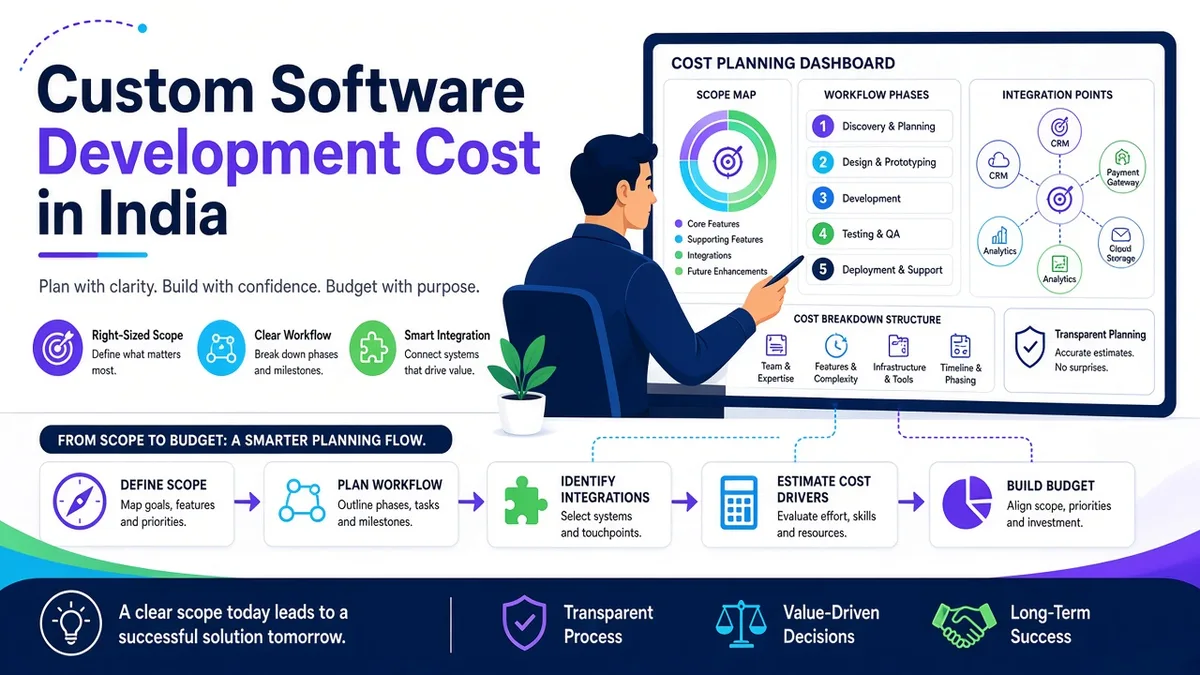
Custom software development cost in India
Learn what custom software costs in India, from MVPs to enterprise systems. See price ranges, cost factors and ways to save before you hire.
Learn more Articles
Custom software vs off-the-shelf software
Compare custom and off-the-shelf software on cost, speed, security and scalability. Use our checklist to decide what fits your business.
Learn more Articles
How to choose a custom software development company
Use this checklist to compare software vendors on experience, pricing, code ownership and support. Includes red flags and questions to ask.
Learn more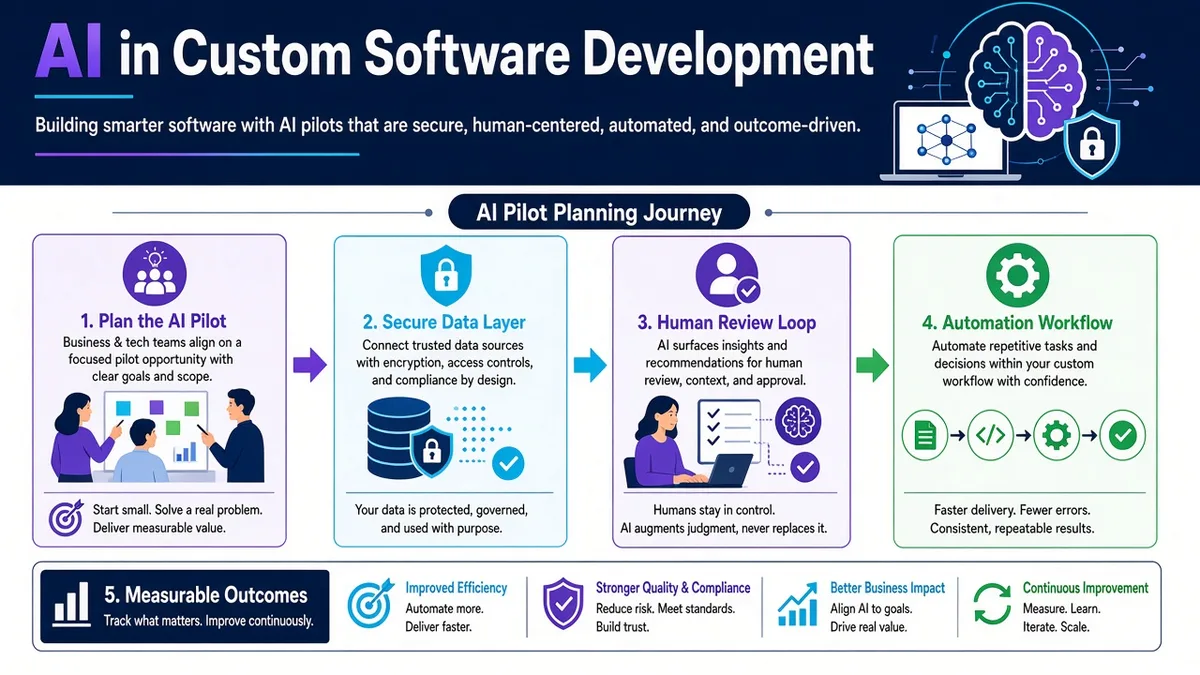 Articles
AI in custom software development
See where AI adds real value in custom software, from chatbots to automation. Learn costs, risks and how to start with a small pilot.
Learn more