


You found three agencies abroad. All three say they can start next week. Each quote looks good, and each sales call went well. So how do you pick the one that will still deliver in month six? This guide shows how to hire an offshore development team step by step, from the first brief to a team that ships every sprint. It is written for founders, CTOs and product owners in the US, Canada, the UK, Europe and Australia who want offshore help without losing control of their product.
You'll learn which engagement model fits your project, where to look and what overlap to expect, how to vet vendors and engineers, why a paid pilot beats a long interview loop, which contract clauses protect your code, and how to run the first 90 days. Every step of how to hire an offshore development team works whichever country you choose.
- Follow a fixed order: outcome, engagement model, shortlist, vetting, paid pilot, contract, then scale. Plan for about six to ten weeks.
- Meet the engineers who will write your code, and test them on a real two to four week paid pilot before you sign a long contract.
- Get a clear IP assignment in writing and keep your code, cloud and app store accounts in your own name from day one.
What an Offshore Development Team Is
An offshore development team is a group of engineers in another country, usually several time zones away, who build and maintain software for you. They might work for an agency, a staffing partner or, less often, a legal entity you set up abroad. They work on your product, under your priorities, while someone else handles their payroll.
Offshore is not the same as nearshore. A nearshore team sits in a nearby country with similar working hours, such as a US company working with Mexico or a German company working with Poland. Offshore usually means a bigger time gap and a lower rate, such as a US or UK company working with India, Vietnam or the Philippines.
An offshore team makes sense when you need more engineering capacity than you can hire locally, when local salaries would stretch your runway, or when you need skills that are hard to find at home. It makes less sense when nobody on your side can write requirements, review work or answer questions within a working day. Before you work out how to hire an offshore development team, check that you have one person who can own the product decisions. That one person matters more than the country you pick.
How to Hire an Offshore Development Team in 8 Steps
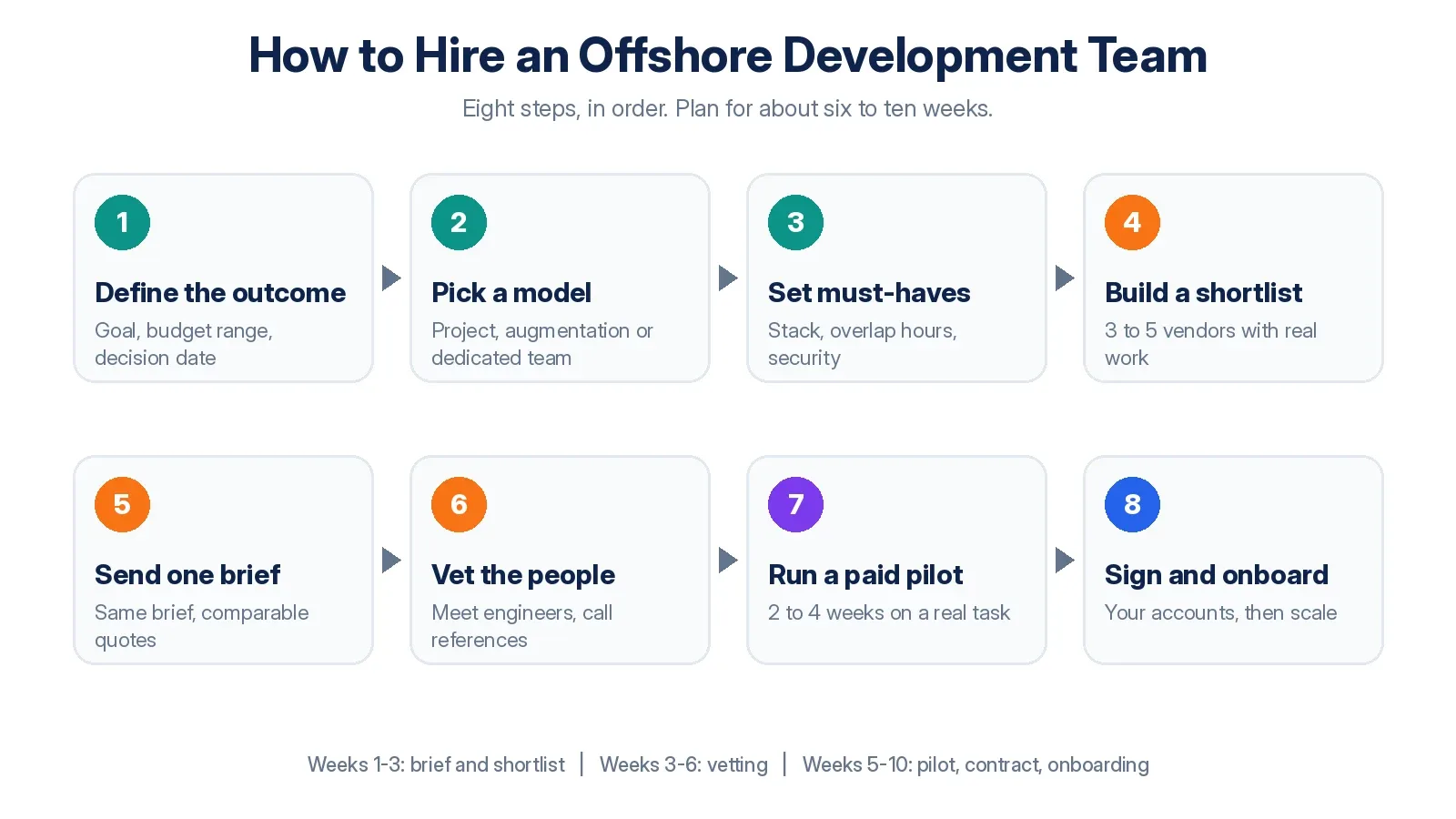
Most hiring guides list tips. Here is the order that works, because each step feeds the next one. If you are learning how to hire an offshore development team for the first time, follow it in sequence and do not skip to the contract.
- Define the outcome. Write one paragraph on what should be true in six months. Add a budget range and a decision date.
- Pick an engagement model. Decide whether you need a fixed-scope project, extra people for your own team, or a full dedicated team.
- Set your must-haves. List the tech stack, the hours of overlap you need, language level, security needs and industry experience.
- Build a shortlist. Find three to five vendors with work you can inspect. Ten is too many to compare well.
- Send one brief to all of them. Ask for an approach, a team shape, a timeline and a quote, so the answers line up.
- Vet the people, not just the company. Meet the engineers who will do the work, check references and run a technical review.
- Run a paid pilot. Give the best one or two vendors a real two to four week task with clear acceptance criteria.
- Sign, onboard and scale. Sign the full contract, set up access in your own accounts, and grow the team only after the pilot proves the fit.
Here is how long each phase usually takes when you plan how to hire an offshore development team. These are planning estimates from typical projects, not fixed rules.
| Phase | Typical time | What you should have at the end |
|---|---|---|
| Brief and model choice (steps 1 to 3) | 1 week | A two to four page brief and a list of must-haves |
| Shortlist and proposals (steps 4 and 5) | 1 to 2 weeks | Three to five comparable proposals |
| Vetting (step 6) | 1 to 2 weeks | Named engineers, reference calls and a scored comparison |
| Paid pilot (step 7) | 2 to 4 weeks | Working code in your repository and a clear go or no-go |
| Contract and onboarding (step 8) | 1 to 2 weeks | Signed contract, access set up and a first sprint planned |
Takeaway: plan for about six to ten weeks from brief to a working team. Rushing the pilot is the fastest way to lock in a poor fit.
Choose the Right Engagement Model
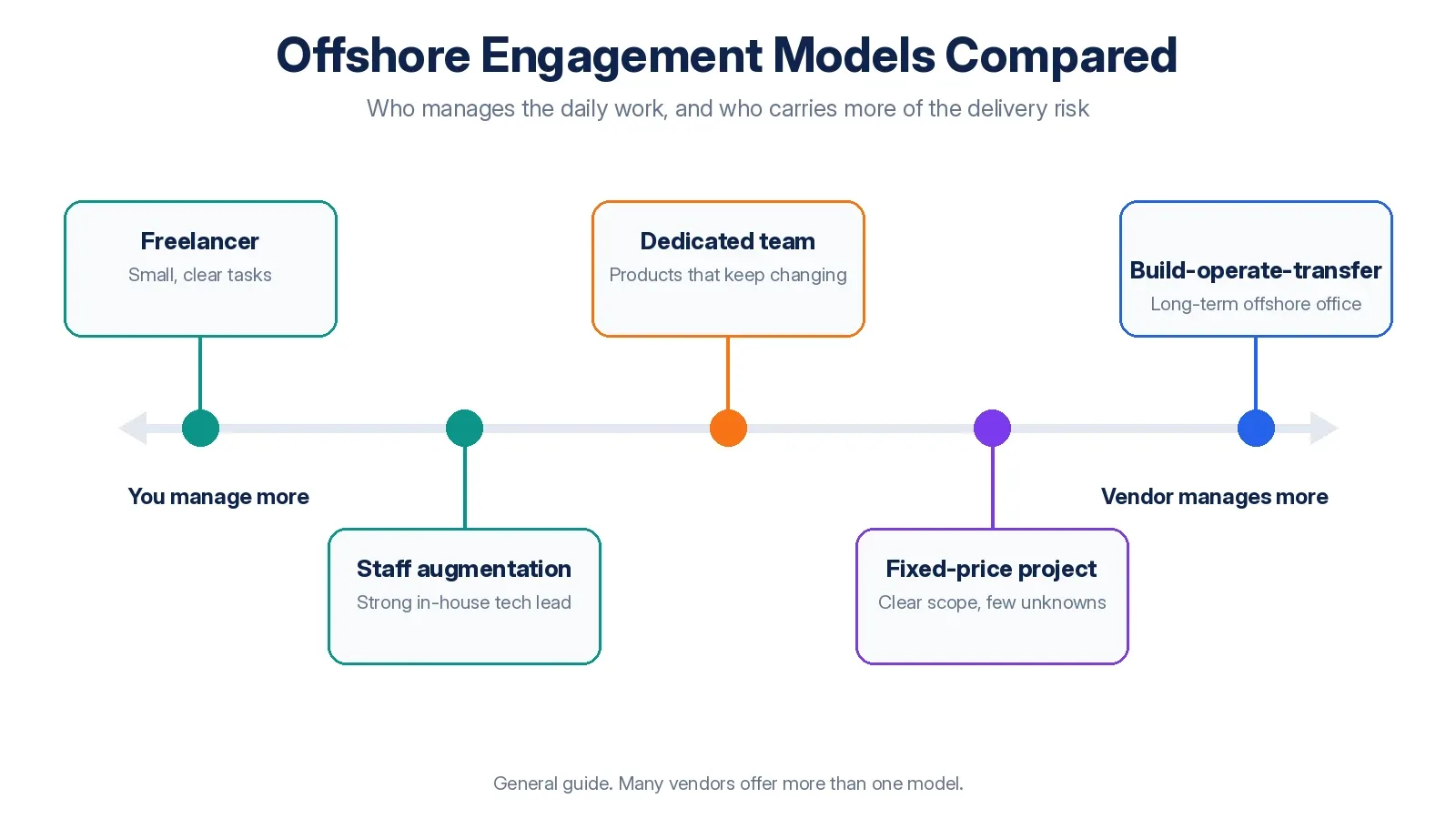
The engagement model decides who manages the work, who carries the delivery risk and how you pay. It is the first big decision in how to hire an offshore development team, so choose it before you talk to vendors, because the same agency will quote very differently for each model.
A freelancer works well for a small, clear task you can manage yourself. Staff augmentation adds individual engineers to your existing team, so you keep full control of the process. A dedicated team gives you a stable group, often with a lead, QA and a project manager, that works only on your product. A fixed-price project hands a defined scope to a vendor, who takes on more of the delivery risk. A build-operate-transfer setup is for larger companies that want their own offshore office in the long run.
Here is how the five models compare when you plan how to hire an offshore development team.
| Model | Who manages daily work | Best for | Main risk |
|---|---|---|---|
| Freelancer | You | Small, well-defined tasks | No backup if the person leaves |
| Staff augmentation | You, with vendor HR support | Teams with a strong tech lead who need more hands | You carry all the delivery risk |
| Dedicated team | Shared: your product owner plus a vendor lead | Products that keep changing over months | Needs steady product input from you |
| Fixed-price project | Vendor | Clear scope with few unknowns | Change requests get slow and costly |
| Build-operate-transfer | Vendor at first, then you | Companies planning a long-term offshore office | High setup effort and legal work |
Takeaway: if your scope will change as you learn, a dedicated team or staff augmentation usually fits better than a fixed price. If your scope is small and clear, a fixed price keeps your risk low.
If you are leaning toward a dedicated team in India, our guide to hiring a dedicated development team in India covers monthly costs by role and team size. For an early product, our breakdown of the cost to build an MVP shows how a fixed first phase can test the market before you commit to a long-term team.
Where to Hire: Regions, Time Zones and Rates
Country choice is the next part of how to hire an offshore development team. It comes down to three things: rates, working-hour overlap and the depth of the talent pool for your stack. Rates matter, but overlap often decides how smooth the work feels day to day.
The rate figures below come from Accelerance's 2026 outsourcing rate summary, which surveyed software firms in each region. The overlap columns show how many hours of a 9 to 5 local day match a 9 to 5 day in New York or London, worked out for standard time in November. They are our calculations, and they change when daylight saving starts.
| Region (example countries) | Junior rate, USD/hour | Senior rate, USD/hour | Overlap with New York | Overlap with London |
|---|---|---|---|---|
| South Asia (India) | $24 to $31 (Asia) | $31 to $41 (Asia) | 0 hours | 2.5 hours |
| Southeast Asia (Philippines, Vietnam) | $24 to $31 (Asia) | $31 to $41 (Asia) | 0 hours | 0 to 1 hour |
| Central and Eastern Europe (Poland, Romania) | $31 to $39 | $64 to $76 | 2 hours | 6 to 7 hours |
| Latin America (Mexico, Brazil) | $33 to $45 | $60 to $75 | 6 to 7 hours | 2 to 5 hours |
These are agency rates, not salaries. Many offshore teams shift their hours so that two to four hours overlap with the client. When you work out how to hire an offshore development team in Asia, ask each vendor what overlap they commit to in writing.
Takeaway: Asia offers the lowest rates but little natural overlap with the Americas. Latin America suits US clients who want live collaboration, and Eastern Europe suits UK and EU clients.
For a wider country-by-country table, including seniority bands and monthly team budgets, see our guide to offshore software development rates by country.
How to Vet Offshore Vendors and Developers
Vetting is where most of the value sits in how to hire an offshore development team. A polished sales deck tells you little. What you need is proof of the people, the process and the past work.
Start with the company. Ask for two or three client references you can call, ideally with products like yours. Look at live work, not logos on a slide. Ask how long engineers usually stay, and what happens when one leaves.
Then vet the engineers. Insist on meeting the people who will write your code, not only the sales team. A good technical interview uses real work: a code review of a sample pull request, a short debugging task with a failing test, or a walkthrough of a project the engineer owned. Clear written English matters as much as spoken English, because most offshore work runs on tickets, pull requests and chat.
Score every vendor on the same sheet, so you compare facts instead of gut feel.
| Criterion | What a good answer looks like | Weight (suggested) |
|---|---|---|
| Relevant past work | Live products in your domain or stack, with references you can call | 20% |
| Named team | Engineers and a lead you met before signing | 20% |
| Engineering process | Pull requests, code review, automated tests and CI on every change | 20% |
| Communication | Written daily or weekly updates, clear overlap hours, fast replies | 15% |
| Security and access | Your own repositories and accounts, least-privilege access, a written policy | 15% |
| Commercial terms | A clear rate card, notice period and replacement policy | 10% |
Takeaway: a vendor that scores well on the named team and process rows is usually a safer bet than the one with the lowest rate. This is the part of how to hire an offshore development team where patience pays.
Before you ask for quotes, run through this list:
Quick checklist
- ☐ You have a two to four page brief with goals, users and constraints.
- ☐ You know which engagement model you want.
- ☐ You have set a budget range and a decision date.
- ☐ One person on your side can answer product questions within a working day.
- ☐ Your code repository and cloud accounts sit in your company's name.
- ☐ You know how many hours of overlap you need each day.
Our guide on how to choose a custom software development company has more questions to ask any software vendor, offshore or not.
Run a Paid Pilot Before You Scale
Interviews show how people talk. A pilot shows how they work. That is why a short, paid pilot is the single most useful step in learning how to hire an offshore development team that lasts.
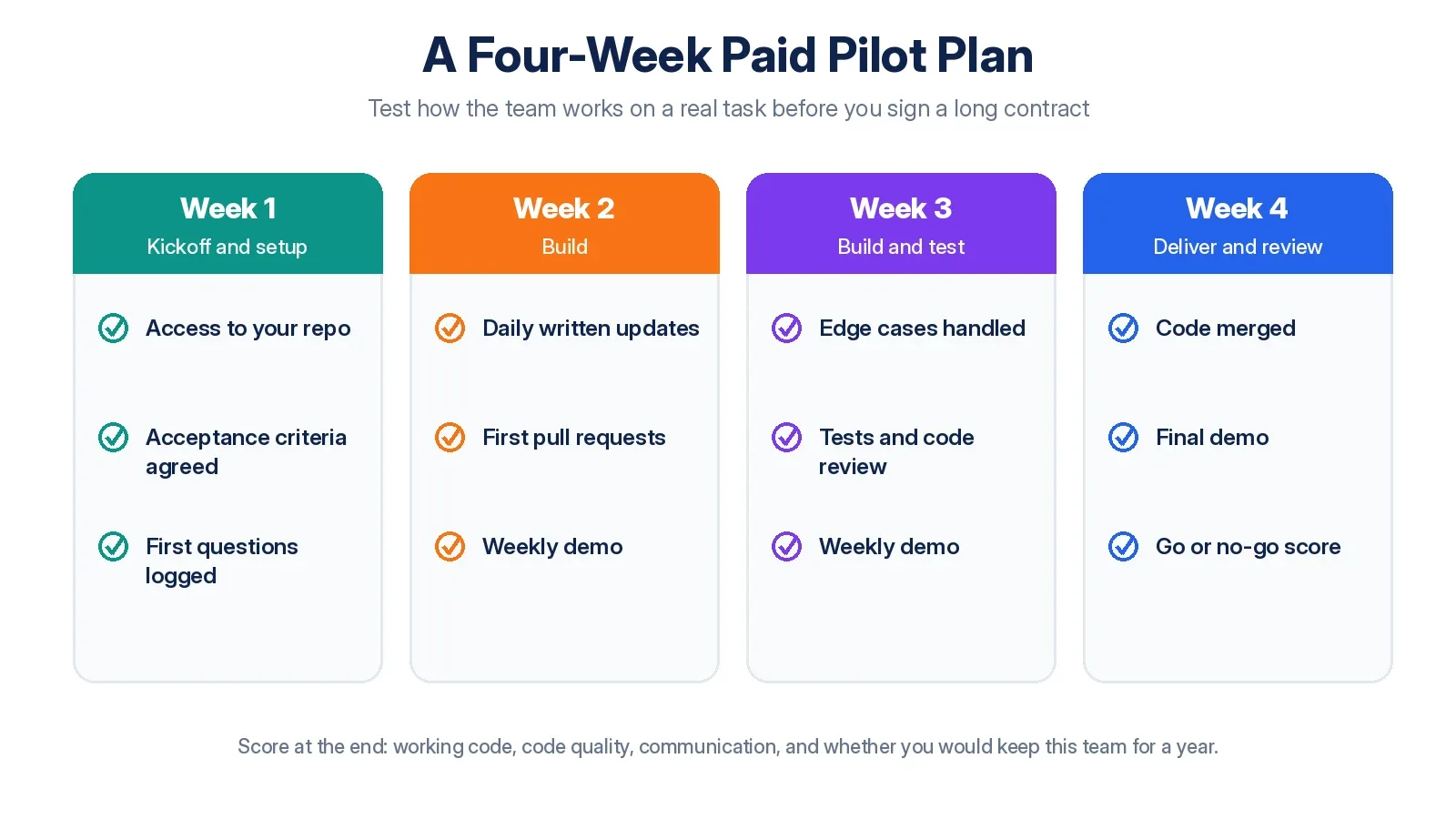
Pick a real task from your backlog that takes two to four weeks, such as a small feature, an integration or a set of bug fixes with an edge case hidden in it. Write clear acceptance criteria before the pilot starts. Pay a fair rate for it, so the vendor puts its real team on the job rather than its sales engineers.
During the pilot, watch more than the code. Notice how quickly the team asks questions, how they report progress, whether they raise problems early, and how they handle feedback on their pull requests. Hold a demo at the end of each week.
At the end, score the pilot against four questions:
- Did they deliver working code that meets the acceptance criteria?
- Is the code readable, tested and merged into your repository?
- Did they communicate clearly and flag risks without being asked?
- Would you be happy if this exact team worked on your product for a year?
If the answer to any of these is no, talk it through or try your second vendor. A failed pilot is cheap, and it is a normal part of how to hire an offshore development team.
Contracts, IP Ownership and Data Protection
Knowing how to hire an offshore development team also means knowing what to sign. The contract protects the one thing you cannot replace: your product. This section is general information, not legal advice, so have a lawyer review the final paper in your own country and, where possible, the vendor's.
Start with intellectual property. Many buyers assume that paying for code means they own it. That is not always true. The US Copyright Office's circular on works made for hire explains that a commissioned work counts as "made for hire" only if it falls into one of nine listed categories and both sides sign a written agreement. Software written by an outside contractor usually does not fit those categories, and many countries do not use the work-for-hire idea at all. So your contract needs a clear assignment of IP to your company, and the vendor should confirm that its own staff and subcontractors have assigned their rights to it.
Data protection comes next. If your team will touch personal data of people in the EU, GDPR rules apply to the transfer. The European Commission publishes standard contractual clauses that can be used as a legal basis for sending data to countries outside the EU. Other regions have their own rules, so ask your lawyer which apply to you.
Here are the clauses to check in any offshore contract.
| Clause | What it should say | Why it matters |
|---|---|---|
| IP assignment | All work product is assigned to you, with a present-tense assignment | Without it, the vendor or its staff may still own parts of your code |
| Background IP | The vendor's existing tools are licensed to you, not left unclear | Stops disputes over reused libraries and templates |
| Confidentiality | A mutual NDA that lasts beyond the contract | Protects your plans, data and trade secrets |
| Data protection | A data processing agreement and, for EU data, suitable transfer terms | Keeps you compliant when personal data crosses borders |
| Access and handover | Code, accounts and documents stay in your systems, with a handover plan | Lets you switch vendors without losing your product |
| Staffing and notice | Named key people, a replacement policy and a notice period | Reduces the damage if a key engineer leaves |
Takeaway: whichever model you use for how to hire an offshore development team, sign the NDA before you share sensitive details, and do not give anyone repository access until the IP and confidentiality terms are signed.
Onboarding: The First 90 Days
A good start makes up for a lot. The first three months set the habits your offshore team will keep, so treat onboarding as the last step of how to hire an offshore development team, not an afterthought.
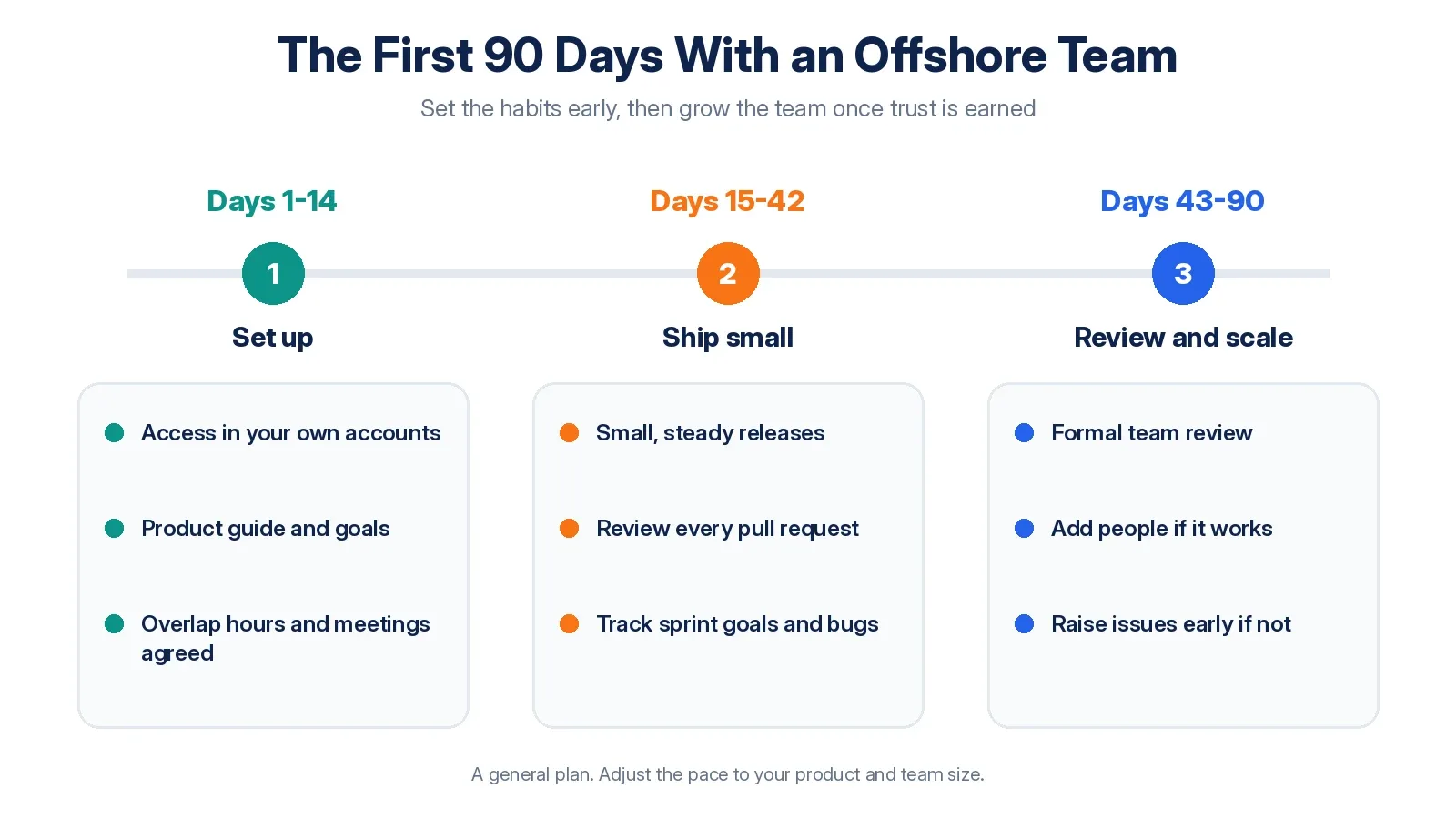
In the first two weeks, set up access in your own accounts: code repository, cloud, project tracker, chat and password manager. Share a short product guide with your users, your goals, your architecture and your definition of done. Agree on the overlap hours and the meetings, such as a daily written update, a weekly demo and a fortnightly planning session.
From weeks three to six, aim for small, steady releases. Review every pull request at first, then step back as trust grows. Track a few simple numbers, such as tickets finished per sprint, bugs found after release and how fast questions get answered.
In weeks seven to twelve, hold a proper review. Is the team hitting its sprint goals? If things are going well, this is the time to add people or hand over a bigger part of the product. If not, raise it early, while the contract notice period still gives you room.
How to Hire an Offshore Development Team Without Costly Mistakes
Most people who get how to hire an offshore development team wrong make the same few mistakes. Here are the mistakes we see most often, and how to spot them early.
Red flags to watch for
- ✗ Choosing on hourly rate alone, without comparing seniority, process or total cost.
- ✗ Signing a long contract before a paid pilot proves the team can deliver.
- ✗ Meeting only the sales team, then getting different engineers after kickoff.
- ✗ Letting the vendor host your code in its own repositories until the final payment.
- ✗ Writing a vague brief, then blaming the team when the result misses the mark.
- ✗ Skipping code review, because the team "seems senior".
- ✗ Ignoring time zones, so every question waits a full day for an answer.
Each of these is cheap to prevent and expensive to fix. A clear brief, a named team, your own accounts and a paid pilot remove most of the risk before you spend serious money. That is the core of how to hire an offshore development team well.

Plan Your Offshore Team With Us
If you are ready to start, send us a short brief: what you are building, the main features, your platforms, the roles you think you need and any launch date or budget limit. We will suggest an engagement model, a team shape and a realistic timeline, and you can meet the engineers before you commit.
Conclusion: Hire for Proof, Not Promises
Now you know how to hire an offshore development team in a way that protects your product and your budget. Define the outcome, pick the right engagement model, shortlist on evidence, meet the real engineers, run a paid pilot, sign a contract that gives you your IP, and plan the first 90 days.
The difference between a great result and a costly one rarely comes down to the country. It comes down to the process you follow when you work out how to hire an offshore development team.
If you would like help, Softfix can plan it with you. Our team in Lucknow, India, with an office in Toronto, builds web, mobile and SaaS products for clients around the world. Explore our software development services and book a free call to plan how to hire an offshore development team for your product, with a team shape and timeline.
Keep reading: Offshore software development rates by country · Hire a dedicated development team in India · Cost to build an MVP · SaaS development cost · Cost to build a marketplace app
Related articles
 Articles
Custom software development cost in India
Learn what custom software costs in India, from MVPs to enterprise systems. See price ranges, cost factors and ways to save before you hire.
Learn more Articles
Custom software vs off-the-shelf software
Compare custom and off-the-shelf software on cost, speed, security and scalability. Use our checklist to decide what fits your business.
Learn more Articles
How to choose a custom software development company
Use this checklist to compare software vendors on experience, pricing, code ownership and support. Includes red flags and questions to ask.
Learn more Articles
AI in custom software development
See where AI adds real value in custom software, from chatbots to automation. Learn costs, risks and how to start with a small pilot.
Learn more