






The internet is supposed to reward originality. Build something valuable, share it with the world, and people will find it.
But sometimes the opposite happens.
Recently, the creator of an open-source AI project discovered that when people searched for his software online, the top result was not his website at all. Instead, a different domain run by someone else appeared above the real project.
Even more surprising, this wasn’t just happening on one search engine. Multiple platforms were showing the same result.
The story has quickly become a real-world example of how complicated search rankings can be, especially when a new project grows faster than its online presence.
The Project Behind the Story
The software involved in this case is NanoClaw, an open-source AI agent framework that attracted significant attention shortly after its release.
The project was built by Gavriel Cohen, a developer who previously worked at Wix.
Cohen introduced NanoClaw as a safer alternative to OpenClaw, another AI agent system that had already gained viral traction among developers.
From the beginning, NanoClaw was positioned as a project focused on security and architecture improvements.
The developer community noticed.
Within a short period of time, the project gained over 18,000 stars on GitHub, which is a strong signal that developers find the project useful or interesting.
Several technology publications also wrote about the tool, and well-known researchers praised its technical design.
Under normal circumstances, that kind of attention would naturally drive people to the project’s official website.
But that’s not what happened.
A Domain Appeared Before the Official Website
At the time NanoClaw was first released, the project didn’t have a dedicated website.
Like many open-source tools, the main home for the project was its repository on GitHub.
That’s a very common approach among developers. Documentation, updates, and discussions all happen inside the repository.
However, while the project itself was gaining popularity, someone else registered a domain called nanoclaw.net
The site that appeared on that domain contained information pulled directly from the GitHub repository.
Essentially, the content had been copied and automatically published on another website.
At first, this might have seemed harmless.
But timing turned it into a serious problem.
Because the domain existed earlier than the official website, search engines discovered it first.
Confusion Started Growing
As NanoClaw gained media attention, more people began searching for the project online.
Journalists, developers, and curious readers were trying to learn more about the software.
Many of them ended up landing on the copied website instead of the real project.
Soon after, Cohen began receiving messages from people asking questions about problems on his website.
The issue was that the website they were referring to was not actually his.
The fake domain had started presenting itself as if it were connected to the real project.
Even worse, the information on the site wasn’t always accurate.
That created a new risk.
If someone controlled that domain, they could easily modify the page to distribute malicious files or redirect users to harmful downloads.
For a project related to software tools, that kind of risk is serious.
Building the Official Website
Once Cohen realized what was happening, he moved quickly to create an official online home for the project.
He launched a new site using the domain nanoclaw.dev.
After publishing the site, he began connecting it to the project in several ways.
These are common steps developers and SEO specialists take when establishing an official website:
| Action | Reason |
| Linking the site from GitHub | Shows ownership of the project |
| Adding structured metadata | Helps search engines understand the content |
| Submitting the site to search engines | Speeds up indexing |
| Filing reports about the fake domain | Requests investigation |
| Getting media coverage links | Builds authority signals |
All of these actions are normally effective when a legitimate site needs to establish its identity.
But in this case, things didn’t change immediately.
The Fake Website Still Ranked Higher
After launching the official website and completing all of the typical SEO steps, Cohen expected the rankings to correct themselves.
Instead, search results continued showing the copied website above the real one.
Even days later, people searching for NanoClaw were still seeing the impostor site first.
The official site was difficult to find, sometimes appearing far down the results, if it appeared at all.
This outcome surprised many observers.
The legitimate project had several strong signals supporting it:
- Thousands of GitHub stars
- Mentions from well-known tech publications
- Public praise from developers and researchers
- Links pointing directly to the official website
In theory, those signals should help search engines identify the genuine source of a project.
Yet the search results suggested otherwise.
It Wasn’t Just One Search Engine
Some people initially assumed the issue was specific to Google.
However, developers started checking the same search query on other platforms.
The pattern appeared again.
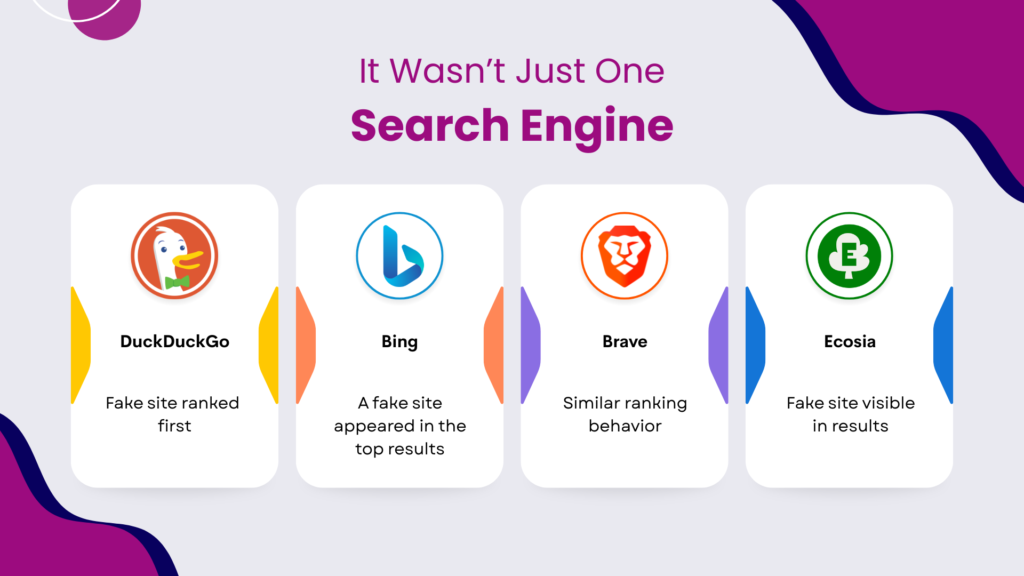
Several search engines were displaying the copied site near the top of the results.
For example:
| Search Engine | Result Observed |
| DuckDuckGo | Fake site ranked first |
| Bing | A fake site appeared in the top results |
| Brave | Similar ranking behavior |
| Ecosia | Fake site visible in results |
One search engine, Mojeek, appeared to rank the correct site instead.
But across most mainstream search tools, the copied website continued to appear prominently.
Why This Might Have Happened
Several possible explanations have been discussed by developers and SEO professionals.
The most likely factor is indexing order.
Search engines record when a page is first discovered.
If two sites publish similar content, the one indexed earlier may sometimes be treated as the original source.
In this case, the copied website appeared online before the official domain existed.
So search engines may have associated the project name with that domain from the beginning.
Correcting that association later can take time because algorithms rely on many different signals to reassess authority.
A Lesson for Developers Launching New Projects
The NanoClaw situation highlights something many developers rarely think about when releasing open-source software.
Most creators focus entirely on building the technology first.
Websites, branding, and domains often come later.
However, the modern internet moves very quickly.
If a project name becomes popular before an official website exists, someone else may register a related domain.
Even if the domain is not used maliciously at first, it can still create confusion for users and search engines.
That’s why many startup founders and developers now secure their domain names before launching a project publicly.
Even a simple landing page can help establish ownership of the name.
The Situation Isn’t Fully Resolved Yet
For now, the ranking issue remains unresolved.
The creator has already reported the copied site and taken steps to establish the official domain.
Some SEO specialists have suggested additional strategies, such as identifying backlinks that point to the fake site and asking those websites to update their links.
Over time, search engines usually adjust rankings as more reliable signals appear.
But the timeline for that correction can vary.
You can also read: Google’s Core Update Could End the Era of Promotional Listicles
Final Thoughts
The NanoClaw story reveals something important about how the internet works.
Search engines rely heavily on signals like timing, links, and indexing history. When those signals become mixed up, even a genuine creator can temporarily lose visibility to a copied site.
For anyone building a new product, tool, or open-source project, the lesson is simple.
Don’t wait too long to claim your domain name.
Because online, the first website search engines see often shape the story they believe.


