


One vendor quotes $22 an hour. Another quotes $65. A US agency asks for $150. All three say they build the same kind of software. So which number is real? This guide compares offshore software development rates by country for 2026, in US dollars, so you can set a fair budget before you speak to a single vendor. In short, most offshore agencies bill between $20 and $75 an hour, and the country is only one part of the price.
You'll see what an hourly rate includes, a country-by-country rate table, rates by seniority, how offshore compares with nearshore and onshore teams, a worked monthly team budget, the costs that sit outside the rate, and the red flags to check in any quote. It is written for founders, CTOs and business owners in the US, Canada, the UK and Europe who are weighing an offshore team.
- Most offshore agencies bill about $20 to $75 an hour in 2026. India, the Philippines and Vietnam sit at the low end, while Eastern Europe and Latin America cost more.
- Seniority moves a quote as much as country does. Compare the same roles and experience levels, and compare agency rates with agency rates.
- The hourly rate is not the total cost. Add your management time, ramp-up and rework risk, and start with a short paid trial.
What an Offshore Hourly Rate Includes
Before you compare offshore software development rates by country, check what each number is measuring. Three very different things get called a "rate," and mixing them up is the main reason guides to offshore software development rates by country disagree so much.
A freelancer's rate is what one person charges you directly. It covers their own time and little else. A developer's pay rate is what the engineer earns from an employer, before overhead. An agency's billed rate is what a development company charges you per hour. It covers the developer's salary plus benefits, office and equipment, project management, quality checks, sales costs, bench time between projects and profit.
That is why a freelancer in one country can cost less than half of what an agency in the same city bills. Neither number is wrong. They just measure different things. When people search for offshore software development rates by country, they usually mean agency rates, because most businesses hire a managed team, not a single freelancer.
Here is how the three rate types compare, and which one each guide to offshore software development rates by country tends to quote.
| Rate type | What it covers | Who it suits |
|---|---|---|
| Freelancer rate | One person's time, tools and taxes | Small, well-defined tasks you can manage yourself |
| Developer pay rate | Salary only, paid by the employer | Useful as a floor, not a price you can buy at |
| Agency billed rate | Salary, benefits, management, QA, tools, overhead and margin | Products that need a team, process and accountability |
Takeaway: always ask which type of rate you are looking at. Compare agency rates with agency rates, or the cheapest number on the page will mislead you.
Offshore Software Development Rates by Country: 2026 Table
The table below shows offshore software development rates by country for 2026. The first rate column is the band that most development firms in that country list on Clutch, a B2B review site, from its software development pricing guide (updated September 2026). The second column is a typical planning range for mid-level to senior agency developers. It is our estimate, based on the published rate tables we reviewed, not a quote. The last column shows how many hours of a 9 to 5 US Eastern workday overlap with a 9 to 5 local day, worked out for standard time in November.
| Country | Region | Most firms on Clutch (USD/hour) | Typical agency range, mid to senior (USD/hour, estimate) | Overlap with US Eastern 9 to 5 |
|---|---|---|---|---|
| India | South Asia | $25 to $49 | $20 to $50 | 0 hours |
| Philippines | Southeast Asia | $25 to $49 | $20 to $45 | 0 hours |
| Vietnam | Southeast Asia | Not listed in guide | $20 to $45 | 0 hours |
| Ukraine | Eastern Europe | $25 to $49 | $30 to $55 | 1 hour |
| Poland | Central Europe | $50 to $99 | $45 to $80 | 2 hours |
| Romania | Eastern Europe | Not listed in guide | $35 to $65 | 1 hour |
| Spain | Western Europe | $50 to $99 | $45 to $85 | 2 hours |
| Mexico | Latin America | $25 to $49 | $35 to $65 | 7 hours |
| Brazil | Latin America | Not listed in guide | $30 to $60 | 6 hours |
| Argentina | Latin America | Not listed in guide | $35 to $60 | 6 hours |
| United Kingdom | Western Europe | Not published | $60 to $110 | 3 hours |
| Canada | North America | $100 to $149 | $90 to $150 | 8 hours |
| United States | North America | $50 to $99 | $85 to $165 | 8 hours |
A few notes help you read these offshore software development rates by country. Clutch shows the band that most listed firms choose, so many good firms sit above or below it. Our planning range is wider, because it runs from a mid-level developer at a lean firm to a senior engineer at an established one. For the US, our range sits above the Clutch band because it reflects full-service agencies of the kind most buyers compare against.
Takeaway: South and Southeast Asia offer the lowest offshore software development rates by country, at roughly $20 to $50 an hour. Latin America and Central Europe cost more, but give you more working hours that match US or European clients.

Rates by Region and Seniority
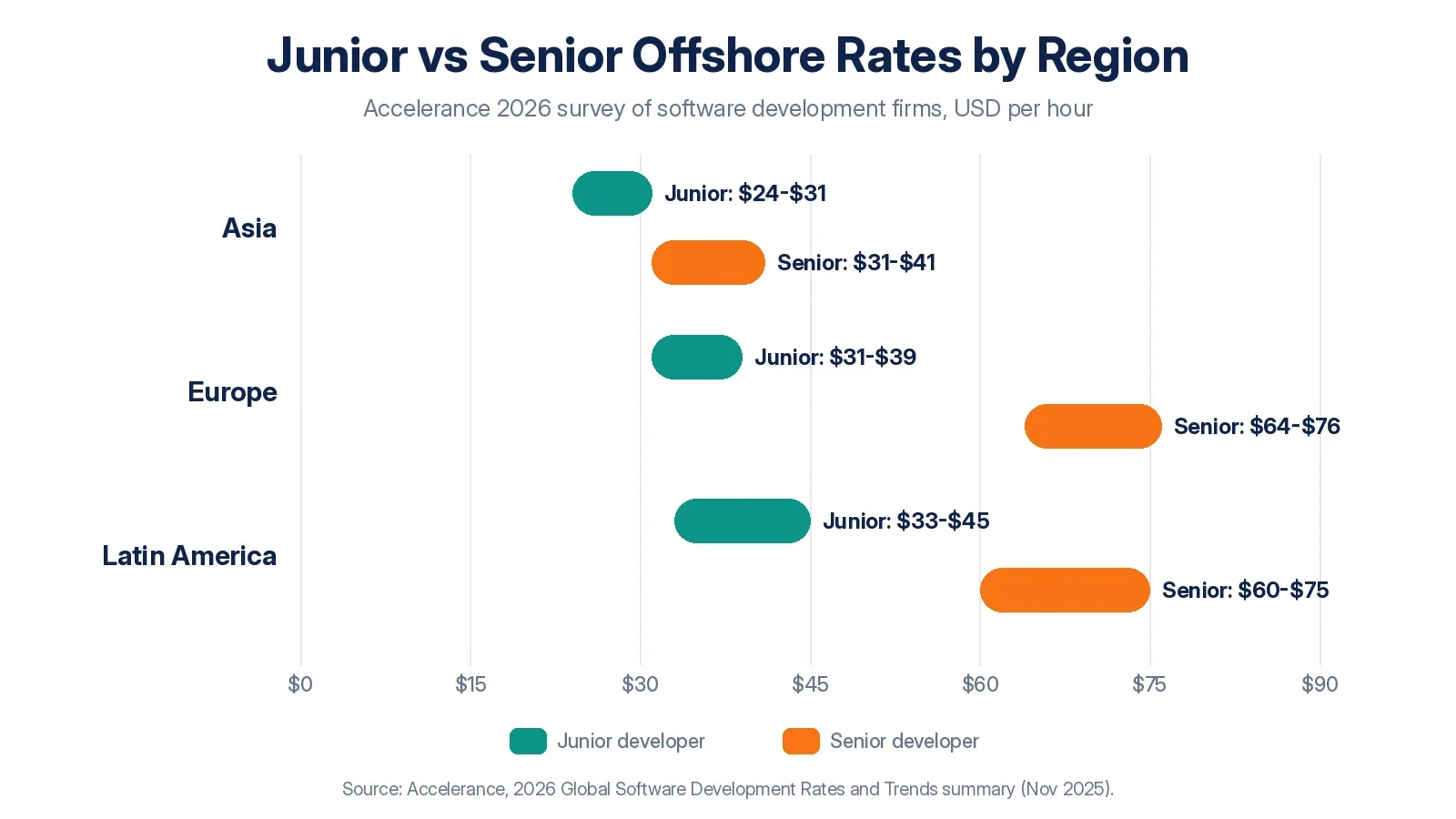
Country averages hide the biggest single factor in any quote: seniority. Most lists of offshore software development rates by country show one number per country, but that number changes a lot with experience. A senior engineer can cost almost twice as much as a junior one in the same city. The best public view of this comes from Accelerance, an outsourcing advisory firm. Its 2026 rate trends summary, based on a survey of software development firms, gives these regional bands.
| Region (Accelerance grouping) | Junior developer (USD/hour) | Senior developer (USD/hour) | Change in 2025 |
|---|---|---|---|
| Asia | $24 to $31 | $31 to $41 | Down nearly 8% |
| Europe | $31 to $39 | $64 to $76 | Down 4.4% |
| Latin America | $33 to $45 | $60 to $75 | Down 7.1% |
Two things stand out in these offshore software development rates by country groupings. First, rates in all three regions went down in 2025, not up. Accelerance links this to strong competition and wider use of AI tools by development teams. Second, the gap between junior and senior pay is much smaller in Asia than in Europe or Latin America. That makes senior talent in India and nearby countries a strong value, as long as you check that "senior" really means senior.
Use seniority as your main lever when you read offshore software development rates by country. A team with one strong senior engineer and two mid-level developers often ships faster than four juniors, even though its blended rate is higher. You pay for fewer hours, fewer bugs and less of your own management time.
Takeaway: compare offshore software development rates by country at the same seniority level. A senior rate in Asia often costs about what a junior rate costs in Latin America.
Offshore vs Nearshore vs Onshore Costs
Offshore means a team far away, often in a very different time zone, such as a US company working with India. Nearshore means a nearby country with similar working hours, such as a US company working with Mexico or a German company working with Poland. Onshore means a team in your own country.
To put offshore software development rates by country in context, you need an onshore baseline. Start with pay. The US Bureau of Labor Statistics reports a 2025 median pay of $134,040 a year, or $64.44 an hour, for software developers, QA analysts and testers. That is wages only. Once an employer adds benefits, payroll taxes, equipment, office space and management, the real hourly cost of an in-house US developer is much higher. US agencies then add their own overhead and margin on top.
Here is how the three models usually compare for a US or Canadian buyer.
| Model | Typical agency rate (USD/hour) | Working-hour overlap | Best for |
|---|---|---|---|
| Offshore (South and Southeast Asia) | $20 to $50 | Little or none | Clear scope, async teams, longer builds |
| Nearshore (Latin America for US buyers) | $35 to $65 | 6 to 8 hours | Daily calls, fast feedback, agile sprints |
| Onshore (US or Canada) | $85 to $165 | Full day | In-person work, regulated projects, small scopes |
Many companies mix these models instead of picking one. A common setup is a product owner and lead in North America with the build team offshore. Softfix works this way too, with an office in Toronto and a delivery team in Lucknow, India, so clients get a local contact and offshore pricing.
Takeaway: offshore gives the lowest rate, nearshore gives the most shared hours, and onshore gives the easiest communication. Offshore software development rates by country only tell you the first part. Pick the model that matches how closely you need to work with the team each day.
What Drives Offshore Software Development Rates by Country
Several forces explain why offshore software development rates by country differ so much, and why two vendors in the same city can quote very different numbers.
- Local salaries and cost of living. Engineers in India or Vietnam earn less in dollar terms than engineers in Poland or the US, so firms there can charge less and still pay well locally.
- Seniority mix. A quote built on senior engineers costs more per hour than one built on juniors, but usually needs fewer hours.
- Technology stack. Common stacks such as PHP, JavaScript, .NET and Java cost less. Rare skills such as AI and machine learning, data engineering, blockchain or legacy systems cost more in every country.
- Company size and brand. Global firms with large sales teams and offices charge more than lean, specialist firms with the same engineers.
- Engagement model. Fixed-price projects include a risk buffer. Time and materials and dedicated teams usually have lower hourly rates but less cost certainty.
- Time-zone premium. Nearshore teams that work your hours can charge more because they save you management time.
- Currency and demand. Exchange rates and local demand for engineers move rates over time, which is why rates can fall in one year and rise in the next.
Takeaway: offshore software development rates by country set the starting range, but seniority, stack and engagement model decide where your quote lands inside it.

A Monthly Team Budget, Worked Out
Offshore software development rates by country are hard to picture as hourly numbers. A monthly team budget is easier. Take a typical product team: one senior developer, two mid-level developers, one QA engineer and a half-time project manager or designer. That is 4.5 people at about 160 hours a month each, or roughly 720 billable hours.
Here is what that same team might cost each month at different blended rates. These are planning estimates, not quotes. Rupee figures use roughly ₹93 to the dollar (November 2026) and are for comparison only.
| Team location | Blended rate (USD/hour, estimate) | Monthly cost for 720 hours | Rough INR comparison |
|---|---|---|---|
| India | $25 to $40 | $18,000 to $28,800 | About ₹17 lakh to ₹27 lakh |
| Eastern Europe | $45 to $65 | $32,400 to $46,800 | About ₹30 lakh to ₹44 lakh |
| Latin America | $45 to $65 | $32,400 to $46,800 | About ₹30 lakh to ₹44 lakh |
| Western Europe or UK | $70 to $110 | $50,400 to $79,200 | About ₹47 lakh to ₹74 lakh |
| US or Canada agency | $100 to $150 | $72,000 to $108,000 | About ₹67 lakh to ₹1 crore |
Over a six-month build, the gap between an India team and a US agency for this example is roughly $260,000 to $540,000. That is why offshore software development rates by country matter so much for a budget. The saving is real, but only if the offshore team is as productive as the one you compare it with.
For a product-level view of what this means for a first release, see our guide to the cost to build an MVP. If you want the monthly cost of a full-time India team in more depth, read our guide on how to hire a dedicated development team in India.
Takeaway: a 4.5-person offshore team in India can cost roughly 25% to 40% of the same team at a US agency. Always compare like for like, with the same roles and seniority.

How to Choose a Country and a Vendor
Choosing well matters more than finding the lowest number in a table of offshore software development rates by country. Start with how you work. If you need daily calls during US hours, nearshore may suit you. If your scope is clear and you are happy with written updates, offshore usually gives the best value. Then judge the vendor, not just the country, because offshore software development rates by country vary a lot between firms in the same city.
Before you ask for quotes, run through this list to compare vendors fairly.
Quick checklist
- ☐ Write a short scope with your main features, users and platforms.
- ☐ Ask each vendor for hours by phase and named roles, not just one total.
- ☐ Check the seniority of the actual people who will work on your project.
- ☐ Ask for two or three client references in your industry or region.
- ☐ Confirm you will own the code, designs and data, in writing.
- ☐ Agree on how many working hours will overlap each day.
- ☐ Start with a short paid discovery or trial sprint before a long contract.
Our guide on how to choose a custom software development company covers vendor checks in more detail. If you are budgeting a full product, our custom software development cost guide for India shows typical project price ranges.
Red Flags in Offshore Rate Quotes
Some quotes look attractive but carry hidden risk. Watch for these patterns when you compare offshore software development rates by country and vendors within them. Here are the mistakes and red flags that cost buyers the most.
Red flags to watch for
- ✗ A rate far below the local market, with no clear reason.
- ✗ One total price with no breakdown of hours, roles or phases.
- ✗ No named team, or a promise that senior people will "oversee" work done by juniors.
- ✗ No testing, design or project management in the quote.
- ✗ Code kept in the vendor's accounts, not yours.
- ✗ Pressure to sign a long contract before any trial work.
- ✗ Vague answers about who owns the code and data.
If you see two or more of these in a single quote, ask more questions before you sign. A quote that sits well below the offshore software development rates by country in this guide needs a clear explanation.

Get a Free Offshore Team Estimate
If you are ready to price your project, send us a short brief: what you are building, the main features, your platforms, the roles you think you need and any launch date or budget limit. That is enough for us to suggest a team shape, a monthly cost in USD and a realistic timeline.
Conclusion: Compare Costs, Not Just Rates
Offshore software development rates by country give you a useful starting point. In 2026, most offshore agencies in South and Southeast Asia bill about $20 to $50 an hour, Latin America and Eastern Europe about $35 to $80, and US agencies far more. Rates in the main offshore regions even dipped in 2025.
Even so, offshore software development rates by country are only half of the story. Seniority, working-hour overlap, team stability and the quality of your scope decide your real cost. Compare vendors on the same written scope, look at monthly team cost and total cost, and start with a small paid trial.
If you want a clear number for your own product, Softfix can help. Our team in Lucknow, with an office in Toronto, builds web, mobile and SaaS software for clients worldwide. Explore our software development services or our custom software development team, and ask us for a free team estimate based on real offshore software development rates by country, not guesswork.
Keep reading: Hire a dedicated development team in India · Cost to build an MVP · How to choose a custom software development company · How to hire an offshore development team · SaaS development cost · Pharmacy management software development cost
Related articles
 Articles
Custom software development cost in India
Learn what custom software costs in India, from MVPs to enterprise systems. See price ranges, cost factors and ways to save before you hire.
Learn more Articles
Custom software vs off-the-shelf software
Compare custom and off-the-shelf software on cost, speed, security and scalability. Use our checklist to decide what fits your business.
Learn more Articles
How to choose a custom software development company
Use this checklist to compare software vendors on experience, pricing, code ownership and support. Includes red flags and questions to ask.
Learn more Articles
AI in custom software development
See where AI adds real value in custom software, from chatbots to automation. Learn costs, risks and how to start with a small pilot.
Learn more