


Your pharmacy has outgrown its software. Stock counts drift, expired batches slip through, claims get rejected and every store runs its own spreadsheet. Before you replace it, you need a real budget. This guide explains pharmacy management software development cost in 2026 in US dollars. As a planning guide, a single-store core system often costs $30,000 to $75,000, a full retail pharmacy system $75,000 to $190,000, and a chain or e-pharmacy platform $150,000 to $400,000 or more. These are our estimates, not quotes.
You'll see what the system includes and what it costs by scope and feature. You'll also see how rules in the US, UK and EU change the price, how team region changes the total, what it costs to run, and when to buy instead. It is written for pharmacy owners, chains and health startups.
- A single-store core pharmacy system often costs $30,000 to $75,000, a full retail system $75,000 to $190,000 and a chain or e-pharmacy platform $150,000 to $400,000 or more (planning estimates).
- Integrations and compliance drive the price. Insurance claims, e-prescriptions and rules such as HIPAA, EPCS, GDPR or NHS EPS add the most work.
- The build is only the first bill. Plan for hosting, drug data licences, network fees and upkeep of about 15% to 20% of the build each year.
What Pharmacy Management Software Includes
A pharmacy management system runs the daily work of a pharmacy. It tracks stock by batch and expiry date and takes prescriptions. It guides staff through dispensing, rings up sales, bills insurers and keeps the records a regulator may ask for. A small shop needs some of this. A chain needs all of it, across every store.
Pharmacy work is more than retail. Staff handle patient data, prescription rules and, in many markets, controlled drugs. That is why pharmacy management software development cost is higher than the cost of a normal shop POS with the same number of screens. Each safety check, alert and audit record adds design, code and testing. A quote that ignores them will look cheap at first and grow later.
This article covers retail, chain and online pharmacies. A hospital pharmacy usually lives inside a wider hospital system, which our guide to hospital management software development cost covers. Lab testing workflows are covered in our diagnostic lab management software cost guide.
Here are the main drivers of pharmacy management software development cost, from the ones that move the price most to those that move it least.
| Cost driver | What it covers | Effect on the budget |
|---|---|---|
| Scope and modules | Inventory, POS, dispensing, claims, apps | High: each module adds weeks of work |
| Integrations | E-prescription networks, insurers, wholesalers, drug data | High: every outside system needs its own build and tests |
| Compliance | Privacy, security, controlled drugs, drug tracing | Medium to high, depending on the market |
| Number of stores | Central stock, transfers, roles per branch | Medium: grows with each location model |
| Team region | Hourly rate and skill mix | High: the same scope can cost 2 to 4 times more onshore |
Takeaway: integrations and compliance, not screen count, decide most of the price. List them first when you ask for a quote.
Pharmacy Management Software Development Cost by Scope
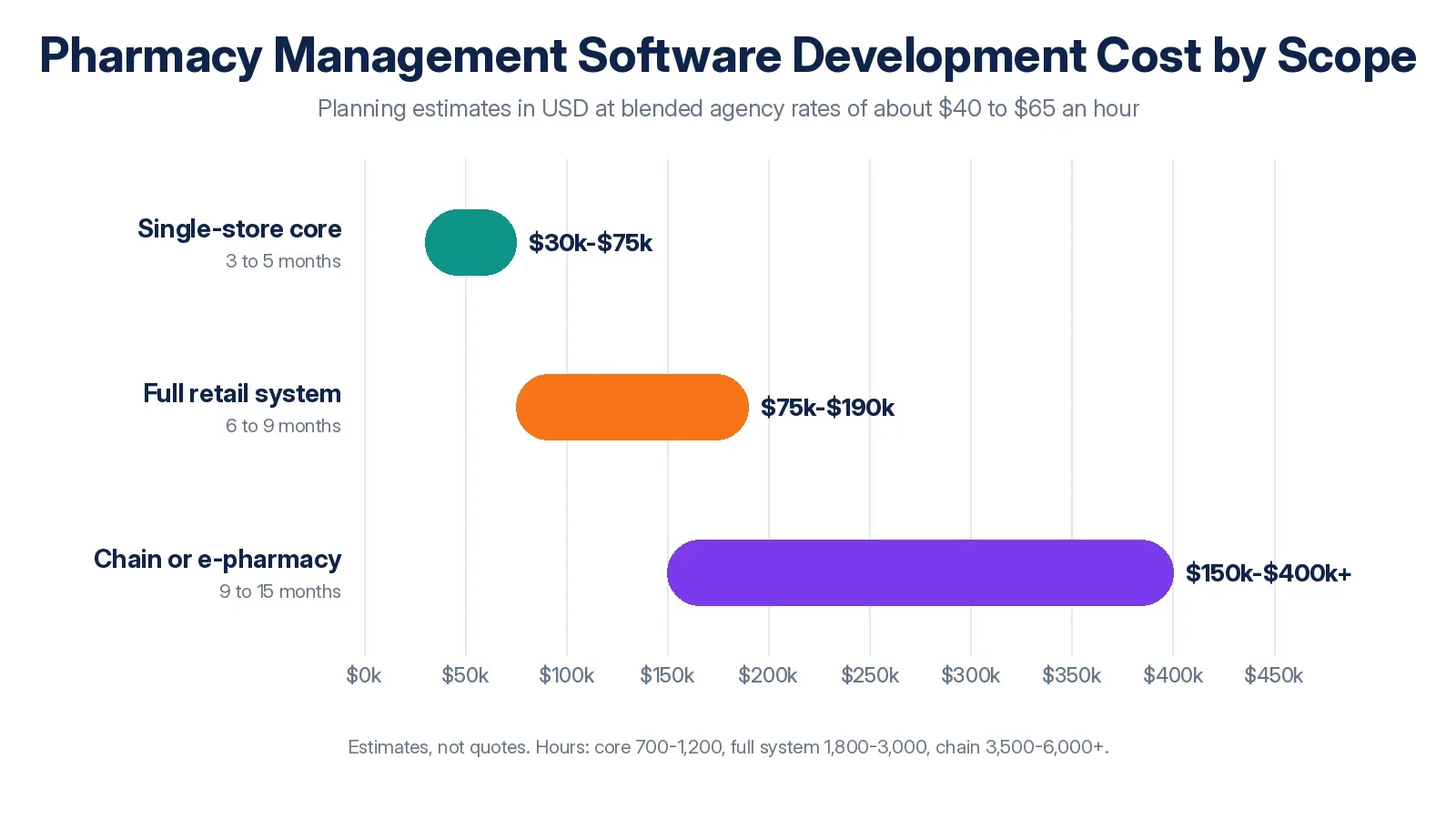
The fastest way to estimate pharmacy management software development cost is to pick a scope level. Most projects fall into one of three groups. The hours and prices below are our estimates at blended agency rates of about $40 to $65 an hour.
Use this table to compare pharmacy management software development cost across the three scope levels.
| Scope level | What it covers | Hours (estimate) | Cost in USD (estimate) | Timeline |
|---|---|---|---|---|
| Single-store core | Inventory with batch and expiry, POS and billing, prescription queue, basic reports | 700 to 1,200 | $30,000 to $75,000 | 3 to 5 months |
| Full retail system | Adds e-prescriptions, insurance claims, patient profiles, drug alerts, audit logs | 1,800 to 3,000 | $75,000 to $190,000 | 6 to 9 months |
| Chain or e-pharmacy platform | Adds central stock, store transfers, customer app, delivery, analytics | 3,500 to 6,000+ | $150,000 to $400,000+ | 9 to 15 months |
Other agencies publish similar bands. Several 2026 vendor guides put a small build at around $30,000 to $90,000 and chain systems above $350,000. So a wide spread in quotes is normal. What matters is which level your first release needs. Pharmacy management software development cost rises fast once you add claims and apps, so be strict about scope.
Start smaller than you think. A single-store core can go live, prove its value and give staff time to learn it. Add claims, apps and multi-store tools in later phases. Our guide to the cost to build an MVP explains how to cut a first version down to the parts that matter.
Takeaway: most independent pharmacies fit the first or second level. Only chains and online pharmacies need the full platform from day one.
Feature-by-Feature Cost Breakdown
If you already know the modules you need, price them one by one to build up your pharmacy management software development cost. This view of pharmacy management software development cost also helps you compare quotes. Ask each vendor to split its price the same way.
Here is the effort each common module adds. The hours are our estimates for a typical build and include design, code and testing.
| Module | What it does | Build effort (estimate) |
|---|---|---|
| Inventory, batch and expiry | Stock by batch, expiry alerts, reorder points, stock counts | 150 to 300 hours |
| POS and billing | Barcode sales, taxes, receipts, returns, discounts | 120 to 250 hours |
| Prescription intake and dispensing | Rx queue, labels, pharmacist checks, refills | 150 to 300 hours |
| E-prescriptions | Receive and update electronic prescriptions from a national or private network | 200 to 400 hours |
| Insurance claims | Submit claims, read rejections, resubmit, reconcile payments | 250 to 500 hours |
| Drug data and safety alerts | Interaction and allergy checks using a licensed drug database | 100 to 200 hours, plus licence fees |
| Multi-store tools | Central stock view, transfers, branch roles | 200 to 400 hours |
| Customer app and delivery | Online orders, refill requests, delivery tracking | 400 to 800 hours |
Two modules raise pharmacy management software development cost more than buyers expect. Insurance claims take time because every payer has its own rules and error codes. E-prescription links take time because each network has its own testing and approval steps before you can go live.
Do not build a drug database yourself, since it would add a lot to pharmacy management software development cost. Licence one from a specialist provider and connect to it. The licence fee becomes a running cost, but it is far cheaper and safer than keeping drug data up to date on your own.
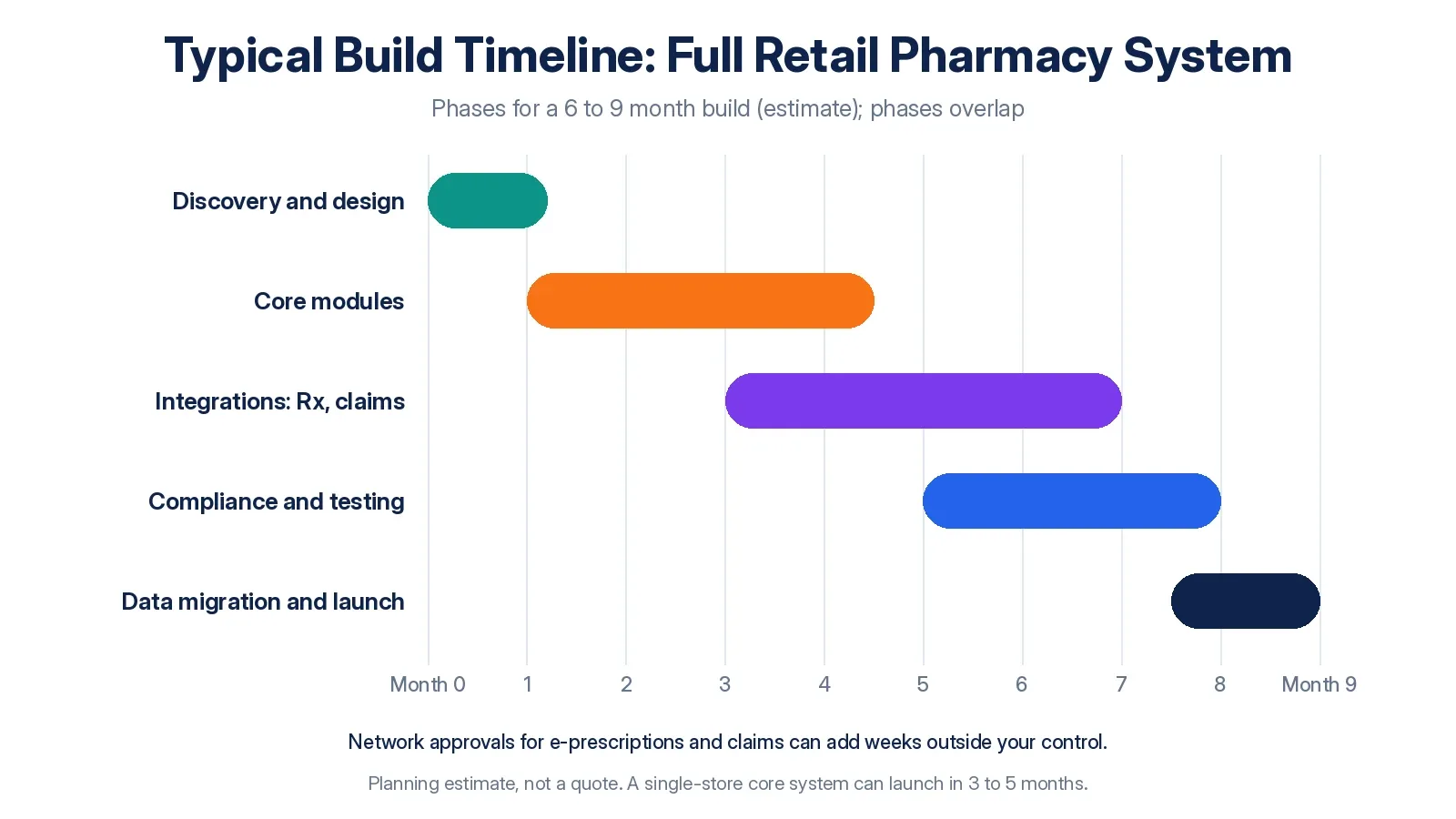
Time matters as much as money. A typical full retail build runs in five phases: discovery and design, core modules, integrations, compliance and testing, then launch and data migration. Network approvals often sit outside your control, so start those talks early. Every extra month of team time adds to pharmacy management software development cost, so a clear plan saves real money.
Takeaway: claims and e-prescriptions together can be a third of the build. If you can launch without them, your first release gets much cheaper.
Compliance by Market: HIPAA, EPCS, DSCSA, GDPR and NHS EPS
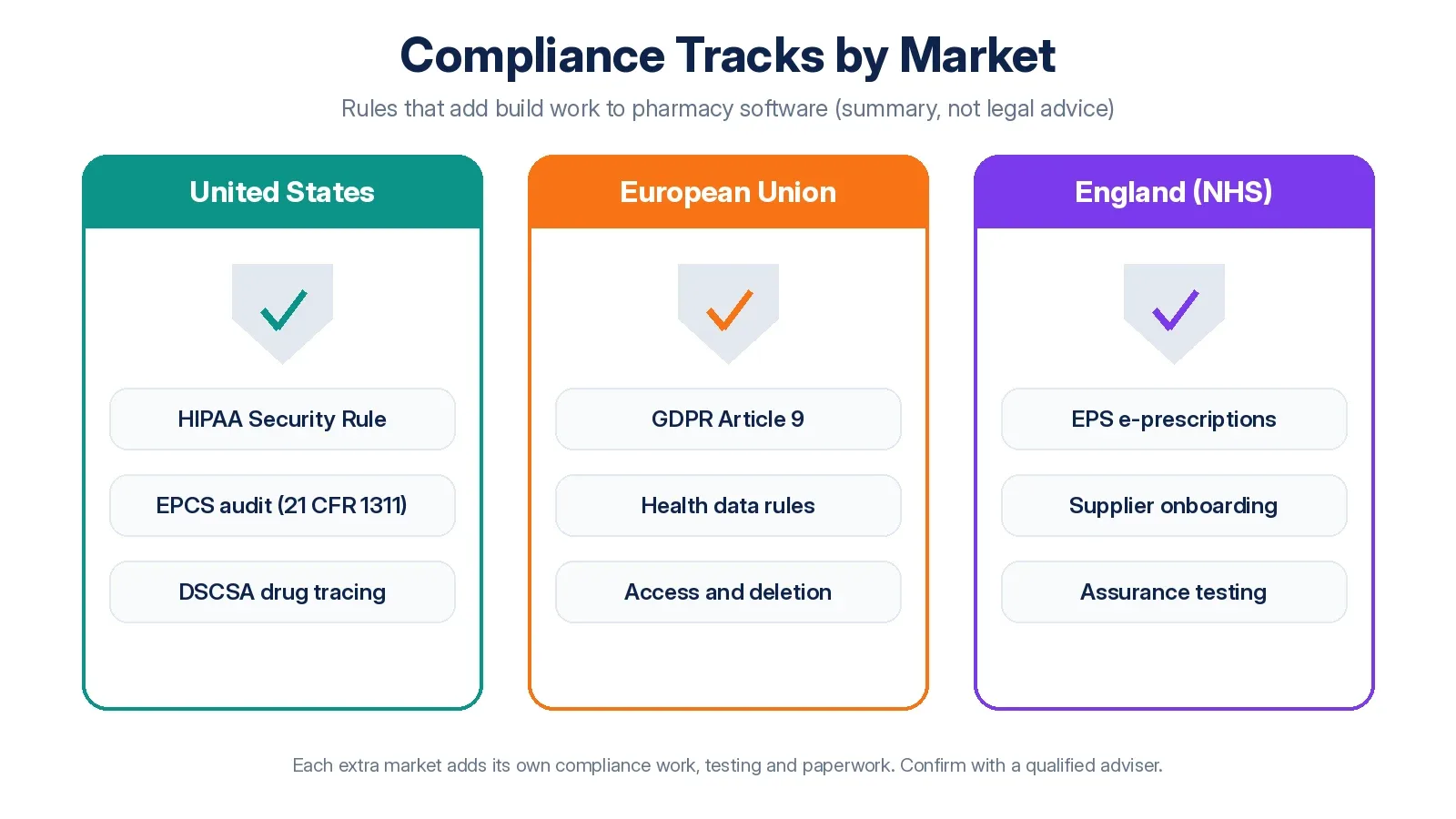
Compliance is where pharmacy management software development cost differs most by country. The rules below come from the official pages we opened. This is a summary for budgeting, not legal advice, so confirm what applies to you with a qualified adviser.
In the US, the HHS summary of the HIPAA Security Rule sets rules for covered entities and their business associates. They must have administrative, physical and technical safeguards for electronic health data. That includes a risk analysis and audit controls that record activity in systems holding that data. A software vendor that handles this data for a pharmacy usually signs a business associate agreement.
Controlled drugs add more work. Under 21 CFR 1311.300, the provider of a pharmacy app needs a third-party audit or approved certification. It must have this before the app handles electronic prescriptions for controlled drugs. It must repeat this when related features change, or every two years, whichever comes first. The FDA's Drug Supply Chain Security Act page describes an electronic way to trace certain prescription drugs at the package level. That affects how you record stock you receive.
In the EU, GDPR Article 9 treats health data as a special category. It may only be processed under listed conditions, such as providing health care. In England, NHS England's Electronic Prescription Service page says over 95% of prescriptions are now produced electronically. EPS is not strictly mandated but is strongly recommended, and suppliers go through an onboarding and assurance process.
Here is how each track changes the product work. The extra hours are our estimates.
| Market or rule | What it means for the software | Extra build effort (estimate) |
|---|---|---|
| US: HIPAA Security Rule | Access controls, audit logs, encryption, risk analysis support | 120 to 250 hours |
| US: EPCS (21 CFR 1311) | Controlled-drug Rx handling plus third-party audit | 150 to 300 hours, plus audit fee |
| US: DSCSA | Capture and store product tracing data on receipt | 80 to 200 hours |
| EU: GDPR Article 9 | Lawful basis, access and deletion requests, data minimisation | 80 to 160 hours |
| England: NHS EPS | Supplier onboarding and assurance for e-prescriptions | 150 to 300 hours |
Other markets add their own rules. In Canada, PIPEDA covers how private businesses handle personal information, and Ontario, New Brunswick, Nova Scotia and Newfoundland and Labrador have their own health information laws, as the Office of the Privacy Commissioner of Canada explains. In Australia, most community pharmacies now dispense from electronic prescriptions, according to the Australian Digital Health Agency, so your software should handle e-prescription tokens. In India, the Digital Personal Data Protection Act, 2023 sets consent and processing rules for digital personal data. Check the exact duties in each market with a local adviser before you fix the scope.
Compliance work also lasts after launch. Rules change, audits repeat and security tests need to run each year. Count that time when you compare pharmacy management software development cost between vendors, because a cheap quote with no compliance plan is not cheap.
Takeaway: pick one market for launch. Each extra country adds its own compliance track, testing and paperwork to the budget.
Pharmacy Management Software Development Cost by Team Region
Where your team is based changes pharmacy management software development cost more than almost any feature. It is the one lever you control from the first day. For context, the US Bureau of Labor Statistics puts the median pay of software developers at $135,980 a year in May 2025, in its Occupational Outlook Handbook. Agency rates sit above salary because they include management, testing, tools and profit.
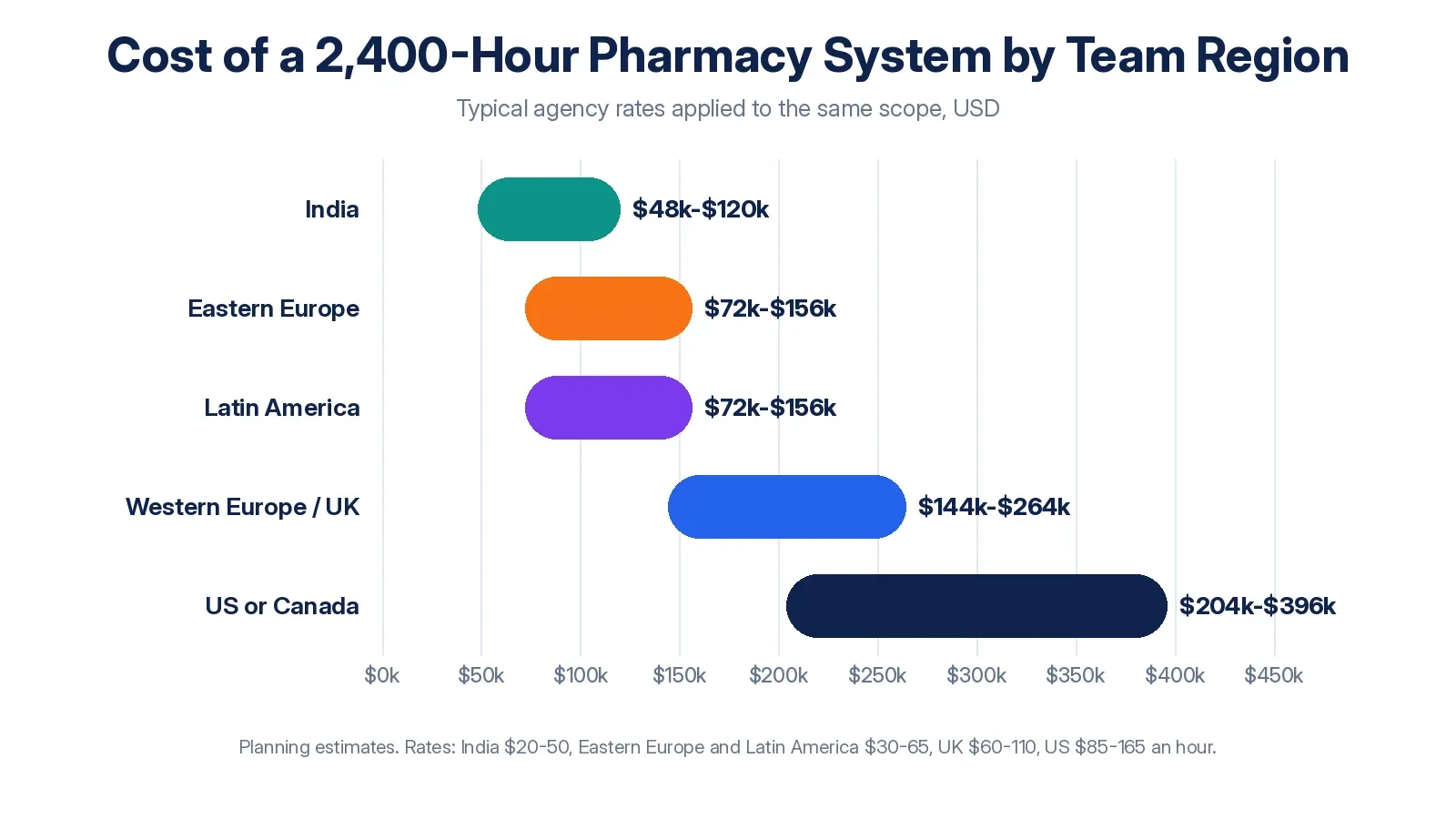
The table below prices one example, a 2,400-hour full retail system, at typical agency rates by region. The rates come from our guide to offshore software development rates by country, and the totals are estimates.
| Team region | Typical agency rate (USD per hour) | 2,400-hour system (USD, estimate) | Working-hours overlap with US East |
|---|---|---|---|
| India | $20 to $50 | $48,000 to $120,000 | Low, needs a planned overlap window |
| Eastern Europe | $30 to $65 | $72,000 to $156,000 | 1 to 2 hours |
| Latin America | $30 to $65 | $72,000 to $156,000 | 6 to 7 hours |
| Western Europe or UK | $60 to $110 | $144,000 to $264,000 | 2 to 3 hours |
| US or Canada | $85 to $165 | $204,000 to $396,000 | Full day |
A lower rate only cuts pharmacy management software development cost if the team knows health data. Ask for proof that the team has built systems with audit logs, role-based access and encrypted records. A weak team will lose its savings through rework and failed audits. Many buyers mix models: a product lead near the pharmacy, with a delivery team offshore. This keeps pharmacy management software development cost down while someone close to the business owns the decisions.
Takeaway: compare the total cost for the same scope, not the hourly rate alone. Healthcare experience matters more than the cheapest rate.
Running Costs After Launch
The build is only the first bill. Once the system is live, you pay every month to host it, license data and keep it safe. Plan these costs before you sign. They decide the true pharmacy management software development cost over five years.
Here are the main running costs. The ranges are our planning estimates, and the licence and network fees depend on vendor quotes.
| Running cost | What it covers | Planning range (estimate) |
|---|---|---|
| Cloud hosting and backups | Servers, database, storage, monitoring | $150 to $800 a month for one store, $800 to $4,000+ for a chain |
| Drug database licence | Drug names, interactions, pricing data | Vendor quote, often priced per store |
| E-prescription and claims networks | Per-transaction or monthly network fees | Vendor quote |
| Maintenance and updates | Bug fixes, security patches, rule changes | 15% to 20% of the build cost each year |
| Audits and reviews | EPCS audit every two years in the US, security tests | Auditor quote |
Maintenance is the part of pharmacy management software development cost that most buyers forget. A common planning rule is 15% to 20% of the build each year. That is a rule of thumb, not a measured average, so ask every vendor for a written support plan with response times.
Takeaway: for every $100,000 of build, plan for roughly $15,000 to $20,000 a year of upkeep, plus hosting and licence fees.
Build vs Buy: When Custom Software Makes Sense
You do not always need custom software. Off-the-shelf pharmacy systems already cover inventory, POS and dispensing for many small shops. They charge a monthly fee and handle updates and certification for you. Our guide on custom vs off-the-shelf software explains the general trade-offs.
Custom software makes sense in three cases. Your workflow doesn't fit a packaged product. You run several stores with a central warehouse. Or you are building a new online pharmacy. It also makes sense when per-store fees across a chain add up to more than owning the system. Compare five years of fees with the full pharmacy management software development cost, including upkeep, before you decide.
Here is a simple way to compare the two paths.
| Factor | Buy off-the-shelf | Build custom |
|---|---|---|
| Upfront cost | Low: setup and training | High: $30,000 to $400,000+ (estimate) |
| Monthly cost | Subscription per store or user | Hosting, licences and maintenance |
| Fit to your workflow | You adapt to the product | The product fits your workflow |
| Compliance and certification | Vendor handles most of it | You and your developer own it |
| Data and roadmap control | Limited | Full ownership of code and data |
A middle path is common, and it often gives the lowest pharmacy management software development cost. Keep a certified packaged system for dispensing and claims, then build custom tools around it for stock, reports, a customer app or delivery. This hybrid saves money because you avoid rebuilding the most regulated parts.
Takeaway: buy if a packaged system fits 80% of your work. Build or extend when your workflow is your edge or per-store fees keep rising.
How to Budget and Choose a Development Partner
Your pharmacy management software development cost budget should start with a written scope. List your stores, user roles, daily workflows and every outside system you must connect to. Mark each feature as "launch," "next" or "later." Then ask vendors to price the launch list only, plus a separate estimate for the next phase. Our healthcare software development page shows the kinds of systems we build for clinics, labs and pharmacies.
Before you ask for quotes, run through this list so you can compare each pharmacy management software development cost quote fairly.
Quick checklist
- ☐ You have a one-page scope with stores, roles, workflows and integrations.
- ☐ You know which market you launch in and which rules apply there.
- ☐ The quote splits design, development, testing, compliance work and project management.
- ☐ Drug data, e-prescription and claims networks are listed with their own fees.
- ☐ Hosting, maintenance and audits are listed as running costs.
- ☐ You'll own the code, the cloud accounts and the data from day one.
- ☐ The vendor can show a health or pharmacy system it has built before.
Here are the red flags that most often push pharmacy management software development cost far past the quote.
Red flags to watch for
- ✗ A fixed price with no written feature list or change process.
- ✗ No mention of audit logs, encryption or access roles.
- ✗ A plan to build a drug database from scratch.
- ✗ Compliance described as "included" with no detail.
- ✗ Hosting and licence fees left out of the proposal.
Takeaway: a clear scope and a short paid discovery phase save more money than any discount on the hourly rate.
Get a Free Pharmacy Software Cost Estimate
Ready to price your system? Send us a short brief: how many stores you run, the market you serve, the modules you need, the systems you must connect to and any launch date or budget limit. That is enough for us to suggest a phased plan, a budget in USD and a realistic timeline.
Conclusion: Plan the Build and the Run
Pharmacy management software development cost in 2026 depends on scope, integrations, compliance and team far more than on screen count. As a planning guide, a single-store core system often costs $30,000 to $75,000, a full retail system $75,000 to $190,000, and a chain or e-pharmacy platform $150,000 to $400,000 or more. Then add the run: hosting, drug data licences, network fees and upkeep of about 15% to 20% of the build each year.
To keep pharmacy management software development cost under control, launch in one market, start with the core modules, license drug data and plan compliance work from day one. If you want a pharmacy management software development cost estimate for your own business, share your scope with us. We'll send a phase-by-phase budget and timeline in USD.
Keep reading: Hospital management software development cost · Diagnostic lab management software cost · Offshore software development rates by country · SaaS development cost · How to hire an offshore development team · Property management software development cost
Related articles
 Industries
Healthcare
Simplify healthcare operations with Softfix healthcare software solutions. Develop secure, scalable digital systems for patient management, clinical workflows and care delivery.
Learn more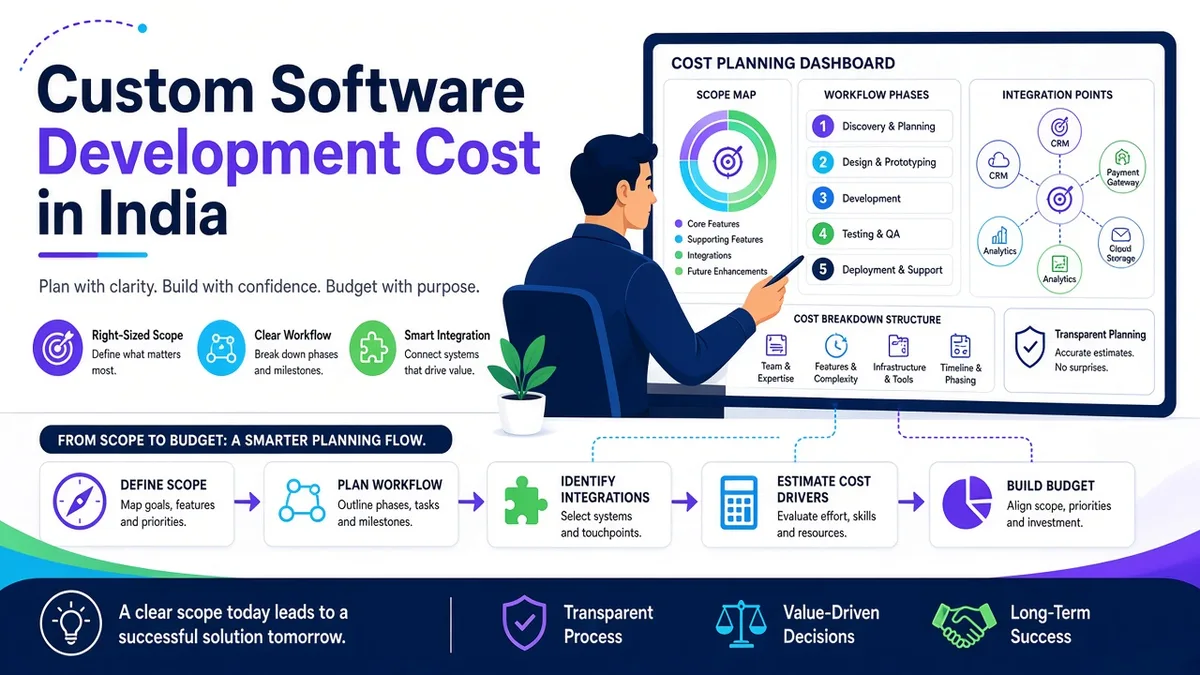 Articles
Custom software development cost in India
Learn what custom software costs in India, from MVPs to enterprise systems. See price ranges, cost factors and ways to save before you hire.
Learn more Articles
Custom software vs off-the-shelf software
Compare custom and off-the-shelf software on cost, speed, security and scalability. Use our checklist to decide what fits your business.
Learn more Articles
How to choose a custom software development company
Use this checklist to compare software vendors on experience, pricing, code ownership and support. Includes red flags and questions to ask.
Learn more