


You have a delivery idea, a few restaurants ready to sign and one big question: what will the app cost? Quotes range from a $5,000 script to a $300,000 platform, and both claim to do the same job. This guide breaks down food delivery app development cost for 2026 in US dollars, so you can set a real budget before you call a vendor. In short, a single-restaurant ordering app starts around $20,000, a local marketplace with four apps runs $60,000 to $150,000, and multi-city platforms pass $300,000.
You'll see cost by app type, what each of the four apps costs, which features drive the price, how team region changes the bill, a realistic timeline, the running fees for maps and payments, and the red flags in a quote. It is written for founders, restaurant groups and grocery operators planning their own platform.
- Food delivery app development cost runs from about $20,000 for a single-restaurant app to $60,000–$150,000 for a four-app local marketplace, and $300,000+ for multi-city platforms.
- A marketplace is four apps on one backend: customer, restaurant, driver and admin. Live tracking, dispatch and payments are the features that move the budget most.
- Plan for running costs too: card fees (2.9% + 30¢ per US Stripe charge), maps, hosting and about 15–20% a year for maintenance.
Food Delivery App Development Cost at a Glance
The biggest factor in food delivery app development cost is not a feature. It is the type of business the app supports. A restaurant that wants its own ordering app has a far lower food delivery app development cost, because it needs far less software than a company that wants to sign up hundreds of restaurants, manage its own riders and handle refunds for all of them.
There are four common product types. A single-restaurant or small-chain app lets customers order from one brand. Delivery is often done by the restaurant's own staff or a third-party courier, so there may be no driver app at all. A local aggregator, or marketplace, lists many restaurants in one city and runs its own rider fleet. A grocery delivery app looks like an aggregator, but it adds large product catalogs, stock levels, item swaps and delivery time slots. A multi-city platform adds several zones, smart dispatch, many payment methods and heavy reporting.
Here is how food delivery app development cost changes by product type. The ranges assume an experienced offshore or nearshore agency and cross-platform apps.
| App type | Apps included | Typical build cost (USD) | Typical timeline |
|---|---|---|---|
| Single-restaurant or small chain | Customer app, simple admin panel | $20,000 – $60,000 | 2 – 4 months |
| Local aggregator (marketplace) | Customer, restaurant, driver and admin apps | $60,000 – $150,000 | 5 – 9 months |
| Grocery delivery | Customer, store picker, driver and admin apps | $80,000 – $180,000 | 6 – 10 months |
| Multi-city platform | All four apps plus dispatch, zones and analytics | $150,000 – $300,000+ | 9 – 14 months |
Takeaway: Decide your business model first, because it sets your food delivery app development cost more than any feature. The jump from one restaurant to a marketplace roughly triples the budget, because you add two more apps and a lot of back-office work.
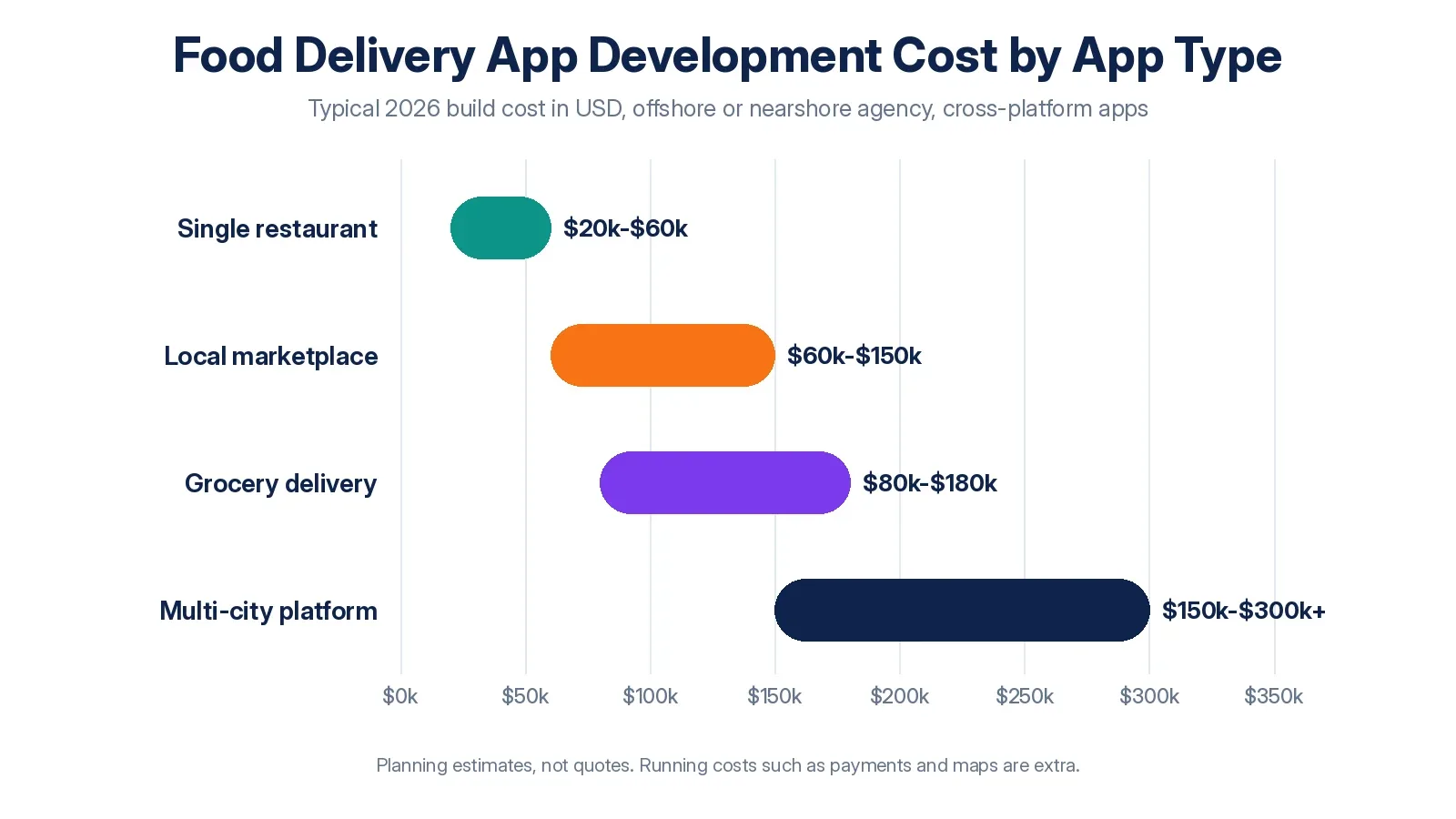
These food delivery app development cost figures are planning estimates based on typical project hours and published agency rate ranges, not quotes. Competitor guides we reviewed in November 2026 quote similar bands, though some start their MVP tier as high as $50,000 because they assume US-level rates. If you are not sure which type you need, start smaller. A focused first version, as explained in our guide to the cost to build an MVP, lets you prove demand before you fund a full platform.
The Four Apps Behind Every Delivery Platform
When people ask about food delivery app development cost, they often picture one app on a phone. A real marketplace is four connected products that share one backend. Each one needs its own screens, logic and testing.
- Customer app. Browse restaurants, search menus, build a cart, pay, track the order on a map, rate and reorder. This is the app people see, so it gets the most design time.
- Restaurant app or panel. Accept or reject orders, set preparation times, switch items on or off, edit menus and see payouts. Many teams build this as a tablet app or a web panel.
- Driver app. Go online or offline, accept jobs, follow turn-by-turn directions, confirm pickup and drop-off with a photo or code, and track earnings. It must run in the background and save battery.
- Admin dashboard. Manage restaurants, riders, customers, zones, commissions, promo codes, refunds and reports. It is the control room for your whole business.
Below is a rough split of effort and food delivery app development cost for a local aggregator. It assumes a blended offshore agency rate of about $35 an hour.
| Component | Typical hours | Cost at about $35/hr | Share of budget |
|---|---|---|---|
| Customer app (iOS and Android) | 900 – 1,300 | $31,500 – $45,500 | About 35% |
| Restaurant app or web panel | 350 – 550 | $12,250 – $19,250 | About 15% |
| Driver app | 450 – 700 | $15,750 – $24,500 | About 20% |
| Admin dashboard and backend APIs | 700 – 1,100 | $24,500 – $38,500 | About 30% |
| Total | 2,400 – 3,650 | $84,000 – $127,750 | 100% |
Takeaway: The customer app is the largest single item, but the backend and admin tools together cost almost as much. A quote that skips them is not a full quote.
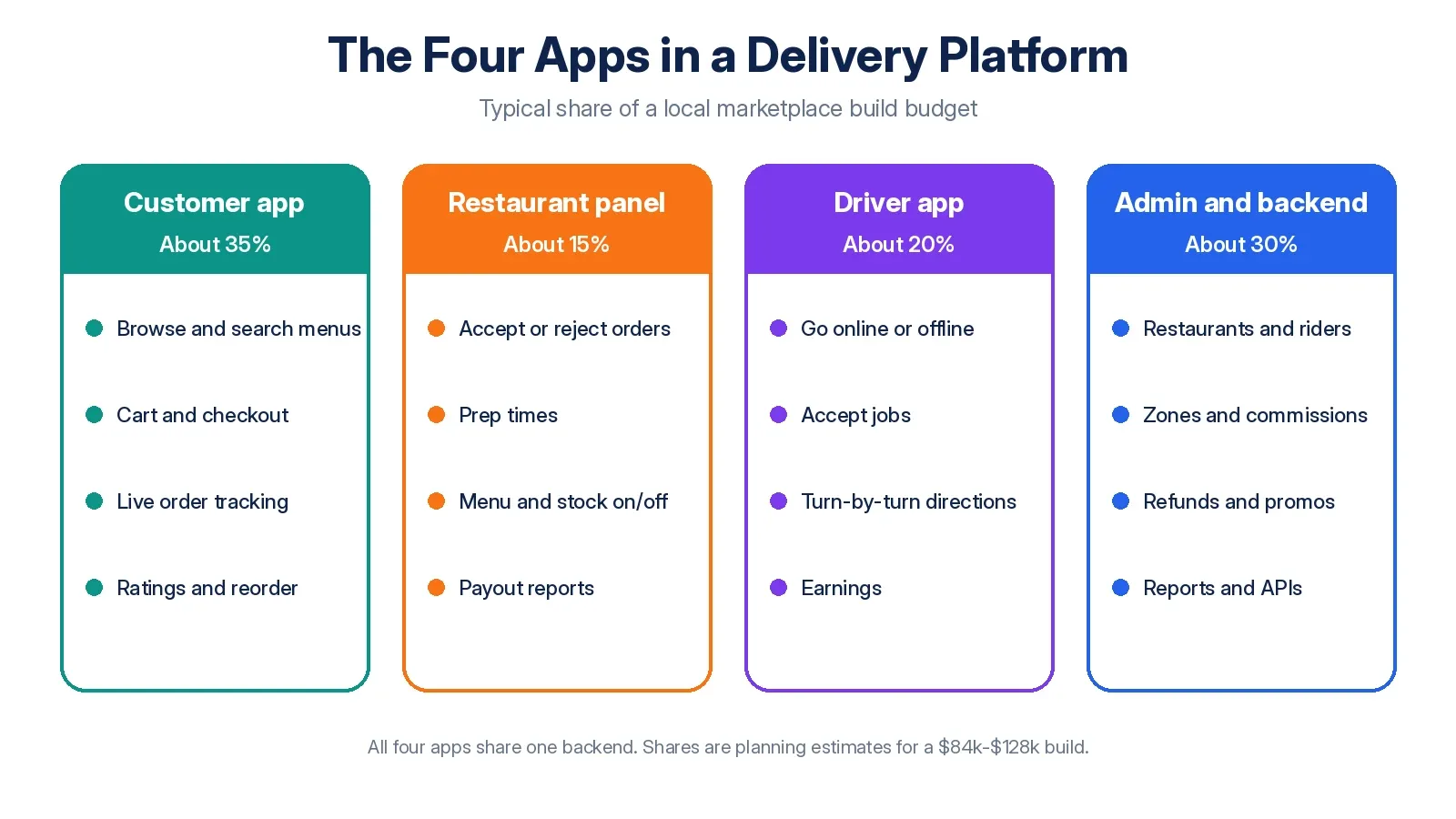
Hours include design, development, testing and project management spread across each app, so the food delivery app development cost per app is all-in. They are planning estimates, so use them to compare quotes line by line rather than as a fixed price.
Features That Drive Food Delivery App Development Cost
Two apps with the same screens can differ in food delivery app development cost by tens of thousands of dollars. The difference is usually in a handful of hard features. Real-time tracking, automatic dispatch and split payments take far more work than menus and carts.
Here are the features that move food delivery app development cost the most, with rough effort for each. Plan the must-haves for launch and push the rest to a later release to keep your first food delivery app development cost lean.
| Feature | Launch or later? | Extra effort (hours) | Why it costs more |
|---|---|---|---|
| Menus, cart and checkout | Launch | Included in base | Standard screens, but must handle add-ons and item options |
| Live order tracking on a map | Launch | 120 – 250 | Location updates every few seconds and a map on two apps |
| Order dispatch to riders | Launch (manual), later (automatic) | 80 – 400 | Automatic dispatch needs distance, load and timing rules |
| Payments and payouts to restaurants | Launch | 120 – 300 | Card payments, refunds and splitting money between parties |
| Push, SMS and email alerts | Launch | 60 – 120 | Status updates at every step of the order |
| Ratings, reviews and support chat | Launch or later | 80 – 200 | Moderation tools and admin views |
| Promo codes, loyalty and referrals | Later | 100 – 250 | Rules engine and fraud checks |
| POS integration with restaurants | Later | 150 – 400 per POS | Each POS brand has its own API |
| Grocery catalog, stock and item swaps | Grocery only | 300 – 700 | Thousands of products, picking flow and substitutions |
| Scheduled orders and delivery slots | Later (grocery: launch) | 80 – 160 | Slot capacity rules for kitchens, stores and riders |
Takeaway: Tracking, dispatch and payments are the three features that decide your budget. Start with manual dispatch from the admin panel and automate it once you have steady order volume.
A good way to keep food delivery app development cost under control is to write each feature as a short user story, then ask vendors to price the same list. If one vendor's total is far lower, check which features they left out.
Food Delivery App Development Cost by Team Region
The same scope costs very different amounts depending on where the team sits. Hourly agency rates in India and Southeast Asia are often a quarter to a third of rates in the US. That is why food delivery app development cost quotes from different countries look so far apart. Our breakdown of offshore software development rates by country explains the reasons in detail.
To show the effect, the table below prices one scope: a local aggregator of about 3,000 hours, with all four apps. Only the hourly rate changes.
| Team region | Typical agency rate (USD/hr) | Cost for a 3,000-hour build | Notes |
|---|---|---|---|
| India and Southeast Asia | $25 – $45 | $75,000 – $135,000 | Lowest cost, plan for time-zone overlap |
| Eastern Europe | $40 – $70 | $120,000 – $210,000 | Good overlap with the UK and Europe |
| Latin America | $40 – $70 | $120,000 – $210,000 | Same working hours as most of the US |
| Western Europe and UK | $80 – $130 | $240,000 – $390,000 | Local contracts and meetings |
| US and Canada | $100 – $160 | $300,000 – $480,000 | Highest cost, easiest communication |
Takeaway: Team region can change food delivery app development cost by four times for the same work. Pick on value: rate, overlap hours, past delivery projects and code ownership terms.
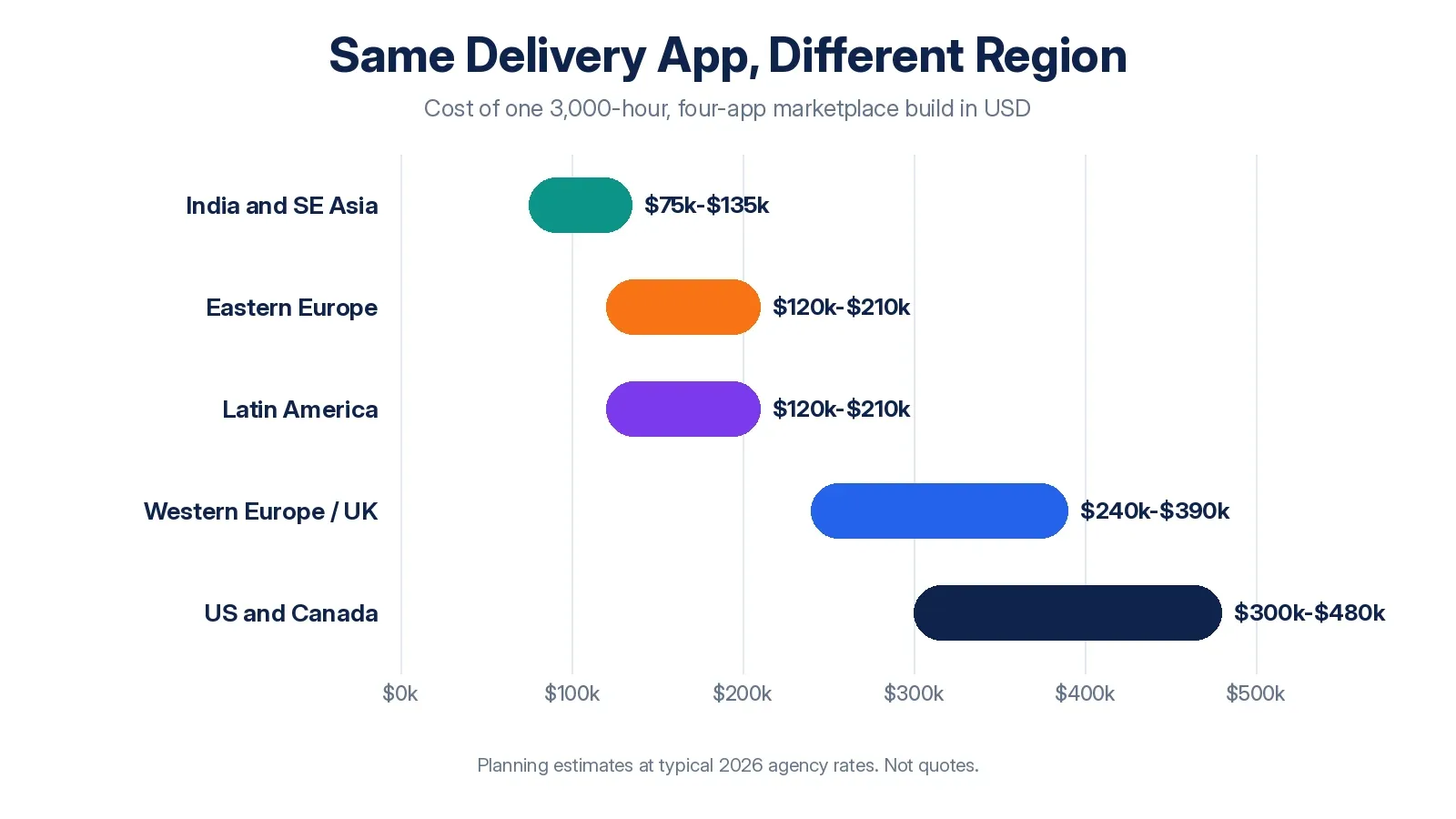
Rates are planning estimates based on published 2026 rate guides, not quotes. For readers comparing in rupees, an India-based build of this size works out to roughly ₹70 lakh to ₹1.25 crore at about ₹93 per dollar. Many founders mix regions to balance food delivery app development cost and control. For example, a product owner in the US or UK works with an offshore build team, which keeps the cost low and the decisions close to the market.
How Long a Delivery App Takes to Build
Time and money move together. Every extra month of development adds team cost, which raises food delivery app development cost, so a clear timeline is part of any honest quote. Most local marketplaces take five to nine months from the first workshop to the app stores.
Here is a typical timeline for a local aggregator with four apps. Single-restaurant apps compress each phase, while grocery and multi-city builds stretch them.
| Phase | What happens | Typical duration |
|---|---|---|
| Discovery and scope | Workshops, user stories, feature list, rough architecture | 2 – 4 weeks |
| UX and UI design | Wireframes and screen designs for all four apps | 3 – 6 weeks |
| Development sprints | Backend, customer, restaurant, driver and admin apps | 14 – 24 weeks |
| Testing and app store review | Device testing, load tests, store submission | 3 – 5 weeks |
| Pilot launch | Live orders in one area, bug fixes, tuning | 2 – 4 weeks |
Takeaway: Plan for six to nine months for a four-app marketplace, and price your food delivery app development cost around that timeline. Design and development can overlap, but skipping discovery usually adds more time later than it saves.
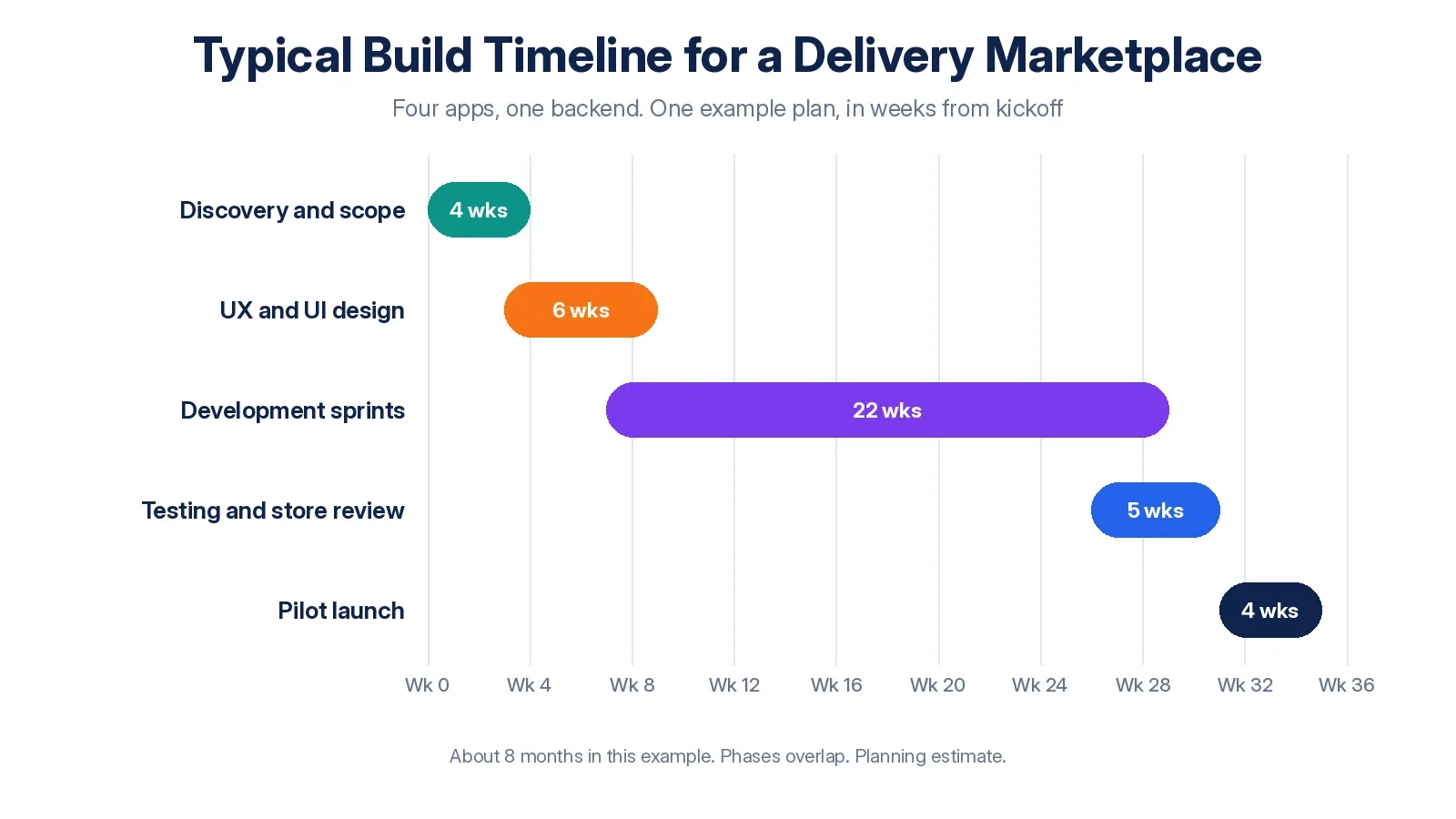
Apple and Google both review apps before they go live, and a rushed launch rarely saves on food delivery app development cost, so leave a buffer before any launch date you announce. A short pilot with a few restaurants in one neighbourhood is the cheapest way to find problems with dispatch and preparation times.
Custom Build or White-Label Script?
You will see ready-made "clone" scripts sold for a few thousand dollars. They look tempting next to a $100,000 quote, and they cut the upfront food delivery app development cost sharply. The trade-off is control. A script gives you generic screens and features, and its code may be hard to change, hard to scale or shared with many other buyers.
A white-label or script route can make sense for a quick test in one small market. It is risky when your plan depends on a unique feature, a specific dispatch model or integrations with local POS systems. Check whether you get full source code, who handles security fixes, and whether you can move the app to another vendor later.
Building custom costs more up front, but you own the product and can shape it around your margins. A middle path is common: start with a custom MVP built in a cross-platform framework such as Flutter, then grow it as orders come in. One codebase for iOS and Android usually keeps food delivery app development cost lower than two native apps.
If you need deep device features on Apple phones, a native iOS app may still be the better choice for the customer app.
How to Lower Your Budget and Pick a Partner
Most budget overruns in food delivery app development cost come from unclear scope, not from bad developers. The good news is that you can cut a lot of risk before any code is written.
- Launch in one city or neighbourhood first, with manual dispatch from the admin panel.
- Use cross-platform apps for the customer and driver apps.
- Build the restaurant side as a web panel before you build a tablet app.
- Use proven services for payments, maps and messages instead of building your own.
- Keep promo engines, loyalty and AI suggestions for version two.
Before you ask for quotes, run through this list so every vendor prices the same project:
Quick checklist
- ☐ A one-page summary of your business model and commission plan
- ☐ The list of apps you need and the users of each one
- ☐ Must-have features for launch, written as short user stories
- ☐ Target cities, languages and payment methods
- ☐ Integrations you need, such as POS systems or accounting tools
- ☐ Your launch date and total budget range
- ☐ Who will own the source code, cloud accounts and app store accounts
When you compare vendors, ask to see a delivery or on-demand app they built, and ask who will work on yours and how they estimate food delivery app development cost. Our guide on how to choose a custom software development company has more questions to ask. A strong partner will break food delivery app development cost into the four apps and the backend, show hours per item and explain what is not included.
Red Flags in Delivery App Quotes
A low quote can turn into the most expensive option if it hides gaps in your real food delivery app development cost. Here are the mistakes and warning signs that show up most often in delivery app proposals:
Red flags to watch for
- ✗ One price for "the app" with no split between the customer, restaurant, driver and admin apps
- ✗ No mention of the backend, server setup or admin dashboard
- ✗ Live tracking and dispatch listed as simple add-ons with tiny hour counts
- ✗ No testing phase, or testing on only one or two devices
- ✗ Running costs such as maps, payments, SMS and hosting left out completely
- ✗ Source code or app store accounts kept in the vendor's name
- ✗ A fixed launch date with no discovery phase to confirm scope
Takeaway: If a quote fails two or more of these checks, ask the vendor to price the same feature list again with each app and phase shown on its own line.
Get a Free Delivery App Estimate
Ready to price your platform? Send us a short brief: your business model, the cities you will launch in, which of the four apps you need, your must-have features and any launch date or budget limit. We will reply with a suggested scope, a timeline and a cost range in USD.
Conclusion: Budget for the Whole Platform
Food delivery app development cost in 2026 ranges from about $20,000 for a single-restaurant ordering app to $60,000 to $150,000 for a local marketplace, and well over $300,000 for a multi-city platform. The type of business you run is the first driver of food delivery app development cost. The number of apps, three hard features and your team's region decide where you land. On top of the build, plan for payment fees, maps, hosting and yearly maintenance.
The safest path is to define your model, launch a lean version in one area, and grow from real orders. Softfix builds mobile apps for startups and restaurant brands, with fixed scopes, clear estimates in USD and full code ownership for you.
Keep reading: Cost to build an MVP · Offshore software development rates by country · How to choose a custom software development company · Cost to build a marketplace app · White label app development · How to hire an offshore development team
Related articles
 Articles
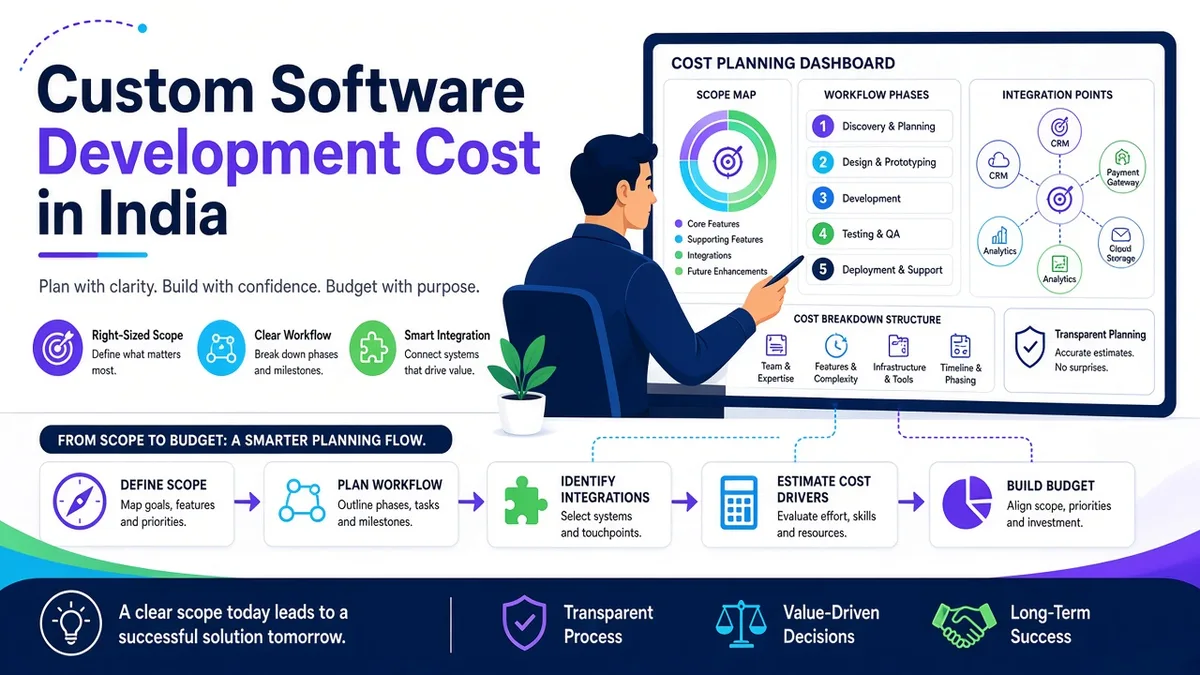
Custom software development cost in India
Learn what custom software costs in India, from MVPs to enterprise systems. See price ranges, cost factors and ways to save before you hire.
Learn more Articles
Custom software vs off-the-shelf software
Compare custom and off-the-shelf software on cost, speed, security and scalability. Use our checklist to decide what fits your business.
Learn more Articles
How to choose a custom software development company
Use this checklist to compare software vendors on experience, pricing, code ownership and support. Includes red flags and questions to ask.
Learn more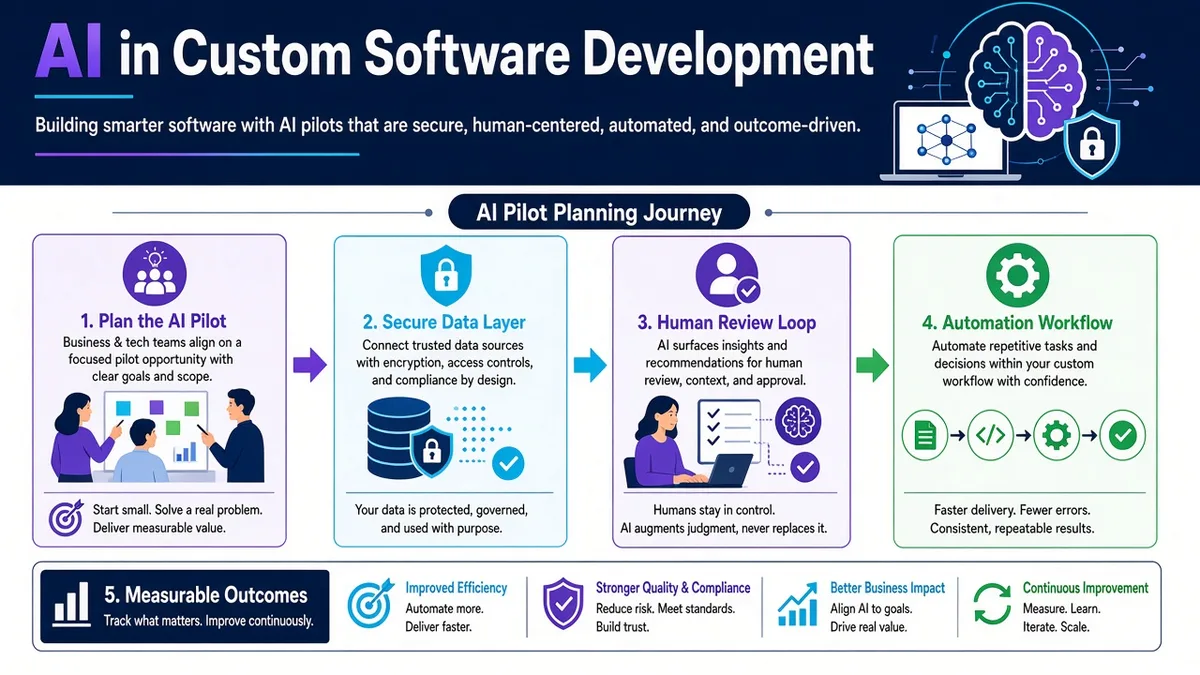 Articles
AI in custom software development
See where AI adds real value in custom software, from chatbots to automation. Learn costs, risks and how to start with a small pilot.
Learn more