


You manage a few hundred units, and your current tool charges per door, hides the API behind its top plan and still can't do the owner report you need. So you start asking what it would take to build your own. This guide explains property management software development cost in 2026 in plain US dollars. In short, property management software development cost runs from about $20,000 to $50,000 for a portal or module on top of your current system. A core custom system for one portfolio costs about $45,000 to $110,000, and a full platform $110,000 to $280,000 or more.
You'll see when buying beats building, cost by scope and module, integrations, team rates by region, running costs and a checklist for quotes. It is written for property managers, landlords and proptech founders in the US, Canada, the UK and Australia.
- A sidecar portal on top of your current system often costs $20,000 to $50,000, a core custom PMS $45,000 to $110,000 and a full platform $110,000 to $280,000 or more (planning estimates).
- Buying is cheaper for most standard portfolios. Build when per-unit fees, unusual workflows or a product idea make it pay back.
- The build is only the first bill. Plan for hosting, payment and screening fees, and upkeep of about 15% to 25% of the build each year.
What Drives Property Management Software Development Cost
Property management software, often called a PMS, runs the work that starts after a lease is signed. It tracks properties, units, tenants and leases. It collects rent, logs repair requests, pays vendors and sends owners their monthly statements. It keeps the books for every property and every owner.
That makes it different from a real estate CRM, which helps agents and builders find buyers and close deals. If your goal is lead tracking for brokers, read our guide to real estate CRM software development cost instead. This guide is about running rental properties day to day.
Property management software development cost comes down to hours multiplied by a rate. The hours depend on how many user roles you need, how many modules you build and how deep the accounting goes. Here is how each driver affects the budget, from the biggest to the smallest.
| Cost driver | What it covers | Effect on the budget |
|---|---|---|
| Accounting depth | Rent ledger, owner balances, trust or escrow rules, bank reconciliation | High: money logic needs careful design and testing |
| Number of portals | Tenant, owner, vendor and staff apps, each with its own screens | High: every portal adds design, code and tests |
| Team region and seniority | Hourly rate and skill mix of the team | High: the same scope can cost 2 to 4 times more onshore |
| Integrations | Payments, screening, e-signature, listings, accounting tools | Medium: each one adds setup, testing and upkeep |
| Data migration | Moving tenants, leases and balances from your old system | Medium: messy data is slow to clean |
| Mobile apps | Native iOS and Android apps for tenants or field staff | Medium: a responsive web app is cheaper to start |
Takeaway: accounting and the number of portals set most of your property management software development cost. Keep both small for the first release.
Build vs Buy: When Custom Software Makes Sense
Before you work out property management software development cost, price what you can buy. Ready-made platforms such as Buildium and AppFolio already handle leasing, rent, maintenance and accounting. For most small portfolios, buying is the cheaper and safer choice.
Here are published starting prices, checked in November 2026 on the Buildium pricing page and the AppFolio pricing page. The yearly figures are our math, licence only, before payment fees, onboarding and add-ons.
| Platform and plan | Published starting price | Yearly licence (our math) | API access |
|---|---|---|---|
| Buildium Essential | $65 per month | About $780 | Not listed on this plan |
| Buildium Growth | $202 per month | About $2,424 | Not listed on this plan |
| Buildium Premium | $420 per month | About $5,040 | Open API included |
| AppFolio Core, 500 units | $1.49 per unit per month (50-unit minimum) | About $8,940 | Not listed on this plan |
| AppFolio Max, 500 units | $5.00 per unit per month | About $30,000 | Read and write API |
Now compare that with property management software development cost for a custom build. A core system at $45,000 to $110,000 plus upkeep of 15% to 25% of the build each year costs far more than a $2,424 or $8,940 licence for years. Buying wins when your work looks like everyone else's.
Building starts to make sense in four cases. First, you run a large portfolio, so per-unit fees grow into tens of thousands of dollars a year. Second, your work doesn't fit the standard model, such as student housing by the bed, short-term rentals or mixed commercial leases. Third, you want to sell property software to other managers. Fourth, you only need one missing piece, such as a better owner portal, on top of the system you already use.
That last case is the most common, and it keeps property management software development cost at its lowest. You keep your current platform for the books and build a "sidecar" portal that pulls data through its API. Check which plan includes API access before you plan this, because both vendors keep it on higher tiers.
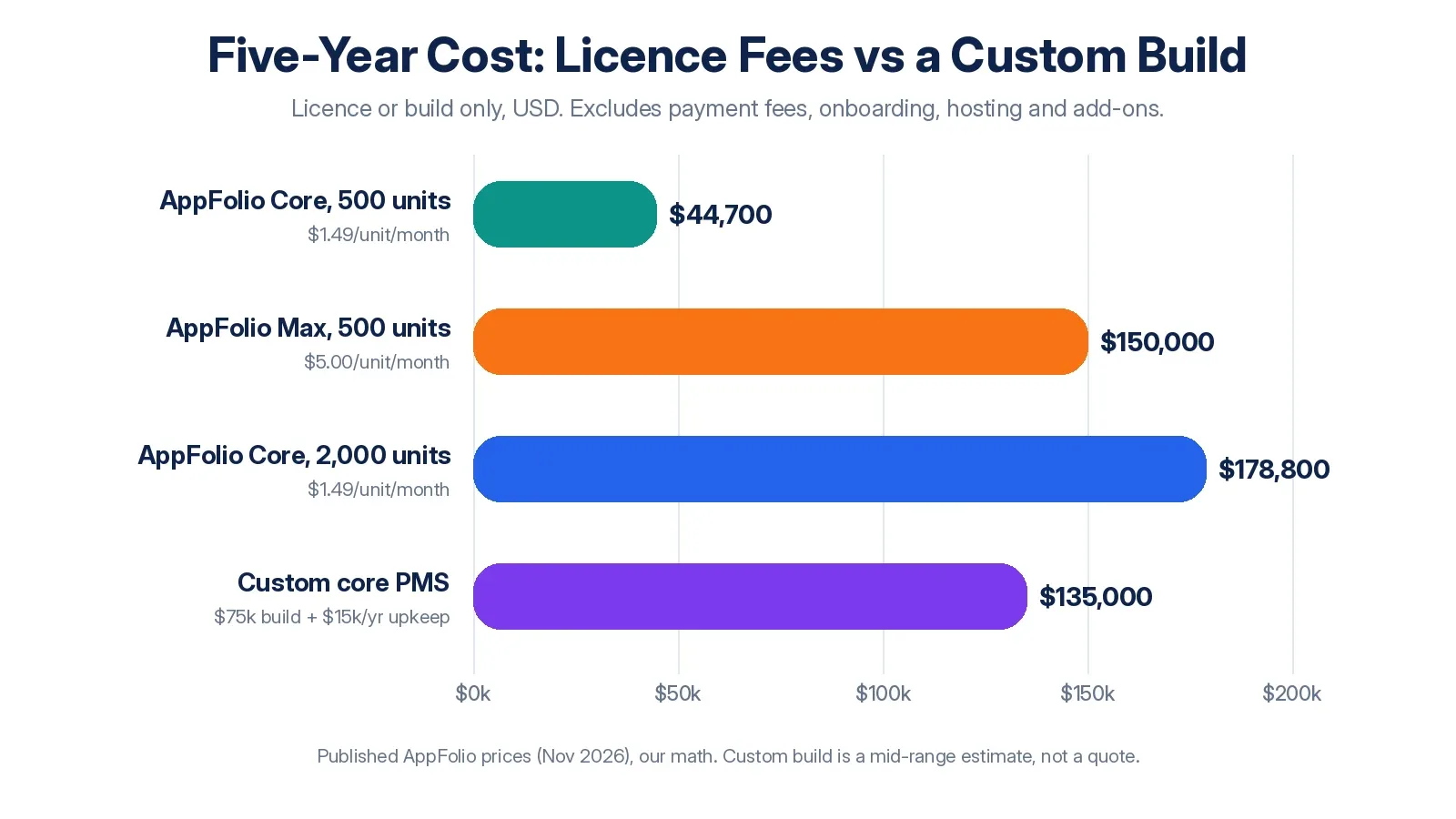
The chart below puts five years side by side, using a $75,000 build plus $15,000 a year of upkeep as a mid-range example. At 500 units on AppFolio Core, the licence stays far below a custom build. At 2,000 units, or on the top plan, five years of fees pass that build, by our math.
Takeaway: buy the core if your work is standard. Build when per-unit fees, unusual workflows or a product idea make the property management software development cost pay back.
Property Management Software Development Cost by Scope
Scope is the clearest way to plan property management software development cost. Each scope answers a different business need, so each needs a different budget.
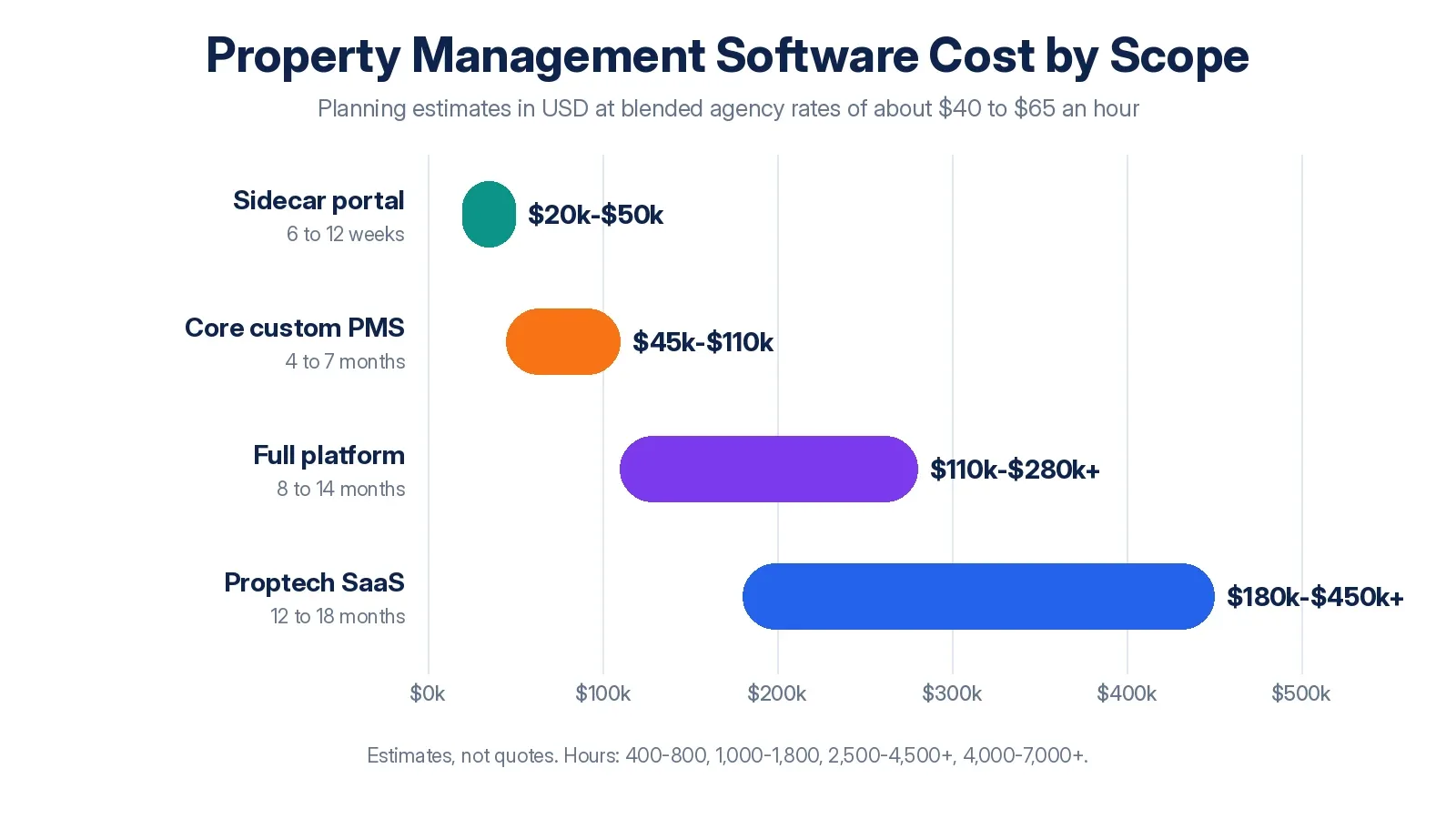
Our planning ranges are below. They are estimates, not quotes. We worked them out from typical hours for each scope and blended agency rates of about $40 to $65 an hour. That is in line with the $25 to $49 an hour most firms list in Clutch's software development pricing guide, plus senior and design time.
| Scope | Typical hours (estimate) | Property management software development cost (USD, estimate) | Timeline | Usually includes |
|---|---|---|---|---|
| Sidecar portal or module | 400 to 800 | $20,000 to $50,000 | 6 to 12 weeks | One portal, such as owners or maintenance, linked to your current PMS |
| Core custom PMS | 1,000 to 1,800 | $45,000 to $110,000 | 4 to 7 months | Properties, leases, tenant portal, online rent, work orders, basic reports |
| Full platform | 2,500 to 4,500+ | $110,000 to $280,000+ | 8 to 14 months | Owner and vendor portals, trust accounting, mobile apps, migration, analytics |
| Proptech SaaS for other managers | 4,000 to 7,000+ | $180,000 to $450,000+ | 12 to 18 months | Everything above, plus multi-company accounts, plans, billing and onboarding |
If you plan to sell your software to other property managers, you are building a SaaS product, which is the top row of the table. Our guide to SaaS development cost covers multi-tenancy, billing and hosting in depth. If you want to test a new idea on a small budget first, the cost to build an MVP guide shows how to scope the first release.
Takeaway: start with the smallest scope that fixes your biggest problem. Most teams get more value from one strong portal than from a half-built full platform.
Cost of Each Module: Portals, Leases, Rent and Accounting
A PMS is a set of modules that share one database. Pricing each module is the easiest way to break down property management software development cost and decide what goes into version one and what can wait. It also makes vendor quotes easier to compare.
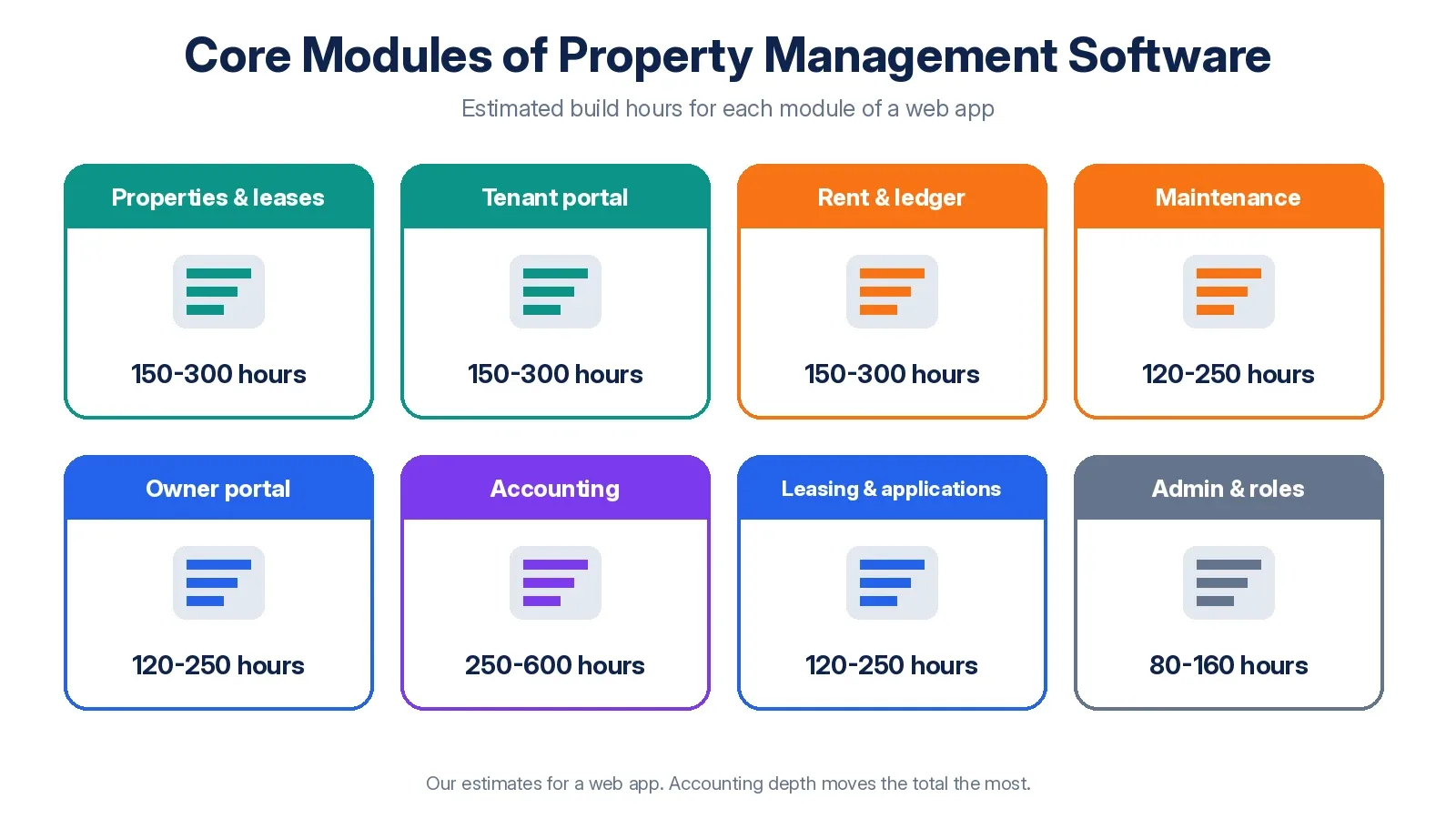
Here are our estimates for each module, for a web app at blended rates of $40 to $65 an hour. Add the modules you need to see a rough property management software development cost for your own scope. Your numbers will move with scope and design.
| Module | What it does | Hours (estimate) | Cost (USD, estimate) |
|---|---|---|---|
| Properties, units and leases | Records for buildings, units, tenants, lease terms, renewals and documents | 150 to 300 | $6,000 to $19,500 |
| Tenant portal | Pay rent, set up autopay, file repair requests, see notices and lease files | 150 to 300 | $6,000 to $19,500 |
| Rent collection and ledger | Charges, late fees, deposits, receipts, payment status and reminders | 150 to 300 | $6,000 to $19,500 |
| Maintenance and work orders | Requests with photos, priorities, vendor assignment and status updates | 120 to 250 | $4,800 to $16,250 |
| Owner portal and reporting | Monthly statements, income and expenses, occupancy, payouts | 120 to 250 | $4,800 to $16,250 |
| Property accounting | General ledger, owner and trust balances, bank reconciliation, year-end reports | 250 to 600 | $10,000 to $39,000 |
| Leasing and applications | Listings, online applications, screening link, e-signature link | 120 to 250 | $4,800 to $16,250 |
| Admin, roles and settings | Staff roles, permissions, audit history and company settings | 80 to 160 | $3,200 to $10,400 |
Accounting deserves extra care. Many places have rules about holding tenant deposits and owner funds in separate accounts. Those rules differ by state, province and country, so confirm them with a local accountant or lawyer before you build. A wrong ledger design is costly to fix once real money has moved through it, and accounting is often the biggest single line in property management software development cost.
Mobile apps are another choice to make early. A responsive web tenant portal works on any phone and keeps the first budget down. Native apps for field staff make sense when technicians need offline work orders and photo uploads. Adding iOS and Android apps can raise property management software development cost by 30% to 60%, by our estimates, depending on how many screens they share with the web app.
Takeaway: properties, leases, rent and the tenant portal form a solid first release. Add owner reporting next, and leave full trust accounting until the basics are stable.
Integrations and Payments
No PMS works alone, and integrations are an easy part of property management software development cost to underestimate. You will connect it to a payment provider, a tenant screening service, an e-signature tool and often an accounting package such as QuickBooks or Xero. Each link adds hours to property management software development cost. Each one also adds fees on every use after launch.
Rent is where payment fees matter most, because rent is a large, repeating payment. Card fees on a $1,500 rent payment add up fast. Bank debits are much cheaper. Here are published US fees from Stripe's pricing page, checked in November 2026, with the ready-made comparison from Buildium.
| Payment item | Published fee | On a $1,500 rent payment (our math) |
|---|---|---|
| Stripe, domestic card | 2.9% + 30¢ | About $43.80 |
| Stripe, ACH Direct Debit | 0.8%, capped at $5.00 | $5.00 |
| Buildium Essential, incoming EFT | $2.35 per transaction | $2.35 |
| Buildium, credit card | 2.99% per transaction | About $44.85 |
Payment fees are not part of the build budget, but you pay them every month after launch. Many managers pass card fees on to tenants or push autopay by bank debit to keep costs down. Check local rules on fee pass-through before you set this up. Your build should support both payment types, saved bank accounts and failed-payment handling.
For each integration, budget roughly 40 to 120 hours of custom property management software work, by our estimates. A simple e-signature link sits at the low end. A two-way accounting sync, or a link into your old PMS through its API, sits at the high end. Listing feeds and smart lock or meter links can add more.
Takeaway: push rent toward bank debit, not cards, and price every integration as a separate line in your property management software development cost.
Cost by Team Region
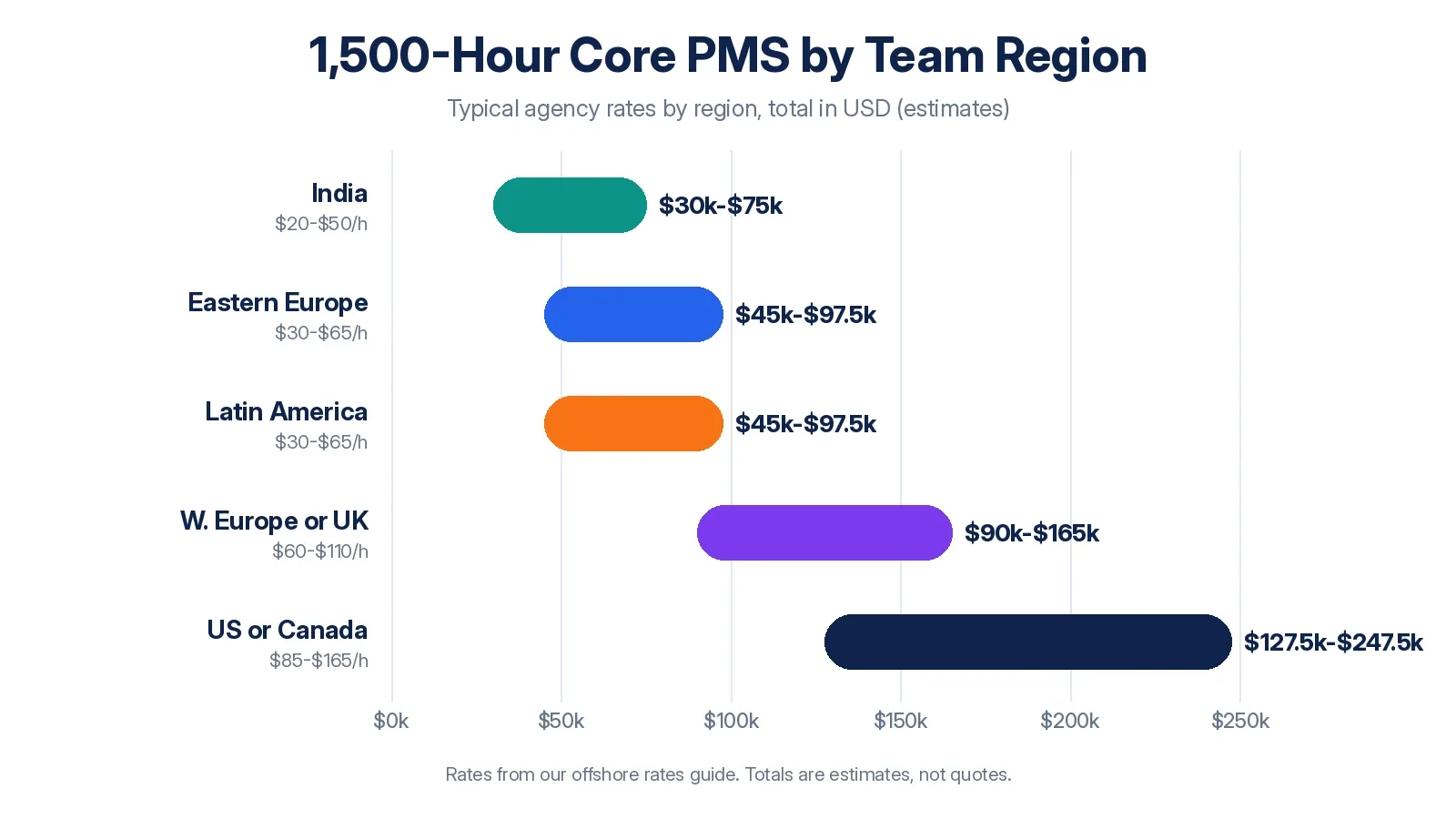
Where your team is based changes property management software development cost more than almost any feature. The same 1,500-hour core system can cost under $75,000 with an offshore agency, or well over $150,000 with a US agency.
The table below prices one example, a 1,500-hour core PMS, at typical agency rates by region. The rates come from our guide to offshore software development rates by country, and the totals are estimates.
| Team region | Typical agency rate (USD per hour) | 1,500-hour core PMS (USD, estimate) | Working-hours overlap with US East |
|---|---|---|---|
| India | $20 to $50 | $30,000 to $75,000 | Low, needs a planned overlap window |
| Eastern Europe | $30 to $65 | $45,000 to $97,500 | 1 to 2 hours |
| Latin America | $30 to $65 | $45,000 to $97,500 | 6 to 7 hours |
| Western Europe or UK | $60 to $110 | $90,000 to $165,000 | 2 to 3 hours |
| US or Canada | $85 to $165 | $127,500 to $247,500 | Full day |
A low rate only lowers property management software development cost if the team knows rental workflows and money logic. A team that has never built a rent ledger will learn on your budget. Many buyers keep a product lead close to the business and use an offshore team for delivery. Our guide on how to hire an offshore development team explains how to vet one.
Takeaway: compare the total for the same scope, not the hourly rate. An experienced offshore team often gives the best value for property management software development cost.
Timeline and Running Costs After Launch
Plan on 6 to 12 weeks for a sidecar portal. A core custom system takes about 4 to 7 months, and a full platform 8 to 14 months or more. Data migration often adds 2 to 6 weeks, because old systems hold duplicate tenants, missing lease dates and balances that don't match. Plan a parallel run, where the old and new systems work side by side for one or two rent cycles.
The build is only the first bill. Running costs sit on top of property management software development cost for as long as you use the system. Here are typical running costs, as our planning estimates, not quotes.
| Running cost (estimate) | Core custom PMS | Full platform |
|---|---|---|
| Cloud hosting, database and backups | $150 to $600 per month | $600 to $3,000+ per month |
| Email, SMS and file storage | $50 to $300 per month | $300 to $1,500 per month |
| Maintenance and small updates | 15% to 25% of build per year | 15% to 25% of build per year |
| Payment, screening and e-signature fees | Per use, often passed to tenants | Per use, often passed to tenants |
That 15% to 25% maintenance figure is a common planning rule, not a measured average. It covers bug fixes, security patches, library updates and small changes. Ask every vendor for a written monthly support plan before you sign.
Takeaway: for every $100,000 of build, plan for about $15,000 to $25,000 a year of upkeep, plus hosting and per-use fees.
How to Budget and Choose a Development Partner
Start your property management software development cost budget with a written scope, not a guess. List your property types, unit count, user roles, the reports owners expect and the tools you must connect. Mark each feature as "launch," "next" or "later." This keeps the first property management software development cost focused, because "later" items drop out of the first quote. Then ask vendors to price the launch list only, plus a separate estimate for the next stage. A scope like this is the single best tool for keeping property management software development cost under control, because every vendor prices the same list.
Before you ask for quotes, run through this list so you can compare each quote fairly.
Quick checklist
- ☐ You have a one-page scope with property types, roles, modules and reports.
- ☐ You have priced a ready-made platform for the same unit count.
- ☐ You know which integrations you need and who pays each fee.
- ☐ The quote splits design, development, testing, migration and project management.
- ☐ Hosting, maintenance and third-party fees are listed as monthly costs.
- ☐ You will own the code, the data and the cloud accounts from day one.
- ☐ The vendor can show a live product with payments or a ledger it built.
Here are the red flags that most often push property management software development cost far past the quote.
Red flags to watch for
- ✗ A fixed price with no written feature list or change process.
- ✗ No plan for data migration or a parallel run.
- ✗ Custom-built payment processing instead of a proven payment provider.
- ✗ No mention of backups, audit history or role-based access.
- ✗ Accounting promised as "simple" with no questions about deposits or owner funds.
Our real estate software development page shows the property projects we take on.
Takeaway: a clear scope and a short paid discovery phase save more than any discount on the hourly rate.

Get a Free Property Software Estimate
Ready to price your system? Send us a short brief: your property types and unit count, the tools you use today, the portals you need, the integrations you must keep and any launch date or budget limit. That is enough for us to suggest a phased plan, a budget in USD and a realistic timeline.
Conclusion: Build the Part That Sets You Apart
Property management software development cost in 2026 depends on scope, accounting depth and team far more than on any price list. As a planning guide, a sidecar portal costs about $20,000 to $50,000, a core custom PMS $45,000 to $110,000 and a full platform $110,000 to $280,000 or more. Then add hosting, per-use fees and upkeep of about 15% to 25% of the build each year.
Buy the core if your work is standard and your portfolio is small. Build when per-unit fees, unusual workflows or a product idea justify it, and start with the one portal that saves your team the most time. If you want a property management software development cost estimate for your own portfolio, share your scope with us. We'll suggest a phased plan, a budget in USD and a timeline.
Keep reading: SaaS development cost · Real estate CRM software development cost · Offshore software development rates by country · Cost to build a marketplace app · White label app development
Related articles
 Articles
Custom software development cost in India
Learn what custom software costs in India, from MVPs to enterprise systems. See price ranges, cost factors and ways to save before you hire.
Learn more Articles
Custom software vs off-the-shelf software
Compare custom and off-the-shelf software on cost, speed, security and scalability. Use our checklist to decide what fits your business.
Learn more Articles
How to choose a custom software development company
Use this checklist to compare software vendors on experience, pricing, code ownership and support. Includes red flags and questions to ask.
Learn more Articles
AI in custom software development
See where AI adds real value in custom software, from chatbots to automation. Learn costs, risks and how to start with a small pilot.
Learn more