


You want an online learning platform, and the quotes don't match. One vendor says $25,000. Another says $200,000. A licensed LMS says $449 a month. This guide breaks down LMS development cost in 2026 in plain US dollars, so you can see why the prices differ and when building beats buying. In short, extending an open-source LMS often costs $15,000 to $40,000, a custom MVP $30,000 to $70,000, a full platform $70,000 to $160,000, and an enterprise or multi-tenant LMS $160,000 or more.
You'll see what drives the price, what each feature adds, custom versus ready-made over five years, video and hosting costs, corporate, academy and school needs, and how team region changes the total. It is written for training teams, course businesses and edtech founders.
- Extending an open-source LMS often costs $15,000 to $40,000, a custom MVP $30,000 to $70,000, a full platform $70,000 to $160,000 and an enterprise LMS $160,000 or more (planning estimates).
- For standard staff training, a ready-made LMS is usually cheaper over five years. Build when the LMS is your product, earns revenue or needs workflows no licence offers.
- Video delivery, hosting and upkeep of about 15% to 25% of the build each year are the costs that keep coming after launch.
What Drives LMS Development Cost
A learning management system, or LMS, is software that delivers courses, tracks progress and proves who completed what. On the surface, it is a course player with a login. Underneath, it handles roles, enrolments, quizzes, content standards, reports, certificates and often payments.
Most of your LMS development cost comes from six things. First is scope: how many user roles, course types and reports you need. Second is content standards such as SCORM and xAPI. Third is video, because recorded and live classes need very different work. Fourth is integrations with HR, CRM, payment or student systems. Fifth is mobile apps. Sixth is the team: its size, its skills and where it is based.
Here is how each driver affects LMS development cost, from the biggest effect to the smallest.
| Cost driver | What it covers | Effect on the budget |
|---|---|---|
| Scope and roles | Learners, instructors, managers, admins, custom workflows | High: each role adds screens, rules and tests |
| Team region and seniority | Hourly rate and experience with learning platforms | High: the same scope can cost 2 to 4 times more onshore |
| Integrations | HRIS, CRM, SSO, payments, student systems | Medium to high, depending on the other system's API |
| Video and live classes | Hosting, streaming, live sessions, captions | Medium for recorded video, high for live classes |
| Content standards | SCORM import, xAPI tracking, LTI tools | Medium: worth it if you buy third-party courses |
| Mobile apps | iOS and Android apps, offline viewing | Medium to high: close to a second front end |
Takeaway: scope, team and integrations set most of your LMS development cost. Video and content standards decide how big the extra lines get.
LMS Development Cost by Scope
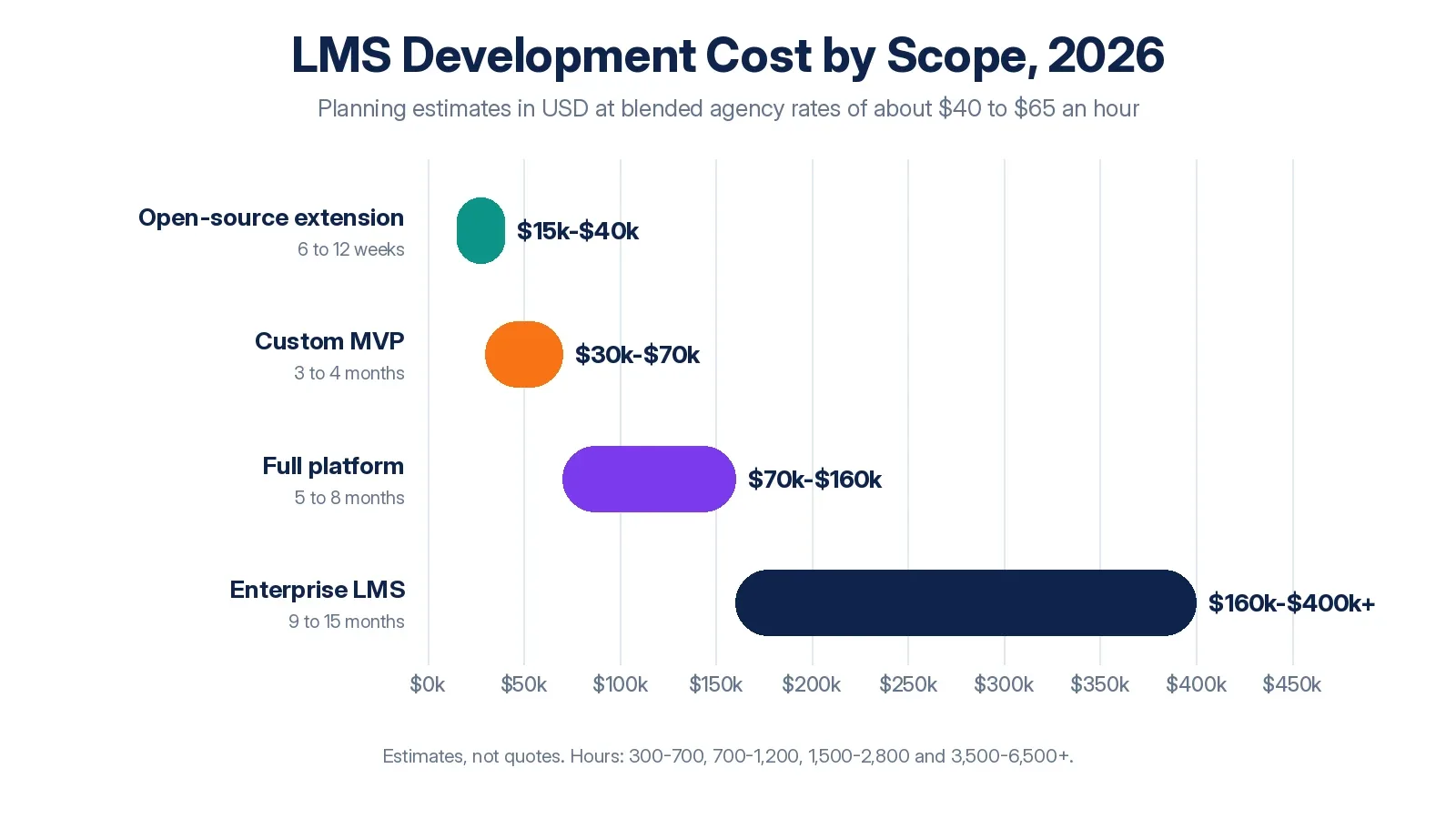
The clearest way to plan LMS development cost is by scope. Each level answers a different need. An open-source extension gets a branded LMS live fast. An MVP tests a new learning product. A full platform runs a serious training business. An enterprise build serves many organisations at once.
Our planning ranges are below. They are estimates, not quotes. We worked them out from typical hours for each level and blended agency rates of about $40 to $65 an hour, in line with the band most firms list in Clutch's software development pricing guide ($25 to $49 an hour) plus senior and design time.
| Scope | Typical hours (estimate) | LMS development cost (USD, estimate) | Timeline | Usually includes |
|---|---|---|---|---|
| Extend an open-source LMS | 300 to 700 | $15,000 to $40,000 | 6 to 12 weeks | Moodle or Open edX with a custom theme, plugins, SSO, one or two integrations |
| Custom MVP | 700 to 1,200 | $30,000 to $70,000 | 3 to 4 months | Courses, enrolment, quizzes, progress tracking, certificates, basic reports |
| Full platform | 1,500 to 2,800 | $70,000 to $160,000 | 5 to 8 months | Learning paths, SCORM and xAPI, payments, live classes, advanced reports, mobile web |
| Enterprise or multi-tenant | 3,500 to 6,500+ | $160,000 to $400,000+ | 9 to 15 months | Many client portals, white-labelling, deep integrations, audit logs, native apps |
If you want to test the idea before a full build, our guide to the cost to build an MVP explains how to cut scope to one core workflow. Most teams start small and add features once learners use the product.
Takeaway: pick the smallest scope that proves your learning model. Then use real learner data to plan the next stage of your LMS development cost.
Core LMS Features and What They Add
Features are where an LMS quote grows or shrinks. Courses, quizzes and certificates are well-known problems, so a good team builds them quickly. Content standards, live video and payments take more care, and they explain most of the gap in learning management system development cost between two vendors. Ask every vendor to price each feature on its own line, so you can see which ones move your LMS development cost the most.
Two standards come up in almost every LMS project. SCORM is the older format most course packages use, so supporting it lets you import courses bought from content vendors. xAPI is newer. The xAPI specification from ADL describes "statements" about learner activity that are stored in a Learning Record Store, or LRS. That lets you track learning outside the LMS, such as simulations or on-the-job tasks. A third standard, LTI, lets you plug outside tools into your courses. 1EdTech describes LTI as a way to give students and teachers secure access to the learning tools they already use.
This table shows the extra build effort each feature usually adds to a custom LMS. The hours are our estimates.
| Feature | What it does | Extra build effort (estimate) |
|---|---|---|
| Course builder and player | Modules, lessons, files, drip release | 120 to 250 hours |
| Quizzes and assessments | Question banks, timers, grading, retakes | 80 to 180 hours |
| SCORM import and player | Run courses bought from content vendors | 100 to 200 hours |
| xAPI tracking with an LRS | Record learning outside the LMS | 80 to 200 hours |
| Certificates | Templates, expiry dates, verification links | 40 to 80 hours |
| Video hosting and player | Upload, streaming, captions, watch progress | 60 to 150 hours |
| Live classes | Scheduling, video sessions, recordings | 120 to 300 hours |
| Payments and course sales | Checkout, coupons, subscriptions, refunds | 80 to 200 hours |
| Native mobile apps | iOS and Android, offline viewing | 400 to 900 hours |
At $40 to $65 an hour, SCORM support alone adds about $4,000 to $13,000 to your LMS development cost. Payments matter most for academies that sell courses. A corporate LMS can often skip them.
Takeaway: list features in order of value, and keep your LMS development cost focused on the first group. Don't build every feature on day one. SCORM, live classes and native apps are the lines most worth delaying until users ask for them.
Custom LMS vs Ready-Made Platforms
Before you plan any LMS development cost, check whether a ready-made platform already does the job. Licensed LMS products charge a monthly fee, usually tied to the number of active users. You pay nothing to build, but you accept their features, their limits and their price rises.
For a real example, here are published prices from TalentLMS's pricing page as of 25 November 2026, billed yearly in USD. Its Core plan is $119 a month for up to 40 users ($149 if billed monthly). Grow is $229 a month for up to 70 users. Pro is $449 a month for up to 100 users and $779 a month for 801 to 1,000 users. There is a free plan for up to 5 users, and enterprise plans start at 1,000 users with pricing from sales.
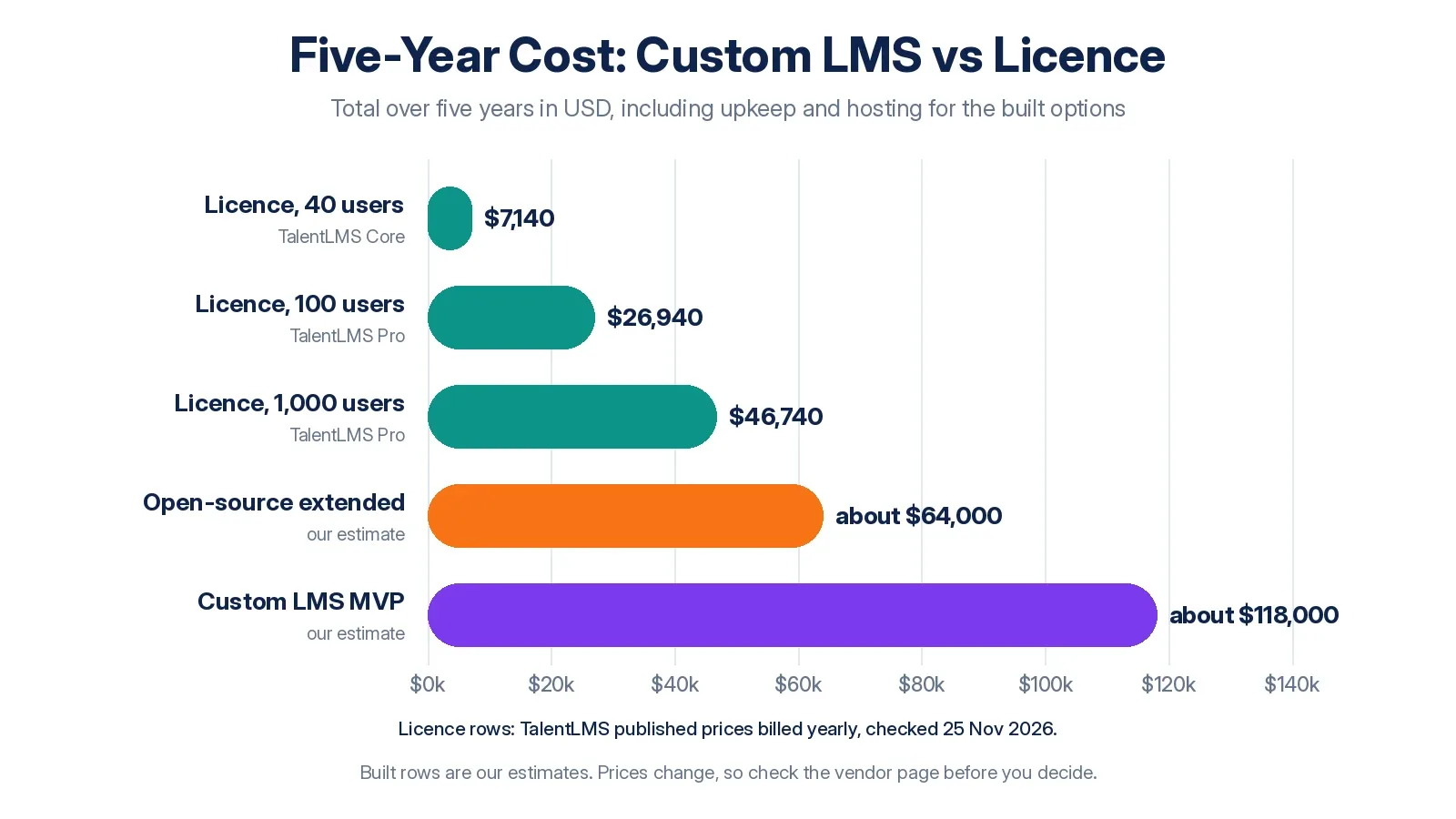
This table compares five-year costs. The licence rows use those published prices. The custom and open-source rows are our estimates, including upkeep and hosting.
| Option | Upfront cost | Yearly cost | Five-year total |
|---|---|---|---|
| TalentLMS Core, up to 40 users | $0 | $1,428 | $7,140 |
| TalentLMS Pro, up to 100 users | $0 | $5,388 | $26,940 |
| TalentLMS Pro, 801 to 1,000 users | $0 | $9,348 | $46,740 |
| Open-source LMS extended (estimate) | About $27,000 | About $7,400 upkeep and hosting | About $64,000 |
| Custom LMS MVP (estimate) | About $50,000 | About $13,600 upkeep and hosting | About $118,000 |
The numbers are clear for standard internal training: buying is cheaper, and no LMS development cost is the cheapest cost of all. A custom LMS makes sense when the LMS is your product, when you sell courses to thousands of learners and per-user fees would grow with every sale, when you need workflows no platform supports, or when you must own the data and the code. In those cases, the LMS development cost works more like an investment in a product than a software bill. For the product case, a white label app or a licensed base with custom add-ons can sit in the middle.
Takeaway: if an off-the-shelf LMS fits 80% of your needs, buy it. Build only when the LMS earns money or does something a licence can't.
Video, Hosting and Other Running Costs
Running costs are the second half of your LMS development cost. Each month you also pay for servers, a database, file storage, email and, above all, video. Video is often the largest running cost for a course business.
Here is a worked example using the published first-tier rates on Mux's pricing page. For 1080p on-demand video at basic quality, encoding is free, storage is $0.003 per minute per month, and delivery is $0.001 per minute after the first 100,000 free minutes each month. Say your library holds 200 hours of video, or 12,000 minutes. Storage costs about $36 a month. If 2,000 learners each watch 5 hours a month, that is 600,000 minutes delivered. After the free 100,000, you pay about $500. So video comes to roughly $536 a month, by our math. That monthly bill can matter more than the one-off LMS development cost for a busy academy.
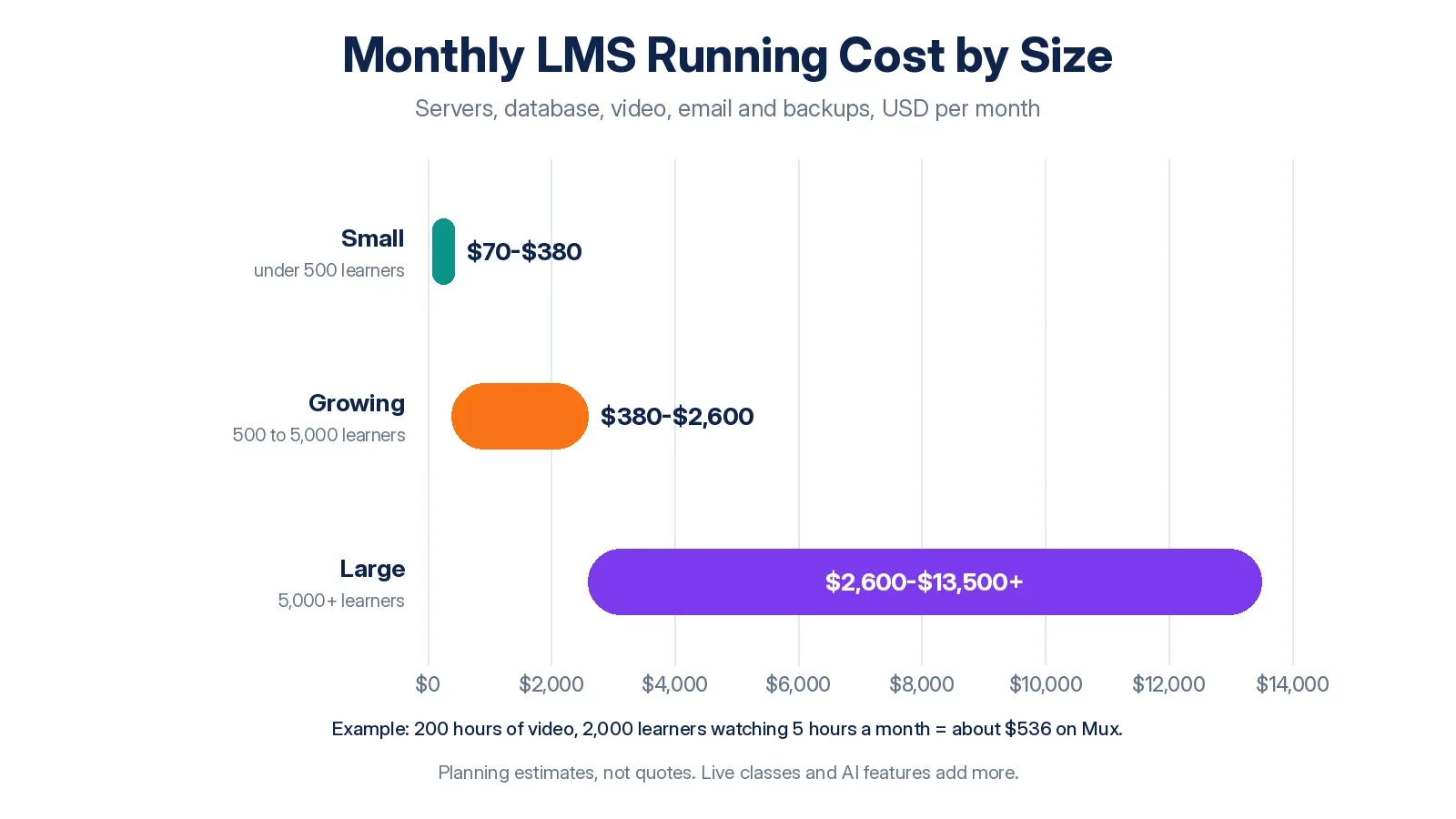
The table below shows planning ranges for monthly running costs. These are our estimates for a typical web LMS, not quotes.
| Monthly item (estimate) | Small (under 500 learners) | Growing (500 to 5,000) | Large (5,000+) |
|---|---|---|---|
| App servers and database | $50 to $200 | $200 to $800 | $800 to $4,000+ |
| Video storage and streaming | $0 to $100 | $100 to $1,500 | $1,500 to $8,000+ |
| Email, files, logs and backups | $20 to $80 | $80 to $300 | $300 to $1,500+ |
| Total running cost | $70 to $380 | $380 to $2,600 | $2,600 to $13,500+ |
Then add maintenance: bug fixes, security patches, updates and small changes. A common rule of thumb is 15% to 25% of the build cost each year. That is a planning habit, not a measured average. Live classes add a video meeting service, and AI features add model usage fees. For more on cloud costs, see our guide to SaaS development cost.
Takeaway: for every $100,000 of build, plan for about $15,000 to $25,000 a year of upkeep, plus a video bill that grows with watch time.
Corporate vs Academy vs School LMS
Who learns on your platform changes what you build, and so it changes your LMS development cost. A corporate LMS, an online academy and a school platform can share a course player, but almost everything around it is different.
A corporate LMS trains staff. It needs single sign-on, HR system sync, compliance courses with expiry dates and manager reports. Payments rarely matter. An academy sells courses to the public, so checkout, coupons, subscriptions, marketing pages and a smooth mobile experience come first. A school or college platform needs classes, teachers, grades and parent access, and it often connects to a student information system.
This table compares the three. The cost ranges are our estimates for a custom build.
| Type | Must-have features | Usual integrations | Typical LMS development cost (estimate) |
|---|---|---|---|
| Corporate training | SSO, compliance courses, certificates with expiry, manager dashboards | HRIS, SSO, video meetings | $40,000 to $150,000 |
| Online academy | Course sales, subscriptions, coupons, reviews, mobile apps | Payments, email marketing, CRM | $35,000 to $160,000 |
| School or college | Classes, grades, assignments, parent and teacher views | Student information system, LTI tools | $50,000 to $180,000 |
A school LMS handles teaching and learning. School administration, such as admissions, fees, attendance and timetables, belongs in a school ERP. If that is what you need, read our guide to school management software development cost, which covers those modules.
Takeaway: decide who your main user is before you scope, because it shapes the whole LMS development cost. A corporate LMS that tries to sell courses, or an academy that tries to run a school, pays for features nobody uses.
LMS Development Cost by Team Region
Where your team works changes LMS development cost more than almost any feature. For context, the US Bureau of Labor Statistics puts the median pay of software developers at $135,980 a year in May 2025, in its Occupational Outlook Handbook. Agency rates sit above salary because they include management, testing, tools and profit.
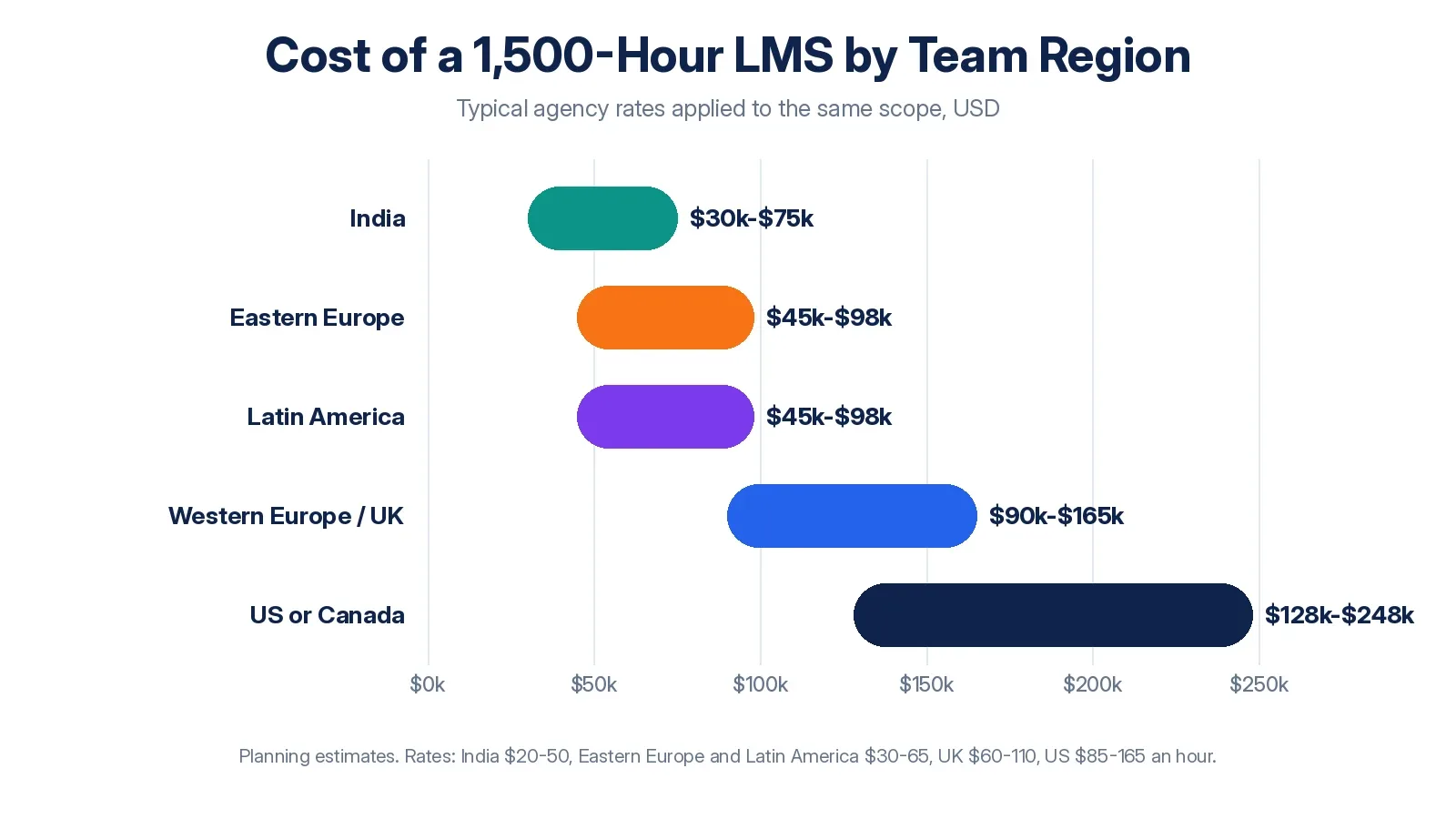
The table prices one example, a 1,500-hour full platform, at typical agency rates by region. The rates come from our guide to offshore software development rates by country, and the totals are estimates.
| Team region | Typical agency rate (USD per hour) | 1,500-hour LMS (USD, estimate) | Working-hours overlap with US East |
|---|---|---|---|
| India | $20 to $50 | $30,000 to $75,000 | Low, needs a planned overlap window |
| Eastern Europe | $30 to $65 | $45,000 to $98,000 | 1 to 2 hours |
| Latin America | $30 to $65 | $45,000 to $98,000 | 6 to 7 hours |
| Western Europe or UK | $60 to $110 | $90,000 to $165,000 | 2 to 3 hours |
| US or Canada | $85 to $165 | $128,000 to $248,000 | Full day |
A lower rate only cuts LMS development cost if the team knows learning platforms. A team learning SCORM on your budget will burn the savings. Ask for a live LMS they built and test it yourself. Then ask how they would cut your LMS development cost without cutting quality, for example by reusing open-source parts for SCORM playback or video players.
Takeaway: compare the total price for the same scope, not the hourly rate alone. An offshore team with real LMS experience often gives the best value.
How to Budget and Choose an LMS Partner
Your LMS development cost budget should start with a written scope, not a guess. List your user roles, course types, the standards you need, your video plans and your integrations. Mark each feature as "launch," "next" or "later." Then ask vendors to price the launch list only, plus a rough estimate for the next stage.
Before you ask for quotes, run through this list so you can compare each LMS development cost quote fairly.
Quick checklist
- ☐ You have checked at least two ready-made LMS products against your needs.
- ☐ You have a one-page scope with roles, course types and reports.
- ☐ You know whether you need SCORM, xAPI or LTI, and why.
- ☐ Video hosting is priced on a real service, with your expected watch time.
- ☐ The quote splits design, development, testing, DevOps and project management.
- ☐ Hosting, video and maintenance are listed as monthly costs.
- ☐ You will own the code, the content and the cloud accounts from day one.
Here are the red flags that most often push LMS development cost far past the quote.
Red flags to watch for
- ✗ A fixed price with no written feature list or change process.
- ✗ "Full SCORM support" with no plan to test real course packages.
- ✗ Video hosting left out of the proposal or called "free."
- ✗ No plan for moving courses and learner records from your old system.
- ✗ Only one senior name in the pitch and juniors on the actual work.
For more on vetting vendors, read our guide on how to choose a custom software development company.
Takeaway: a clear scope and a short paid discovery phase save more money than any discount on the hourly rate.
Get a Free LMS Cost Estimate
Ready to price your learning platform? Send us a short brief: who your learners are, how many you expect, the courses and features you need, any content you already own and your launch date or budget. That is enough for us to suggest whether to build or buy, a stage-by-stage budget in USD and a realistic timeline.
Conclusion: Price the Build and the Run
LMS development cost in 2026 depends on scope, standards, video and team far more than on any price list. As a planning guide, extending an open-source LMS often costs $15,000 to $40,000, a custom MVP $30,000 to $70,000, a full platform $70,000 to $160,000, and an enterprise build $160,000 or more. Then add the run: hosting, video delivery and upkeep of about 15% to 25% of the build each year.
Check ready-made platforms first. If they fit, buy. If your LMS is your product or needs workflows no licence offers, build in stages. If you want an LMS development cost estimate for your own platform, share your plan with us and we'll reply with a stage-by-stage budget and timeline in USD.
Keep reading: SaaS development cost · Cost to build an MVP · School management software development cost · Cost to build a marketplace app · How to hire an offshore development team
Related articles
 Articles
Custom software development cost in India
Learn what custom software costs in India, from MVPs to enterprise systems. See price ranges, cost factors and ways to save before you hire.
Learn more Articles
Custom software vs off-the-shelf software
Compare custom and off-the-shelf software on cost, speed, security and scalability. Use our checklist to decide what fits your business.
Learn more Articles
How to choose a custom software development company
Use this checklist to compare software vendors on experience, pricing, code ownership and support. Includes red flags and questions to ask.
Learn more Articles
AI in custom software development
See where AI adds real value in custom software, from chatbots to automation. Learn costs, risks and how to start with a small pilot.
Learn more