






Software development
- You write the requirements, they build them
- Job's done once the features are delivered
- Judged mainly on deadline and budget
- Probably a different team next time

We help businesses across multiple industries build scalable, secure and future-ready digital products. Our team combines deep technical expertise with industry knowledge to deliver custom software solutions that drive growth.
Let's Talk
We're Softfix, a product engineering company out of Lucknow. Most people who call us have an idea, maybe a Figma file, and a deadline that's a little too tight. We help them get to a working product, and we usually stay on well after launch day.
Product lifecycle
Fair question. A regular dev shop builds whatever's in the spec, hands it over and moves on. We'd rather question the spec first (is this the right feature? does anyone actually need it?) and then stick around to see if the product works in the market.
Some founders hand over everything. Others already have two or three developers and just need a designer, an architect or a proper QA setup. We're a software product development company, so either works for us. We slot in around whoever's already there.
 01
01
Before a single line of code, we turn your idea into clickable screens. Show them to ten potential customers. You'll learn more in a week than in a month of planning.
 02
02
The smallest thing that proves people want it. Eight to twelve weeks is normal. And no, it isn't throwaway code.
 03
03
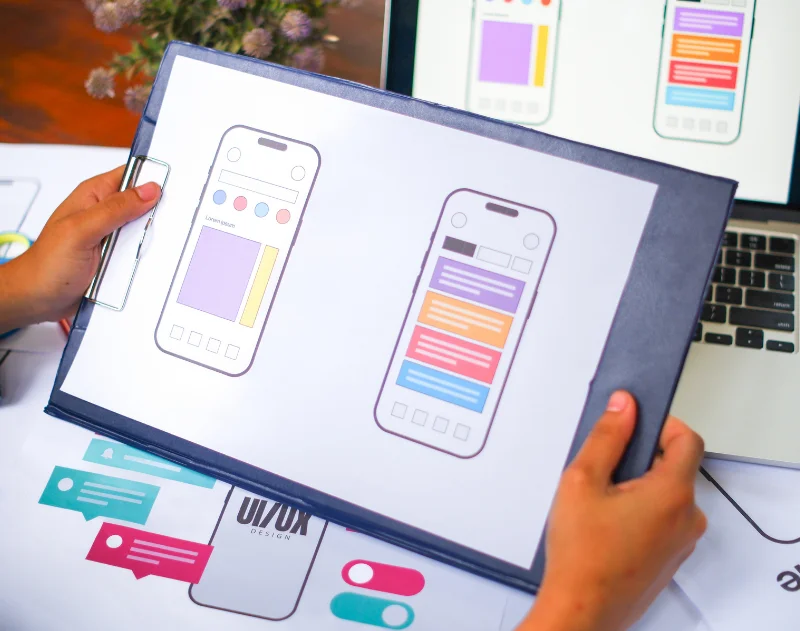
We talk to your users, sketch wireframes and put together a design system. Developers get exact specs, so nobody's guessing at spacing at midnight.
 04
04
Database, services, hosting, security. Getting these right early is cheap. Fixing them in year two? Not so much.
 05
05
Multi-tenancy, subscription billing, user roles, admin panels. Every SaaS needs this stuff and honestly, nobody enjoys building it. We don't mind.
 06
06
Containers and managed services on AWS, Azure or GCP, so nobody on your team gets woken at 2 a.m. by a server alert.
 07
07
API first, screens second. That way your web app, your mobile app and whatever partner integration comes next all share one backend.
 08
08
Worked fine at 500 users, falling over at 50,000? We find out why. (It's usually the database.)
 09
09
Stuck on an old framework, or a monolith nobody wants to touch? We move it over in stages, and you keep shipping features while we do.
 10
10
New UI, newer stack, faster pages. Your existing customers won't notice the switch, except that things get quicker.
 11
11
Manual testing, automated tests, regression suites. Basically, last month's bug stays dead.
 12
12
Code goes from a developer's laptop to production through automated checks. Several releases a week if you like, or one a month if you'd rather.
No two products are the same, but most go through roughly five stages. Once we know where you are, it's easier to decide what to build next. And what to skip.
First we test whatever's most likely to kill the idea. Sometimes it's technical (is the AI model accurate enough?). Sometimes it's just: will anyone sign up?
Core features, nothing extra. A small product that works beats a big one that's half finished.
Now real people are using it. We ship small changes every week or two based on what they do in the app, which isn't always what they tell you.
Once things click, we plan a quarter at a time with you. Same people on the team, so nobody's relearning the codebase.
Speed, cloud bills, new markets. Eventually, quietly removing features nobody touches.
Ever heard a CTO say "we need to rebuild it"? It's nearly always the same story. V1 was rushed, there were no tests, and now each new feature breaks two old ones. These are the product engineering solutions we use so you don't end up there.
Ask about a code reviewWe work in two-week sprints. You get a demo at the end of each one, and you can reorder the backlog yourself whenever you like.
Designer, devs, QA and a PM on one team. They talk daily. Nothing gets thrown over the wall.
Managed databases, autoscaling, infrastructure as code. Need a new test environment? That's minutes, not days.
Only when it makes sense. Most early products are better off as a tidy monolith, to be honest, and we'll tell you if yours is.
Tests run on every pull request automatically. Releasing is one click. Nobody loses a weekend to it.
Clear modules, a code review on every change, and docs a new developer can actually follow in week one.
Raising a round or buying a company? We'll go through the code, architecture and security, and write it all up in plain English.
We set up usage tracking on launch day. So what gets built, fixed or dropped next comes from data, not gut feel.
The short version of what we tell founders.
"How much?" is always the first question, and the honest answer is: it depends. Mostly on how many platforms you need, how many integrations, and how fast you want it live. Below are the three ways most clients work with us. You'll get a proper quote after a quick call.
Defined scope, defined budget
You know exactly what v1 needs to do. We lock scope, price and launch date before starting.
Long-term product ownership
Outsourced product engineering that works like an in-house team. Developers, a designer, QA and a PM, working only on your product.
Independent review, clear answers
A one-time review of an existing product. Useful before a funding round, an acquisition, or deciding whether to rebuild.
No need for a polished brief. Just a few lines: what's the idea, where are you now, and when do you want to launch? One of our product leads will reply within a working day.
sales@softfix.in
Phone
+91 81890 10044
Address
1st Floor, CP/140, Viraj Khand-4, Gomti Nagar, Lucknow, Uttar Pradesh 226010
to help our experts understand your business objectives and create your customized plan.